
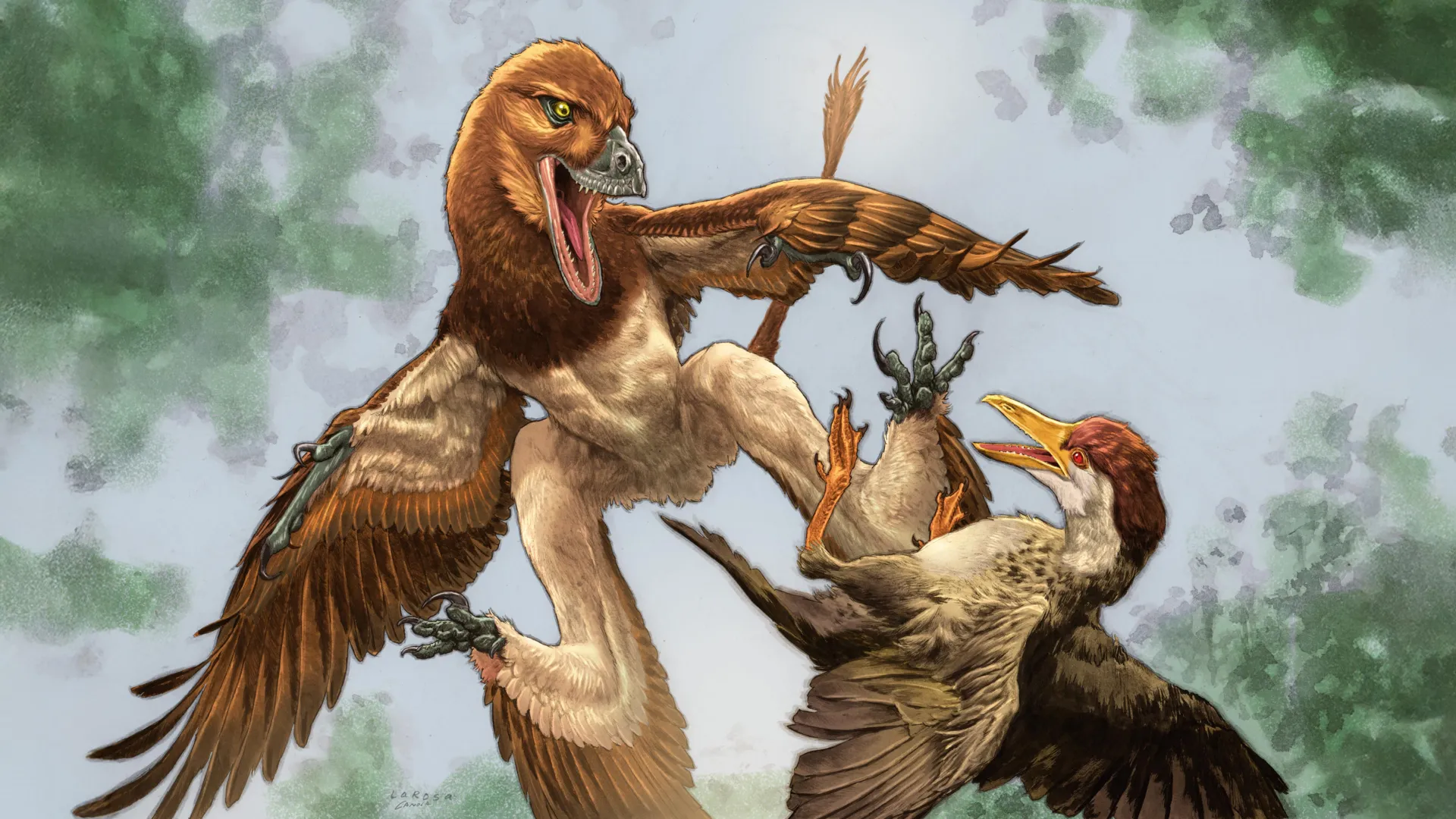
Now, a groundbreaking discovery has potentially provided the definitive answer to this long-standing paleontological puzzle. Researchers, in a study recently published in the prestigious Annals of Carnegie Museum, have unveiled a previously unknown dinosaur species unearthed from the very same fossil beds. This newly described creature, a feathered relative of the famed Velociraptor, possessed distinctive long feathers on both its forelimbs and hind limbs, giving it a striking four-winged appearance. Based on meticulous analysis of its unique arm and shoulder bone features, scientists now propose that this formidable dinosaur was the apex predator responsible for the mysterious, densely packed bird bone clusters, finally completing a crucial piece of the Early Cretaceous ecological mosaic.
"Scientists have found these weird, broken-up clusters of bird bones at this site, and we didn’t know what made them. This new microraptor dinosaur, Jian changmaensis, is our best guess," explains Jingmai O’Connor, the associate curator of fossil reptiles at the Field Museum in Chicago and the senior author of the paper detailing the new species. O’Connor emphasizes the compelling nature of the evidence: "It’s the only dinosaur found at this site that wasn’t a bird, it was a carnivore, and it was much bigger than everything else that we’ve found there." This statement underscores the singularity of Jian changmaensis as a candidate, fitting the predatory profile perfectly within an ecosystem predominantly known for its diverse avian fauna.
The Enigmatic Changma Basin: A Window into Early Bird Life
The Changma Basin has long been recognized as a paleontological treasure trove, particularly for its exquisitely preserved Early Cretaceous avian fossils, dating back approximately 120 million years ago. This geological formation, specifically the Xiagou Formation within the Changma Basin, has provided an unparalleled glimpse into the evolutionary history of birds, showcasing a diverse array of ancient avian species that soared through the skies and roamed the terrestrial environments long before the catastrophic asteroid impact 66 million years ago that ended the reign of non-avian dinosaurs. The exceptional preservation at Changma, often referred to as a Lagerstätte—a fossil site with extraordinary preservation—means that not only bones but also impressions of feathers and soft tissues are frequently recovered, offering detailed insights into the anatomy, plumage, and even lifestyles of these early birds.
Among the hundreds of bird fossils discovered, the peculiar bone accumulations stood out to researchers. These "pellet-like masses" are a strong indication of a predator’s digestive process, a phenomenon well-documented in modern ecosystems. Today’s raptors, such as owls, hawks, and even some shrikes, are known to regurgitate indigestible parts of their prey—bones, fur, feathers, chitinous exoskeletons—in compact, oval-shaped pellets. The consistent morphology and contents of these fossilized masses at Changma strongly suggested a similar biological process, hinting at a specialized predator with a consistent hunting strategy and digestive physiology. However, without a physical representation of the predator itself, paleontologists could only speculate about its identity, ranging from large pterosaurs to as-yet-undiscovered terrestrial dinosaurs. The presence of Jian changmaensis fundamentally shifts this understanding, providing a tangible link to the producers of these enigmatic structures and completing a crucial part of the food web.
Unveiling Jian changmaensis: A Feathered Apex Predator
The discovery of Jian changmaensis marks a pivotal moment in understanding the ancient Changma ecosystem. The animal was identified from a partial fossil, specifically a well-preserved section of its arm and shoulder bones. While not a complete skeleton, these particular elements provided sufficient diagnostic features for researchers to classify it as a new species and infer crucial aspects of its morphology and predatory capabilities. The study, co-authored by a team including Matthew Lamanna of the Carnegie Museum of Natural History, represents years of meticulous fieldwork and laboratory analysis, combining anatomical expertise with taphonomic interpretation.
The dinosaur’s classification places it firmly within the dromaeosaurs, a group of feathered theropod dinosaurs renowned for their agility, intelligence, and predatory prowess. Velociraptor mongoliensis, immortalized (and somewhat exaggerated in size and appearance) by popular culture, is perhaps the most famous member of this group. However, real dromaeosaurs, including Velociraptor and its North American cousin Deinonychus, were typically smaller and far more extensively feathered than their cinematic counterparts, often sporting full coats of plumage, indicative of their close evolutionary relationship to birds. They were characterized by a retractable, sickle-shaped claw on the second toe, a feature that would have been formidable for hunting prey.
Jian changmaensis specifically belongs to a subgroup of dromaeosaurs known as microraptors. These creatures are distinguished by their "four-winged" anatomy, possessing long, asymmetrical feathers not only on their forelimbs but also on their hind limbs, creating additional aerodynamic surfaces. While many microraptors were relatively small, with some species no larger than a modern crow, Jian changmaensis stands out for its impressive size, making it a truly formidable predator in its environment. "Jian is one of the biggest microraptor specimens that has ever been found," O’Connor notes, highlighting its distinction within the subgroup. "The piece of its upper arm bone that we have is about 4 inches long, so the entire dinosaur probably had something like a four-foot wingspan, around the size of a barn owl." This significant size, coupled with its carnivorous nature, powerful limbs, and sharp claws, makes Jian an ideal candidate for the top predator in the Changma bird-dominated environment, capable of preying on a wide range of the ancient birds found at the site.
The Chronology of Discovery and Analysis
The story of Jian changmaensis unfolds over a timeline characteristic of major paleontological breakthroughs, involving years of dedicated effort and international collaboration. The initial discovery of the peculiar bird bone pellets at Changma likely occurred over many years of excavations, dating back to the late 20th and early 21st centuries, prompting initial hypotheses about the presence of a large predator. This set the stage for a targeted search for the perpetrator. The fossil of Jian changmaensis itself was uncovered during subsequent fieldwork in the Changma Basin, though the precise year of its excavation is often kept confidential until publication to prevent illicit fossil hunting.
Once unearthed, the specimen would have undergone careful preparation in a laboratory setting, a meticulous process involving the removal of surrounding rock matrix to expose the fossilized bones. This was followed by rigorous anatomical comparisons with known dinosaur species, using comparative osteology and phylogenetic analysis to determine its evolutionary relationships. The collaborative nature of modern paleontology is evident in the list of contributors to the study, including researchers from institutions across China and the United States, such as the Gansu Geological Museum, Carnegie Museum of Natural History, University of Nebraska State Museum, University of California Museum of Paleontology, Gansu Agricultural University, the Institute of Vertebrate Paleontology and Paleoanthropology (Chinese Academy of Sciences), and the Field Museum. This multi-institutional and international effort underscores the complexity and specialized expertise required to accurately identify, describe, and interpret a new species, especially one with such significant ecological implications. The culmination of this work was the peer-reviewed publication in the Annals of Carnegie Museum, making the discovery official and accessible to the global scientific community. This publication not only formally introduces Jian changmaensis but also presents the compelling evidence linking it to the long-standing mystery of the bird bone accumulations, thus providing a comprehensive narrative from discovery to scientific explanation.
A Four-Winged Glider: Insights into Early Flight Evolution
Although only part of Jian changmaensis‘s arm has been recovered, the researchers are confident that it shared the defining characteristic of other microraptors: the presence of long, vaned feathers on both its forelimbs and hind limbs, creating the impression of four distinct wings. This unique anatomical configuration is a crucial piece of the puzzle in understanding the early evolution of flight in the dinosaur lineage. Unlike modern birds, which typically employ powerful, flapping flight through specialized wing musculature and skeletal adaptations, microraptors like Jian were likely adapted for gliding.
"Jian and the other microraptors probably weren’t capable of true, powered flight, but they could probably glide like a flying squirrel," O’Connor elaborates. This comparison to flying squirrels is apt, illustrating a form of arboreal locomotion where animals launch themselves from elevated positions—such as tree branches or cliffs—and use broad, outstretched membranes or feathered limbs to control their descent and cover significant distances. Such a mode of locomotion would have been highly advantageous for a predator navigating a forested or rugged environment, allowing it to ambush prey from above or efficiently move between trees without expending the energy required for powered flight. The evolution of gliding is often considered an important intermediate step towards powered flight, providing a selective advantage for early arboreal or scansorial (climbing) dinosaurs and highlighting the incremental nature of evolutionary change. The study of microraptors offers critical insights into the various evolutionary experiments with feathers and aerial locomotion that occurred before the emergence of the bird lineage capable of sustained, powered aerial locomotion. These dinosaurs represent a fascinating branch on the evolutionary tree, showcasing the diverse ways in which flight was explored.
The dinosaur’s name itself is a tribute to both its striking appearance and its geographical origin. "Jian" (simplified Chinese: 鹣; traditional Chinese: 鶼; pinyin: jiān) derives from Chinese mythology, referring to a mythical one-legged, winged creature that needs a partner to fly, symbolizing the four-winged nature of the dinosaur and its inferred gliding lifestyle. The species epithet, "changmaensis", directly references the Changma Basin in China’s Gansu province, the very location where this extraordinary fossil was uncovered. This naming convention roots the scientific discovery deeply within its cultural and geographical context, making it memorable and significant.
Broader Implications: Reshaping Our Understanding of Early Bird Ecosystems
The discovery of Jian changmaensis transcends merely identifying a new species; it fundamentally alters our understanding of the Early Cretaceous ecosystem of the Changma Basin. As Matt Lamanna, corresponding author of the study and Carnegie Museum of Natural History’s Mary R. Dawson Curator of Vertebrate Paleontology and senior dinosaur researcher, states, "Jian changmaensis reveals that non-avian dinosaurs lived in what is now the Changma Basin, an area famous for its fossil birds." This statement highlights the significance of finding a non-avian dinosaur, particularly a large predator, in a site previously dominated by avian fossil discoveries. "Our team has recovered more than a hundred bird fossils at Changma, but only this single non-avian dinosaur specimen. Jian provides critical new insight into the biological history of the Changma region and the ecological context of the ancestors of today’s birds."
This single specimen acts as a keystone, filling a critical ecological niche that had been conspicuously vacant. It provides direct evidence of the selective pressures faced by early birds, underscoring that their world was not a serene avian paradise but a dynamic, often dangerous environment where they coexisted with formidable non-avian predators. The presence of a large, gliding dromaeosaur like Jian implies a complex food web where ancient birds were not just evolving but also constantly evading predation, a factor that undoubtedly shaped their own evolutionary trajectory towards more efficient flight, agility, and escape mechanisms. This predator-prey arms race could have been a powerful driver for the rapid evolution of avian characteristics.
Moreover, the find contributes significantly to the broader scientific effort to understand the evolutionary divergence of birds from their close dinosaur relatives. Birds are the only surviving lineage of dinosaurs, having navigated the catastrophic asteroid impact 66 million years ago that wiped out their non-avian counterparts. Understanding their origins and the challenges faced by their early ancestors provides crucial context for their unparalleled evolutionary success and diversification across virtually every ecosystem on Earth. "You cannot understand life on the planet today without looking at its origins," O’Connor wisely observes. "Birds are arguably the most successful group of land-dwelling vertebrate animals on Earth today. Learning about early birds and their close non-bird dinosaur relatives gives us a better understanding of what made the group of birds that survived so special."
The existence of Jian changmaensis suggests that the competition and predatory pressures were intense in the Early Cretaceous. This might have driven the
