
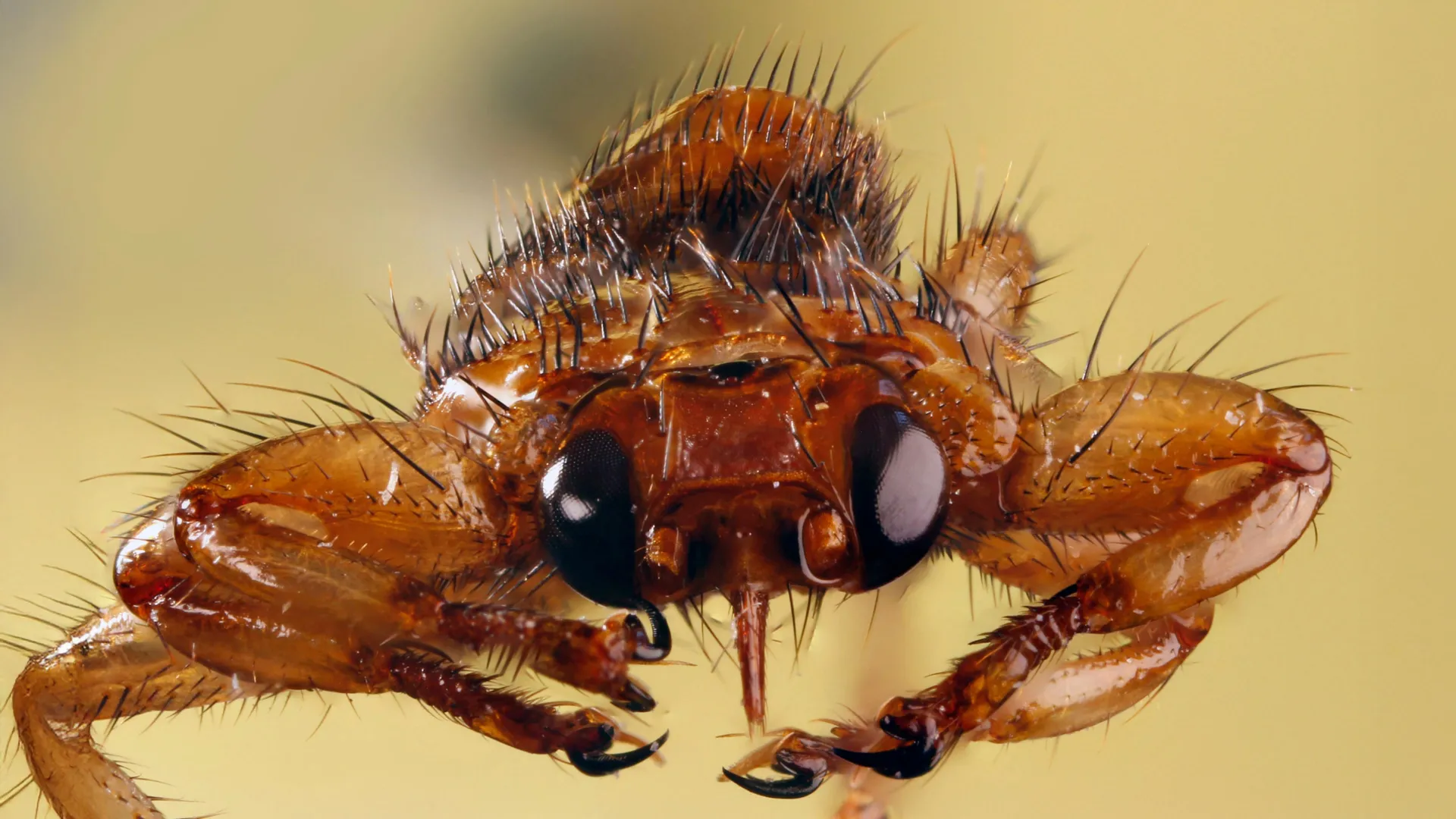
New research has unveiled a remarkable adaptive strategy employed by deer keds, a species of blood-feeding fly, demonstrating a significant reduction in visual sensitivity once they have successfully located a host and permanently abandoned flight. This profound physiological shift, observed by scientists from Aberystwyth University and the University of Florence, underscores an intricate evolutionary trade-off where energy expenditure for sight is reallocated towards functions crucial for a parasitic existence, offering fresh insights into the complex world of sensory ecology and parasite adaptation.
The Dual Lifestyle of the Deer Ked: A Master of Transition
Known scientifically as Lipoptena cervi, deer keds are ectoparasitic biting flies found across a vast geographical range, spanning Europe, Asia, Africa, and the Americas. Their life cycle is characterized by two starkly different phases. As free-flying adults, they are highly mobile, relying heavily on both flight and acute vision to actively search for a suitable mammalian host. While their primary targets are deer – a preference reflected in their common name – they are opportunistic feeders and have been documented to infest humans, livestock, and various other mammals, causing irritation and, in some cases, transmitting pathogens.
The moment a deer ked successfully lands on a host, its life undergoes a dramatic and irreversible transformation. Within a short period, the insect permanently sheds its wings, a decisive act that signals the end of its aerial existence. From this point onward, the wingless adult dedicates the remainder of its lifespan to navigating through the host’s fur, feeding voraciously on blood, and reproducing. This sedentary, parasitic lifestyle represents a complete departure from its earlier free-living phase, necessitating fundamental changes in its biological priorities.
Unveiling Sensory Reprioritization
The collaborative research team, spearheaded by Dr. Roger Santer from the Department of Life Sciences at Aberystwyth University, embarked on an investigation to understand how this radical behavioral and morphological shift might be mirrored in the fly’s sensory system. Their hypothesis posited that such a significant change in lifestyle would likely be accompanied by a recalibration of sensory investment, particularly in energetically demanding systems like vision.
"Vision plays a vital role in animal behavior, guiding everything from foraging to predator avoidance," explained Dr. Santer. "However, maintaining a highly sensitive visual system is also energetically expensive. Evolution consistently favors sensory systems that are efficiently matched to an animal’s specific way of life. Some blood-feeding flies, like tsetse flies, are highly visual hunters, whereas others are permanent ectoparasites with minimal need for sophisticated sight. Deer keds present a uniquely compelling case study because they transition so dramatically between these two distinct lifestyles."
To meticulously investigate this adaptation, the researchers designed a comparative study examining deer keds at different stages of their adult life cycle. They collected two distinct groups: actively flying, winged adults still in the process of searching for hosts, and wingless adults that had already settled on deer and fully adopted their parasitic existence. This direct comparison allowed for an unparalleled examination of the sensory changes accompanying their life transition.
The Molecular Evidence: Opsins and Reduced Visual Sensitivity
The core of the investigation focused on opsin genes – the genetic blueprints for the light-sensitive proteins found in the photoreceptor cells of the eye. Opsins are fundamental to vision across the animal kingdom, and their activity levels directly correlate with the development and sensitivity of an animal’s visual system. By comparing the gene activity (gene expression) of opsins in the two groups of deer keds, the researchers could quantitatively assess how the insects’ visual systems responded to their abrupt lifestyle alteration.
The findings were striking and provided clear molecular evidence for sensory reprioritization. "We observed that the visual system of a flying deer ked is remarkably similar in its genetic profile to that of a tsetse fly," Dr. Santer reported. Tsetse flies (Glossina species) are renowned for their acute vision, which they employ to locate mammal hosts in the challenging African savanna environments. This initial similarity highlights the deer ked’s sophisticated visual capabilities during its host-seeking phase.
However, once a deer ked shed its wings and transitioned into a permanent ectoparasite, the activity of its opsin genes plummeted to approximately half their previous levels. This substantial reduction indicates a significant downregulation of the genetic machinery responsible for maintaining high visual acuity. Crucially, this does not suggest complete blindness but rather a deliberate and substantial reduction in visual sensitivity. The fly retains some basic light perception, but its ability to discern fine details, track moving objects, or perceive distant forms is drastically diminished.
"We hypothesize that the fly is consciously sacrificing high-resolution sight to conserve precious metabolic energy," Dr. Santer elaborated. In a parasitic existence, where the insect is constantly surrounded by fur and no longer needs to navigate open spaces or locate distant hosts, the metabolic overhead of a highly sensitive visual system becomes an unnecessary burden. This conserved energy can then be redirected towards other vital physiological processes, such as efficient blood digestion, immune responses against host defenses, and, most importantly, reproduction.
The Energetic Calculus of Adaptation
The findings underscore a fundamental principle of evolutionary biology: organisms optimize resource allocation to maximize fitness in their specific ecological niche. Vision, particularly the sophisticated compound eyes found in many insects, is metabolically expensive. Photoreceptor cells, neural processing units, and the continuous repair and maintenance of visual pigments all demand significant ATP. For a free-flying insect, this investment is absolutely essential for survival and reproduction. For a sessile parasite, however, the cost-benefit ratio shifts dramatically.
Once embedded within a host’s fur, the primary sensory needs change from long-range detection to close-range tactile and chemosensory cues. Navigating through a dense forest of hair, detecting subtle changes in host skin, and locating feeding sites are likely more dependent on mechanoreceptors and olfactory cues than on high-resolution vision. The reduction in opsin gene expression thus represents a highly efficient biological strategy, allowing the deer ked to channel vital energy reserves into growth, blood meal processing, and egg production, thereby enhancing its reproductive success within its protected, resource-rich parasitic environment.
This phenomenon is not entirely unprecedented in the animal kingdom. Other parasitic species, particularly those that live in dark, enclosed environments or have very specific host relationships, often exhibit reduced or vestigial visual organs. Cave-dwelling fish, deep-sea invertebrates, and certain internal parasites are classic examples. However, the deer ked’s active and dramatic downgrading of a previously functional and essential sensory system mid-life is a particularly elegant demonstration of adaptive plasticity at the molecular level.
Broader Implications for Parasite Ecology and Control
The study, published in the esteemed Journal of Experimental Biology, contributes significantly to our understanding of how parasites dynamically adjust their sensory systems in response to profound lifestyle changes. This research moves beyond simply observing morphological changes to elucidating the underlying molecular mechanisms that drive such adaptations.
From a broader scientific perspective, these findings enrich the field of sensory ecology, illustrating the dynamic interplay between an organism’s environment, its behavior, and the evolution of its sensory apparatus. It provides a compelling example of how natural selection fine-tunes biological systems to achieve optimal energy efficiency and reproductive output.
Beyond fundamental biology, the insights gleaned from this research hold potential practical implications, particularly in the realm of pest and vector control. Deer keds, while primarily a nuisance to wildlife, can transmit bacterial pathogens such as Anaplasma phagocytophilum (which causes anaplasmosis in animals and humans) and Bartonella schoenbuchensis. Their bites are also intensely itchy and can lead to skin irritation and allergic reactions in humans and livestock.
A deeper understanding of how deer keds utilize their senses throughout their life cycle could inform the development of more effective monitoring and control strategies. For instance, knowing the precise sensory cues that attract winged deer keds could lead to the design of more targeted traps or repellents that exploit their visual preferences during the host-seeking phase. Conversely, understanding their sensory limitations once they are on a host might influence strategies for animal treatment or protection.
The Research Process: From Field to Lab
The study involved a meticulous process, beginning with the collection of deer keds from their natural habitats. The "winged adults" would have been collected either directly from vegetation or via trapping methods designed to intercept host-seeking flies. The "wingless adults" would have required careful collection from the fur of deer, likely requiring collaboration with wildlife biologists or veterinarians.
Once collected, the specimens would have been carefully preserved to maintain the integrity of their genetic material. In the laboratory, advanced molecular biology techniques, likely including quantitative polymerase chain reaction (qPCR) or RNA sequencing, would have been employed to measure the expression levels of opsin genes. This allowed the researchers to quantify the genetic activity with high precision and compare it statistically between the two groups. The rigorous methodology and careful controls ensured the reliability and robustness of their findings.
Future Directions and Unanswered Questions
While this study provides a crucial piece of the puzzle, it also opens avenues for further research. Future investigations could explore:
- Other sensory modalities: Do other sensory systems, such as olfaction (smell) or mechanoreception (touch), become more sensitive or undergo different forms of adaptation once the deer ked is on a host?
- The molecular switch: What specific molecular pathways or environmental cues trigger the downregulation of opsin genes? Is it purely the act of shedding wings, or are there biochemical signals from the host?
- Behavioral consequences: How do deer keds actually behave with reduced vision? Does it impact their movement within the fur, their feeding efficiency, or their ability to find mates on the host?
- Evolutionary origins: When did this adaptive strategy evolve within the Hippoboscidae family? Are there related species that exhibit similar, albeit perhaps less dramatic, sensory trade-offs?
- Pathogen transmission: Does the altered sensory landscape of the parasitic deer ked have any implications for its ability to acquire or transmit pathogens?
In conclusion, the research from Aberystwyth University and the University of Florence illuminates a fascinating example of evolutionary economy in action. By strategically downscaling an energetically demanding sensory system once it becomes redundant, deer keds demonstrate a remarkable capacity for adaptation. This study not only deepens our fundamental understanding of insect biology and parasitic strategies but also provides valuable insights that could one day contribute to more effective management of these ubiquitous and sometimes problematic blood-feeding insects. The journey of the deer ked, from a sharp-eyed aerial hunter to a vision-deprived, fur-dwelling parasite, stands as a testament to the elegant efficiency of natural selection.
