
In 1982, cartoonist Gary Larson introduced a famous Far Side comic called Cow Tools. The illustration, depicting a cow proudly standing next to a strange collection of crudely fashioned, seemingly useless objects labeled as tools, instantly became iconic. Its humor relied on a widely accepted idea, almost a societal axiom: cows lack the intelligence to create or use tools, making the very notion absurd. For decades, this perception solidified a particular view of bovine cognitive capabilities – or rather, the perceived lack thereof. That ingrained assumption is now being questioned, not by another cartoon, but by a real cow named Veronika, whose documented ingenuity promises to reshape our understanding of animal intelligence.
A groundbreaking study published recently in the esteemed journal Current Biology reports the first scientifically documented case of tool use in a pet cow. This remarkable finding suggests that cattle, often relegated to the lowest rungs of cognitive hierarchies in popular imagination, may be far more capable than previously believed. The implications extend beyond a single animal, challenging long-held scientific and societal views about livestock intelligence, animal welfare, and the very definition of tool use itself.
"The findings highlight how assumptions about livestock intelligence may reflect gaps in observation rather than genuine cognitive limits," says Alice Auersperg, a cognitive biologist at the University of Veterinary Medicine, Vienna, and a lead author of the study. Her statement underscores a critical point: often, our understanding of animal capabilities is limited by the environments we provide and the questions we ask, rather than the intrinsic potential of the animals themselves.
The Enduring Legacy of "Cow Tools" and Shifting Perceptions
Gary Larson’s Cow Tools resonated deeply because it tapped into a common human anthropocentric bias. We tend to measure animal intelligence against human standards, particularly our ability to manipulate our environment through tools. The image of a cow, an animal primarily associated with grazing and milk production, attempting to create or use tools was inherently funny precisely because it seemed so incongruous with our established understanding of their cognitive world. This perception is not entirely unfounded, as complex tool use is indeed rare in the animal kingdom, often cited as a hallmark of advanced cognition, seen predominantly in primates, some birds (like New Caledonian crows), and a few other select species.
Historically, livestock animals like cows have been largely studied from an agricultural perspective – focusing on productivity, health, and breeding. Their cognitive lives, beyond basic learning for husbandry, received comparatively little scientific attention. This has led to a widespread underestimation of their intellectual and emotional capacities. However, in recent decades, a growing body of research has begun to reveal the complex inner lives of farm animals, demonstrating their abilities to form social bonds, exhibit problem-solving skills, possess individual personalities, and even experience a range of emotions. Veronika’s case now adds a dramatic new chapter to this evolving narrative.
Meet Veronika: An Unlikely Pioneer in Bovine Cognition
Veronika is a Swiss Brown cow, but her life deviates significantly from that of most cattle. She lives not as an animal raised for food production, but as a cherished companion animal on an organic farm. Her owner, Witgar Wiegele, a dedicated organic farmer and baker, considers Veronika a part of his family. This unique living situation, characterized by extended lifespan, enriched environment, and consistent human interaction, appears to have been a crucial factor in the development and observation of her extraordinary behavior.
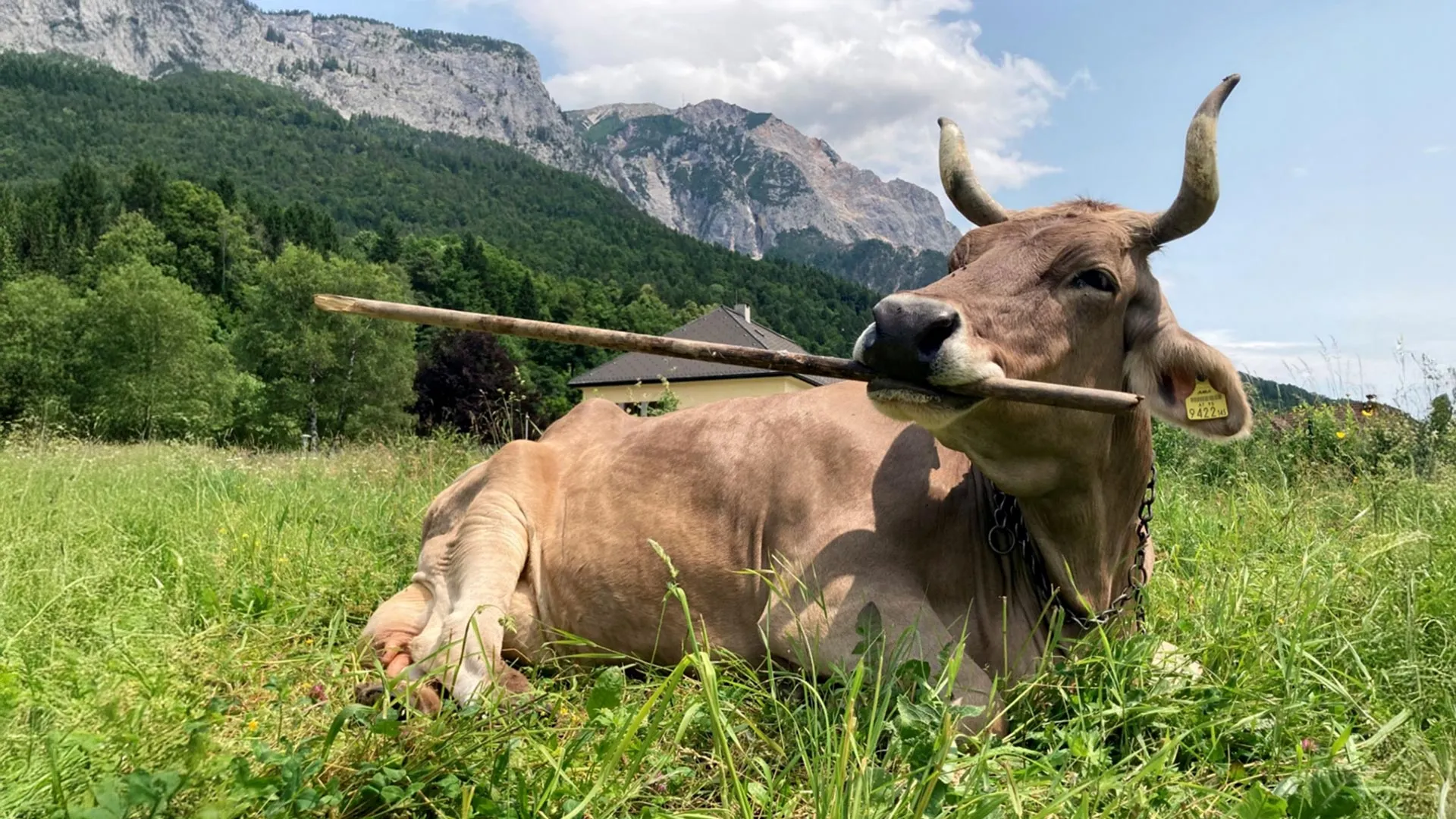
More than a decade ago, Wiegele first noticed Veronika exhibiting an unusual behavior. She would pick up sticks or other objects found in her environment and meticulously use them to scratch various parts of her body. For years, this was a charming quirk observed by Wiegele and his family. The behavior eventually caught scientific attention when it was recorded on video and shared with researchers, including Alice Auersperg’s team.
"When I saw the footage, it was immediately clear that this was not accidental," Auersperg recalls, expressing the scientific community’s initial surprise and intrigue. "This was a meaningful example of tool use in a species that is rarely considered from a cognitive perspective." The clarity and intentionality of Veronika’s actions were striking, compelling researchers to delve deeper into her capabilities.
Rigorous Scientific Scrutiny: Testing Tool Use in Controlled Experiments
To move beyond anecdotal observation and rigorously confirm Veronika’s tool-using abilities, the researchers designed a series of structured, controlled experiments. The goal was to eliminate alternative explanations, such as accidental rubbing or mere object manipulation, and to demonstrate true, intentional tool use. For these tests, a deck brush was selected as the primary "tool" due to its robust nature and varying textures, which could offer different scratching sensations.
Researchers placed the deck brush on the ground in various positions and observed how Veronika interacted with it. Across multiple trials conducted over an extended period, Veronika consistently demonstrated a remarkable level of discernment and intentionality. Her selections were far from random. Instead, she chose specific parts of the brush depending on where on her body she wanted to scratch, precisely matching the tool’s features to the needs of different areas.
"We show that a cow can engage in genuinely flexible tool use," explains Antonio Osuna-Mascaró, another key researcher involved in the study. His statement emphasizes the cognitive sophistication at play. "Veronika is not just using an object to scratch herself. She uses different parts of the same tool for different purposes, and she applies different techniques depending on the function of the tool and the body region." This level of flexibility and adaptability is a hallmark of advanced cognitive function and distinguishes her actions from simpler forms of object interaction.
Unpacking Flexible, Multi-Purpose Tool Use: A Rare Feat
The researchers observed clear, repeatable patterns in how Veronika utilized the deck brush. For larger, firmer areas of her body, such as her back or flanks, she consistently preferred to use the bristled side of the brush, applying broader, stronger motions to achieve a satisfying scratch. Conversely, for more sensitive regions on her lower body, abdomen, or inner legs, she would deliberately switch to manipulating the smoother handle of the brush, employing slower, more precise movements. This nuanced application of different tool features for different bodily needs is what elevates her behavior to a highly significant cognitive achievement.
Tool use is scientifically defined as the use of an external object as a means to achieve a goal through physical interaction between the user and the object. Veronika’s actions unequivocally meet this definition. Moreover, her behavior goes beyond the basic definition; it qualifies as flexible, multi-purpose tool use. This means she not only uses a tool but strategically employs different features of the same object to achieve distinct outcomes, adapting her technique based on the specific context and desired result.
This type of sophisticated, flexible tool use is exceptionally rare in the animal kingdom. While many species might use a simple stick or stone, the ability to discern and utilize different parts of a single object for varying tasks has previously been clearly documented only in a very select group of non-human species, most notably chimpanzees and, in some contexts, specific bird species like New Caledonian crows, famous for modifying tools. The addition of a cow to this exclusive list fundamentally alters our understanding of cognitive evolution and distributed intelligence across the animal kingdom.
Overcoming Physical Constraints: A Test of Dexterity and Anticipation
Veronika’s tool use is directed at her own body, a form known as egocentric tool use. While this type of tool use is generally considered less complex than using tools to manipulate external objects (e.g., a chimp using a stick to retrieve food), it still presents significant physical and cognitive challenges, especially for an animal like a cow.
Cows, unlike primates, lack prehensile hands. This means Veronika must manipulate the tools primarily using her mouth and tongue, a task requiring remarkable dexterity and fine motor control. Despite this inherent physical limitation, the study observed her demonstrating careful control, adjusting her grip on the brush and modifying her movements to achieve the desired scratching effect. This suggests not only motor skill but also an apparent ability to anticipate the effects of her actions – a key indicator of planning and foresight. She doesn’t just randomly poke; she positions the tool and applies pressure with purpose.
This oral manipulation of tools is particularly noteworthy. It indicates that cognitive capacity for tool use is not solely dependent on the presence of human-like hands. Instead, it can manifest and adapt to the specific anatomical features of a species, leveraging whatever means are available for interaction with the environment.
Why Veronika? The Role of Environment and Enrichment
The researchers believe that Veronika’s unique living conditions played a pivotal role in the development and manifestation of her tool-using behavior. Her life stands in stark contrast to that of most cattle globally, who are often raised in confined, relatively barren environments with limited opportunities for exploration, problem-solving, or complex social interaction.
Veronika has lived a long life, spanning over a decade, in a complex and stimulating environment. As a companion animal, she benefits from daily interactions with humans, which can foster unique learning pathways. Crucially, she has continuous access to a variety of objects in her environment that she can manipulate and explore. These factors likely created an "enriched environment" that encouraged curiosity, innovation, and the development of novel behaviors that might otherwise remain dormant in less stimulating settings.
This observation is critical for understanding animal cognition. It suggests that many animals, including those we traditionally perceive as less intelligent, might possess latent cognitive abilities that only emerge when given the opportunity to engage with a complex and stimulating world. The study implicitly argues that our current assessment of livestock intelligence might be artificially low due to the restrictive conditions in which most of these animals are kept.
As the researchers aptly put it in their paper, "[Veronika] did not fashion tools like the cow in Gary Larson’s cartoon, but she selected, adjusted, and used one with notable dexterity and flexibility." They conclude with a profound thought: "Perhaps the real absurdity lies not in imagining a tool-using cow, but in assuming such a thing could never exist."
Broader Implications for Cognitive Science and Animal Welfare
This discovery represents the first confirmed case of flexible, multi-purpose tool use in cattle and significantly expands the range of species known to demonstrate this advanced ability. It forces the scientific community to reconsider the evolutionary pathways of intelligence and the cognitive toolkit available to different animal groups. It also raises the intriguing possibility that similar, unobserved behaviors may exist in other species, or even in other cows, but have simply gone unnoticed due to lack of observation or unsuitable living conditions.
The implications of Veronika’s story are far-reaching:
- Redefining Animal Intelligence: It challenges the anthropocentric bias in defining intelligence and forces a broader, more inclusive understanding of cognitive capabilities across the animal kingdom.
- Animal Welfare: If cows possess such sophisticated cognitive abilities, it strengthens arguments for improved animal welfare standards in agriculture. Providing enriched environments, opportunities for exploration, and acknowledging their individual needs become even more ethically imperative. This could influence debates around sentient animal legislation and farming practices.
- Agricultural Practices: The findings could prompt a re-evaluation of industrial farming models that often neglect the cognitive and behavioral needs of livestock. Investing in more stimulating environments could potentially lead to healthier, less stressed animals.
- Cognitive Evolution: The presence of flexible tool use in a species as distantly related to primates as cattle suggests either convergent evolution (where similar traits evolve independently) or that the cognitive building blocks for such behaviors are more widespread than previously thought.
- Human-Animal Relationships: Veronika’s story fosters a deeper appreciation for the complex inner lives of animals we commonly interact with, encouraging a shift from utilitarian views to one of respect and understanding.
The research team is now actively exploring which specific environmental and social conditions allow such complex behaviors to develop. They aim to understand the mechanisms that foster innovation and learning in cattle. Recognizing the potential for similar behaviors to be more widespread than currently documented, they are also actively encouraging others to report similar observations.
"Because we suspect this ability may be more widespread than currently documented," Osuna-Mascaró states, appealing to a broader audience, "we invite readers who have observed cows or bulls using sticks or other handheld objects for purposeful actions to contact us." This open call for citizen science highlights the ongoing nature of discovery and the potential for everyday observations to contribute significantly to scientific understanding. Veronika, the unassuming Swiss Brown cow, has not only scratched an itch but has also scratched the surface of a profound new understanding of bovine intelligence, inviting us all to look closer and think differently.
