
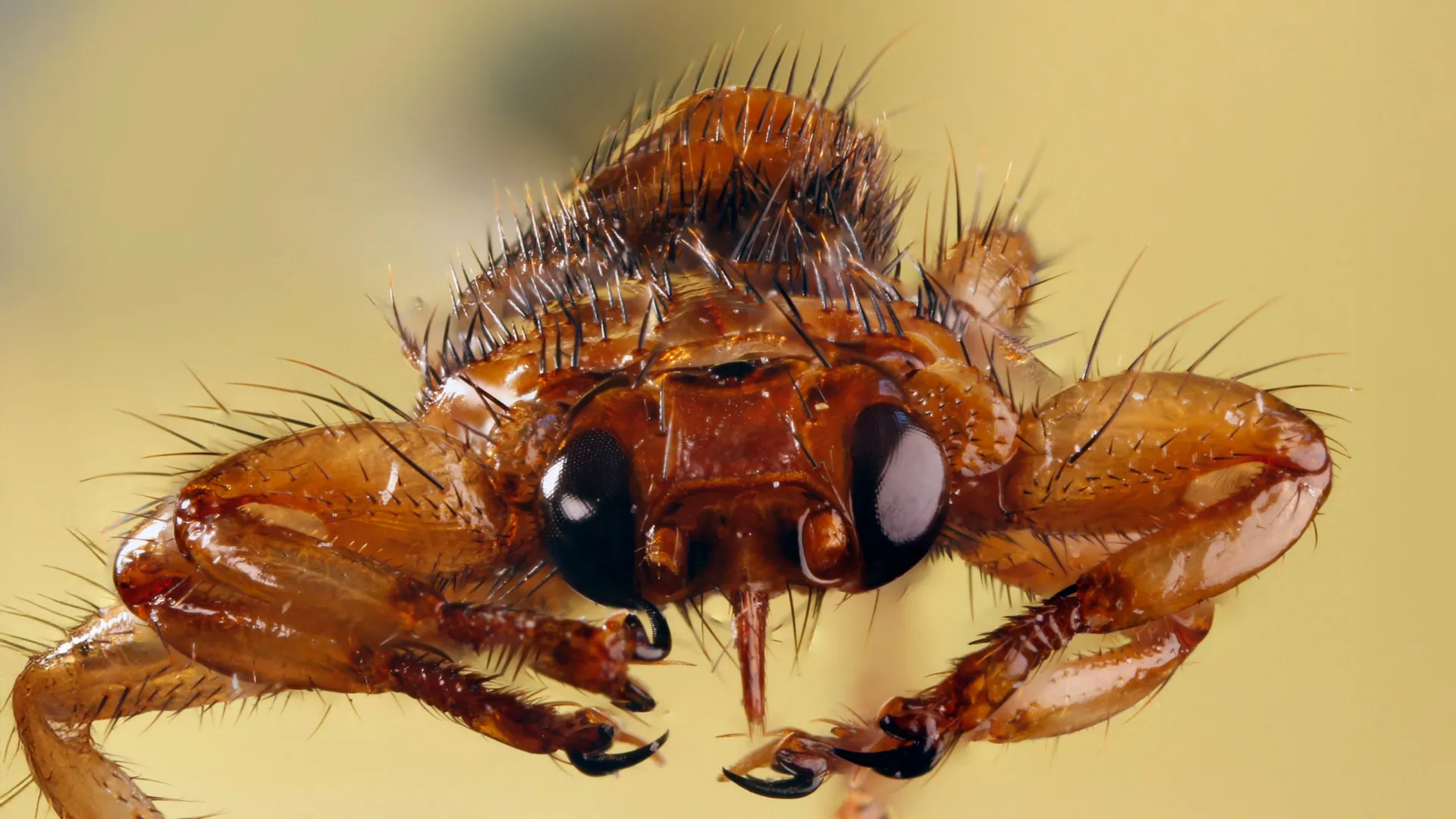
The recent findings from a collaborative study involving scientists at Aberystwyth University and the University of Florence have unveiled a remarkable adaptation in the deer ked, a widespread blood-feeding fly. This insect, known for its dramatic lifestyle shift from an active aerial hunter to a sessile, permanent ectoparasite, appears to strategically reduce its visual capabilities once it has secured a host. This adaptive response, characterized by a significant decrease in the activity of genes associated with visual sensitivity, offers profound insights into how organisms optimize energy allocation and sensory systems in response to profound environmental and behavioral transitions. The research, published in the Journal of Experimental Biology, underscores the intricate evolutionary pressures shaping parasitic life and opens new avenues for understanding and potentially managing these ubiquitous insects.
The Dramatic Life Cycle of the Deer Ked
Deer keds, scientifically classified within the Hippoboscidae family, and primarily represented by species like Lipoptena cervi, are fascinating subjects for entomological study due to their unique life cycle. These biting flies are geographically pervasive, found across vast swathes of Europe, Asia, Africa, and the Americas, indicating their adaptability to diverse climates and host populations. As winged adults, their primary mission is host-seeking, a phase during which both flight and keen vision are indispensable. They actively patrol environments frequented by their preferred hosts, predominantly deer species such as red deer, roe deer, moose, and elk. However, their opportunistic nature means they will readily target other large mammals, including humans, cattle, horses, and even domestic pets like dogs, causing significant nuisance and discomfort.
The initial stage of their adult life is characterized by aerial mobility, allowing them to cover considerable distances in search of a suitable warm-blooded host. During this period, their visual acuity is paramount, enabling them to detect the silhouettes, movements, and perhaps even the thermal signatures of potential hosts. Their compound eyes are finely tuned to perceive changes in light intensity and patterns, crucial for navigating complex environments and homing in on their targets. Beyond vision, chemical cues such as carbon dioxide exhaled by mammals and specific kairomones (chemicals emitted by one species that benefit another) also play a role in guiding them towards a host. This multi-sensory approach maximizes their chances of successful host acquisition, a critical bottleneck in their life cycle.
The full life cycle of the deer ked begins with pupation, typically occurring in the soil or leaf litter, often in areas where deer bed down. Adult flies emerge from these pupae, usually in late summer or early autumn, marking the start of their winged, host-seeking phase. This emergence is often synchronized with periods of high host activity or specific environmental conditions that favor dispersal. Once emerged, the winged adults become active hunters, relying on their sophisticated sensory array to locate a host within a relatively short timeframe, usually a few days. Failure to find a host within this window often results in mortality, highlighting the urgency of their initial quest.
The moment a deer ked successfully lands on a host marks an irreversible and dramatic turning point in its existence. Upon establishing a foothold, typically by burrowing into the fur, the insect undergoes a remarkable morphological and behavioral transformation. It permanently sheds its wings, rendering itself incapable of flight for the remainder of its life. This act is not merely a physical shedding but symbolizes a complete commitment to a parasitic lifestyle. From this point onwards, the deer ked becomes a permanent resident on its chosen host, navigating through the dense fur, feeding exclusively on blood, and dedicating its remaining energy to reproduction. This transition from a free-flying, visually-dependent hunter to a wingless, tactile, and chemosensory-driven ectoparasite represents one of the most striking examples of adaptive specialization in the insect world. The shedding of wings, a seemingly drastic measure, serves to prevent the fly from being dislodged or caught in the host’s grooming activities, while also removing an energetically costly appendage that is no longer needed. Once established, female keds produce larvae internally, which are then deposited as pre-pupae directly into the host’s environment, continuing the cycle.
A Deep Dive into Sensory Adaptation
The radical shift in lifestyle prompted scientists from Aberystwyth University and the University of Florence to investigate how this behavioral metamorphosis might influence the insect’s sensory apparatus. The central hypothesis was that such a fundamental change in how an animal interacts with its environment would necessitate corresponding adjustments in its sensory investments. Vision, while vital for the initial host-seeking phase, becomes largely redundant once the fly is ensconced within the host’s fur, where light penetration is minimal and navigation is primarily through tactile and olfactory cues.
Dr. Roger Santer, from the Department of Life Sciences at Aberystwyth University, who spearheaded the study, articulated the core evolutionary principle guiding their research: "Vision plays a vital role in animal behavior, but it is also energetically expensive. Evolution favors sensory systems that are efficiently matched to an animal’s way of life. Some blood-feeding flies rely heavily on vision, while others live permanently on hosts and have little need for it. Deer keds are especially interesting because they switch between these two lifestyles." This statement encapsulates the concept of adaptive energy allocation, where an organism’s biological resources are distributed to maximize fitness in its current ecological niche. Maintaining and operating a complex visual system, from the synthesis of light-sensitive proteins to the neural processing of visual information, demands a significant metabolic outlay. For an insect that transitions from an open-air environment to a dark, confined space, continuing to invest heavily in vision would represent a substantial energetic waste.
To unravel these adaptations, the research team adopted a comparative approach, studying deer keds at distinct phases of their adult life cycle. They meticulously collected and analyzed two groups: winged adult keds that were actively engaged in host-searching behaviors, representing the pre-parasitic, visually-dependent stage; and wingless adult keds, harvested directly from the fur of deer, embodying the permanent parasitic stage. This methodological distinction was crucial for isolating the physiological changes directly attributable to the lifestyle transition rather than developmental stages. The research design deliberately focused on adult insects to ensure that any observed differences were a direct consequence of their parasitic commitment and not merely part of a developmental trajectory from larva to adult.
Unveiling the Mechanisms: Opsin Gene Regulation
The focus of the investigation narrowed to the genetic underpinnings of vision, specifically genes responsible for the production of opsins. Opsins are a class of light-sensitive proteins found in photoreceptor cells, forming the core component of visual pigments. These pigments absorb photons of light, initiating the biochemical cascade that translates light into electrical signals, which are then processed by the nervous system as visual information. The expression levels of opsin genes are direct indicators of an animal’s investment in its visual system; higher activity typically correlates with greater visual sensitivity and capability.
By comparing the activity levels of these opsin genes in winged versus wingless deer keds, using advanced molecular biology techniques such as quantitative polymerase chain reaction (qPCR), the researchers could directly observe the molecular response to the insects’ radical change in lifestyle. The findings were compelling and provided clear evidence of sensory system plasticity. Dr. Santer elaborated on these crucial observations: "We found that a flying deer ked’s visual system is much like that of a tsetse fly, which famously hunt out mammal hosts in Africa. However, after a deer ked loses its wings and becomes an ectoparasite, activity of its opsin genes reduces to around half the previous level. This suggests that the flies do not lose vision entirely, but that their visual sensitivity is reduced. We think the fly might be sacrificing sight to conserve energy for functions such as digestion and reproduction."
The comparison to tsetse flies (Glossina spp.) is particularly illustrative. Tsetse flies are renowned for their highly developed visual systems, which they employ effectively for long-range host detection in the African savanna, relying on visual cues to navigate and locate hosts. The initial visual capacity of deer keds, akin to such dedicated visual hunters, highlights the importance of sight during their free-flying phase. The subsequent reduction in opsin gene activity by approximately 50% in the wingless stage is a strong indicator of a deliberate down-regulation of visual function. This isn’t a complete abandonment of vision, which would imply total blindness, but rather a strategic scaling back. The residual opsin activity suggests that a rudimentary form of light perception might still exist, perhaps useful for detecting gross changes in light intensity or the presence of a light source, even within the confines of dense fur. However, the energy investment required for high-resolution vision is clearly no longer being made.
This reduction in visual investment is strongly hypothesized to be an energy-saving mechanism. The energy conserved from maintaining a robust visual system can then be reallocated to other biological processes that become more critical for the parasitic stage. These include enhanced digestion to process the blood meal, robust immune responses to combat host defenses and pathogens, efficient reproductive output (as females need to produce many larvae over their parasitic lifespan), and the constant repair and maintenance of the cuticle, which is subject to wear and tear from movement through fur. In the resource-limited environment of a parasite, every unit of energy must be judiciously spent, and this sensory trade-off represents a highly optimized evolutionary strategy. The University of Florence team contributed crucial expertise in insect physiology and molecular analysis, strengthening the robustness of these findings.
Evolutionary Insights and Ecological Ramifications
The study’s publication in the Journal of Experimental Biology signifies its importance within the scientific community, offering fresh insight into the fascinating field of parasite adaptation. From an evolutionary perspective, the deer ked serves as an exquisite model for understanding sensory system plasticity and the fine-tuning of organismal biology to specific ecological niches. The ability to dramatically alter sensory investment in response to a permanent environmental shift is a testament to the power of natural selection in shaping highly efficient biological systems. It reinforces the idea that adaptations are often compromises, and organisms evolve to optimize their chances of survival and reproduction within their immediate context, even if that means shedding previously vital attributes. This phenomenon, known as regressive evolution, is often observed in species that transition to parasitic or cave-dwelling lifestyles where certain sensory organs become redundant.
The broader ecological ramifications of this research extend beyond the deer ked itself. Understanding the sensory ecology of parasites is fundamental to comprehending their interactions with hosts, their distribution, and their potential as vectors of disease. While deer keds are not typically considered major disease vectors in the same vein as mosquitoes or ticks, they can transmit bacterial pathogens such as Anaplasma phagocytophilum (which causes anaplasmosis in humans and animals) and Bartonella species. Moreover, their persistent feeding can cause significant irritation, stress, and anemia in heavily infested hosts, particularly deer, which can impact their overall health and reproductive success. For livestock, infestations can lead to reduced weight gain, damage to hides from repeated biting, and overall economic losses for farmers. The flies can also spread skin lesions and create entry points for secondary bacterial infections.
The findings also contribute to the growing body of knowledge on insect sensory systems. By demonstrating a clear genetic basis for sensory down-regulation, the study provides a robust example of how genes and behavior are intricately linked in an adaptive context. This level of understanding can inform comparative studies across other parasitic insect groups that exhibit similar lifestyle changes, such as other members of the Hippoboscidae family (e.g., sheep keds, bird keds) or even some flea species that exhibit reduced visual capabilities after host attachment. The principle of metabolic economy through sensory reduction is likely a common theme in the evolution of permanent ectoparasitism.
Towards Improved Monitoring and Control
The practical implications of this research are significant, particularly in the realm of pest management. Current strategies for controlling biting flies and ectoparasites often rely on broad-spectrum insecticides, which can have non-target effects, contribute to environmental contamination, and lead to the development of insecticide resistance. A more nuanced understanding of how deer keds and similar biting flies utilize their senses to locate and persist on hosts could pave the way for more targeted, environmentally friendly, and effective monitoring and control strategies.
For instance, knowledge of the deer ked’s visual capabilities during its host-seeking phase could inform the design of more effective traps. If specific wavelengths of light or patterns are particularly attractive to the flying adults, traps could be engineered to exploit these visual cues, thereby reducing populations before they infest hosts. Current trapping methods for other flies often use visual and olfactory lures; this research provides a strong scientific basis for optimizing the visual component for deer keds. Conversely, understanding the reduced reliance on vision and increased reliance on tactile and chemosensory cues in the parasitic stage might suggest different approaches for host-applied treatments or repellents that interfere with their ability to navigate fur or feed. For example, compounds that disrupt their tactile perception or mask host olfactory cues could be explored.
Dr. Santer and his colleagues emphasize that this research is a foundational step. While the study primarily focused on opsin genes and visual sensitivity, future investigations could explore other sensory modalities. For instance, how do the genes associated with olfaction (smell) and mechanoreception (touch) change during this transition? It is plausible that while visual investment decreases, investment in these other senses might increase, compensating for the loss of flight and vision in the new, fur-dwelling environment. Such a comprehensive understanding of the entire sensory landscape of the deer ked could lead to multi-pronged control strategies that target different sensory pathways at different life stages, offering a more integrated pest management approach.
The Future of Parasite Research
This study exemplifies the power of interdisciplinary research, combining entomology, evolutionary biology, and molecular genetics to unravel complex biological puzzles. The collaboration between Aberystwyth University and the University of Florence highlights the global nature of scientific inquiry and the benefits of diverse expertise. The insights gained are not merely academic; they contribute to a broader understanding of biodiversity, ecological interactions, and potentially, to the health and well-being of both wildlife and domestic animals.
In conclusion, the deer ked’s ability to selectively "turn down" its vision after finding a host is a compelling testament to the efficiency of evolution. It underscores the principle that biological systems are constantly optimizing, shedding unnecessary metabolic burdens to reallocate resources where they are most critically needed. As human-wildlife interfaces continue to change, and as concerns about zoonotic diseases and animal welfare grow, fundamental research into the biology of parasites like the deer ked becomes increasingly vital. This study is a significant step forward, offering a detailed blueprint of adaptive sensory changes and opening doors to innovative solutions for managing the impact of these intriguing, blood-feeding insects. The journey from flying hunter to permanent parasite is not just a physical one; it is a sensory and genetic re-engineering, finely tuned by millions of years of natural selection.
