
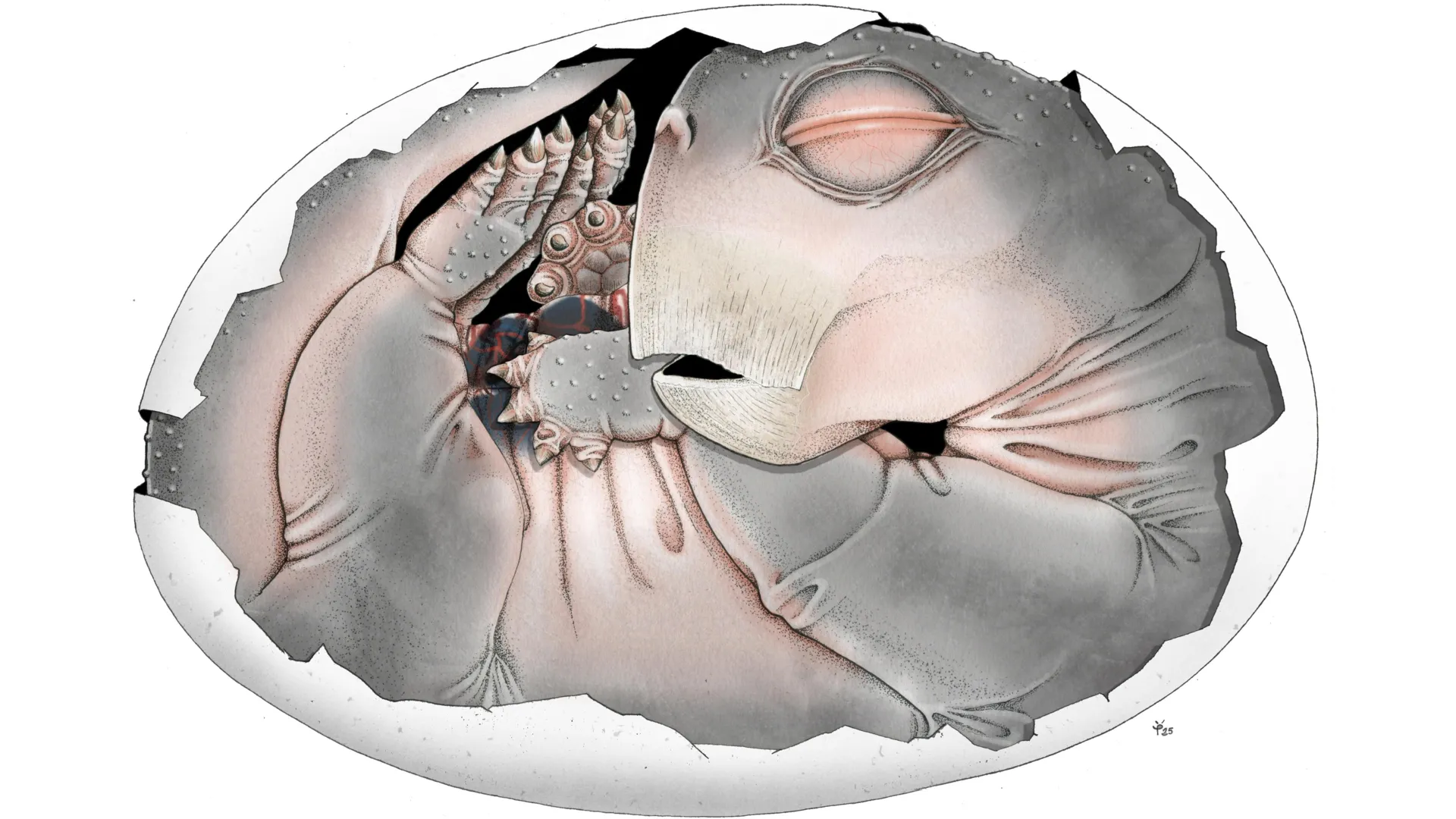
A groundbreaking fossil discovery is revolutionizing scientific understanding of the End-Permian Mass Extinction, Earth’s most catastrophic ecological event, and shedding crucial light on the evolutionary lineage of mammals. Researchers have identified an exquisitely preserved egg containing a Lystrosaurus embryo, a robust, plant-eating ancestor of mammals, dating back approximately 250 million years. This unprecedented find not only resolves a decades-old scientific mystery regarding the reproductive strategies of early mammal ancestors but also provides profound insights into how life adapted and thrived in the extreme environmental upheaval that followed the "Great Dying."
The Dawn of a New Understanding: A Fossil Unveiled
The pivotal discovery, detailed in new research published in PLOS ONE, centers on a fossilized egg, the first ever confirmed from a synapsid, the group of animals that includes mammals and their direct ancestors. This 250-million-year-old specimen provides definitive evidence that early mammal ancestors, specifically the dicynodont therapsid Lystrosaurus, reproduced by laying eggs. This conclusion has been a subject of long-standing debate among paleontologists, who have grappled with the scarcity of direct fossil evidence for reproductive modes in these ancient creatures.
The international research team responsible for this breakthrough was co-led by Professor Julien Benoit and Professor Jennifer Botha from the Evolutionary Studies Institute at the University of the Witwatersrand, South Africa, alongside Dr. Vincent Fernandez from ESRF – The European Synchrotron in France. Their collaborative efforts, spanning over a decade, culminated in the definitive identification and analysis of this remarkable fossil.
Chronology of a Scientific Breakthrough
The journey to this discovery began much earlier, in 2008, during a routine field excursion led by Professor Botha. It was during this expedition that John Nyaphuli, a skilled preparator and fossil finder, identified a small nodule that initially revealed only minute flecks of bone. As Nyaphuli meticulously prepared the specimen, it gradually became clear that it contained a perfectly curled-up Lystrosaurus hatchling. Professor Botha recalls suspecting at the time that the creature had died within its egg, but the technological limitations of the era prevented conclusive confirmation.
For years, the fossil remained a tantalizing enigma, a testament to the mysteries held within the Earth’s ancient strata. The true nature of the specimen would only be revealed with the advent of advanced imaging techniques. Modern synchrotron X-ray computed tomography (CT) scanning, utilizing the powerful X-rays available at the ESRF, finally provided the means to peer inside the delicate fossil without causing any damage. This cutting-edge technology allowed researchers to construct detailed three-dimensional images of the internal structures, confirming what had long been a hypothesis: the presence of an embryo still encased within an egg.
Dr. Fernandez emphasized the significance of this technological leap: "Understanding reproduction in mammal ancestors has been a long-lasting enigma and this fossil provides a key piece to this puzzle. It was essential that we scanned the fossil just right to capture the level of detail needed to resolve such tiny, delicate bones." The precision afforded by synchrotron scanning was instrumental in distinguishing the embryonic bones and the faint outlines of the surrounding egg material, which had otherwise been lost to time.
Further analysis of the embryo itself provided critical clues. Professor Benoit noted a particularly exciting observation: "When I saw the incomplete mandibular symphysis, I was genuinely excited. The mandible, the lower jaw, is made up of two halves that must fuse before the animal can feed. The fact that this fusion had not yet occurred shows that the individual would have been incapable of feeding itself." This crucial anatomical detail definitively indicated that the Lystrosaurus was still in a pre-hatching stage of development, confirming its demise within the egg.
The End-Permian Extinction: A World Transformed
To fully appreciate the significance of Lystrosaurus‘s survival and reproductive strategy, it is essential to understand the cataclysmic backdrop against which it flourished. Around 252 million years ago, the planet experienced the End-Permian Mass Extinction, often referred to as the "Great Dying." This event was by far the most severe extinction in Earth’s history, obliterating an estimated 90-95% of all marine species and approximately 70% of terrestrial vertebrate species. It marked a stark boundary between the Permian and Triassic geological periods, fundamentally reshaping the course of life on Earth.
The primary driver of this ecological collapse is widely attributed to massive volcanic eruptions in the Siberian Traps, a large igneous province in modern-day Siberia. These eruptions, which lasted for hundreds of thousands of years, released colossal amounts of greenhouse gases, including carbon dioxide and methane, into the atmosphere. This led to rapid and extreme global warming, with average temperatures potentially rising by 8-10 degrees Celsius.
The warming triggered a cascade of devastating environmental effects:
- Ocean Anoxia: Warmer oceans held less dissolved oxygen, leading to widespread anoxia (oxygen depletion), suffocating marine life and allowing anaerobic bacteria to thrive, which in turn produced toxic hydrogen sulfide.
- Ocean Acidification: Increased atmospheric CO2 dissolved into the oceans, making them more acidic and impairing the ability of many marine organisms to form shells and skeletons.
- Long-lasting Droughts: Terrestrial environments suffered from severe and prolonged droughts, exacerbating desertification and decimating plant life, which formed the base of many food webs.
- Ozone Depletion: Volcanic emissions, particularly halogens, may have severely thinned the ozone layer, exposing terrestrial life to lethal levels of ultraviolet radiation.
The planet became an inhospitable wasteland, characterized by extreme heat, widespread aridification, and unstable conditions. Ecosystems collapsed, food chains disintegrated, and biodiversity plummeted. The recovery period was exceptionally slow, stretching for millions of years, earning the early Triassic the moniker "the Age of Disaster."
Lystrosaurus: A Survivor’s Profile
Amidst this apocalyptic landscape, one creature not only survived but thrived, rising to become one of the dominant species of the early Triassic: Lystrosaurus. This dicynodont therapsid, roughly pig-sized to cow-sized, was a robust, heavily built herbivore with a distinctive shovel-like snout and two tusks. Its anatomical features suggest adaptations for digging for roots and tubers in arid environments, a crucial advantage when other plant life became scarce.
Lystrosaurus became incredibly abundant and widespread, with fossils found across what was then the supercontinent Pangaea – in Africa, India, Antarctica, and China. Its remarkable success in colonizing the ravaged post-extinction world has long puzzled scientists. The discovery of its reproductive strategy now provides a key piece of this evolutionary puzzle.
Unlocking Ancient Reproduction: Key Findings and Implications
The new research reveals two critical aspects of Lystrosaurus‘s reproductive strategy that likely contributed to its astonishing success:
-
Soft-Shelled Eggs: The researchers posit that Lystrosaurus laid soft-shelled eggs. This explains why such eggs have been exceptionally rare in the fossil record, resolving the long-standing mystery of why direct evidence of egg-laying in mammal ancestors was so elusive. Unlike the hard, mineralized shells of many dinosaur eggs, which are robust and readily fossilize, soft-shelled eggs are highly susceptible to decay before they can be preserved. This rarity makes the confirmed discovery of this Lystrosaurus embryo within its egg an extraordinary event, akin to finding a needle in a geological haystack. Modern animals like many turtles, snakes, and even monotremes (echidnas and platypuses) lay soft-shelled eggs, demonstrating the viability of this reproductive mode.
-
Large Eggs and Precocial Young: The study indicates that Lystrosaurus produced relatively large eggs compared to its body size. In contemporary animals, larger eggs typically contain a greater amount of yolk, providing substantial nutritional reserves for the developing embryo. This suggests that Lystrosaurus hatchlings were likely "precocial," meaning they were born at an advanced stage of development. Precocial young are relatively mature and mobile shortly after hatching, capable of feeding themselves and avoiding predators with minimal or no parental care. This stands in contrast to "altricial" young, which are born helpless and require extensive parental investment, often including feeding with milk, as seen in most modern mammals.
The implication here is profound: Lystrosaurus likely did not feed its young with milk, a defining characteristic of modern mammals. Instead, its strategy revolved around producing self-sufficient offspring. This reproductive approach offered several distinct advantages in the harsh, unstable conditions of the early Triassic:
- Independence: Precocial young reduced the burden on parents in an environment where resources were scarce and unpredictable.
- Rapid Development: The ability to feed themselves and develop quickly meant a faster progression to maturity, allowing for earlier reproduction and contributing to population recovery.
- Drought Resistance: Larger eggs, with their greater yolk volume, would have been more resistant to drying out. This was a critical adaptation in a world plagued by long-lasting droughts and extreme aridity, offering better protection for the vulnerable developing embryo.
In essence, Lystrosaurus thrived by employing a strategy of rapid growth and early reproduction, an exceptionally effective approach in the wake of global ecological collapse.
Evolutionary Significance and Broader Implications
This discovery provides the first direct fossil evidence of egg-laying in a synapsid, solidifying our understanding of the evolutionary trajectory leading to mammals. It definitively places egg-laying as the ancestral reproductive mode for the mammalian lineage, with the subsequent evolution of live birth (viviparity) and placental development occurring later in mammalian history. The retention of egg-laying in modern monotremes (platypuses and echidnas) thus represents a remarkable evolutionary echo of their deep ancestral past.
Furthermore, the research offers a compelling case study in evolutionary resilience and adaptability. As Professor Benoit articulated, "This research is important because it provides the first direct evidence that mammal ancestors, such as Lystrosaurus, laid eggs, resolving a long-standing question about the origins of mammalian reproduction. Beyond this fundamental insight, it reveals how reproductive strategies can shape survival in extreme environments: by producing large, yolk-rich eggs and precocial young, Lystrosaurus was able to thrive in the harsh, unpredictable conditions following the end-Permian mass extinction."
Expert Perspectives and Future Horizons
Professor Botha reflected on the long journey of discovery: "What makes this work especially exciting is that we were able to quite literally follow in John Nyaphuli’s footsteps, returning to a specimen he discovered nearly two decades ago and finally solve the puzzle he uncovered. At the time, all we had was a beautifully curled embryo, but no preserved eggshell to prove it had died within an egg. Using modern imaging techniques, we were able to answer that question definitively." She further highlighted the pioneering nature of the find for South African paleontology: "For over 150 years of South African paleontology, no fossil had ever been conclusively identified as a therapsid egg. This is the first time we can say, with confidence, that mammal ancestors like Lystrosaurus laid eggs, making it a true milestone in the field."
Dr. Fernandez also emphasized the collaborative spirit and technological marvels involved: "The opportunity to work at the European Synchrotron Radiation Facility alongside beamline scientists was also an unforgettable part of the journey. The cutting-edge data we generated there allowed us to ‘see’ inside the fossil in extraordinary detail, ultimately revealing that the embryo was still at a pre-hatching stage. That moment, when the pieces all came together, was incredibly rewarding."
This discovery extends beyond a mere paleontological triumph. It offers a crucial "deep-time perspective" on how organisms cope with rapid environmental change and ecological crises. As Professor Benoit underscored, "In a modern context, this work is highly impactful because it offers a deep-time perspective on resilience and adaptability in the face of rapid climate change and ecological crisis. Understanding how past organisms survived global upheaval helps scientists better predict how species today might respond to ongoing environmental stress, making this discovery not just a breakthrough in paleontology, but also highly relevant to current biodiversity and climate challenges."
The story of Lystrosaurus and its ancient egg serves as a powerful reminder that survival in the face of extreme global crises hinges on a combination of adaptability, resilience, and effective reproductive strategies. As humanity grapples with its own climate challenges and biodiversity loss, studying the success stories of Earth’s deep past, like that of Lystrosaurus, offers invaluable lessons for navigating an uncertain future. This ancient egg, once a hidden mystery, now illuminates a pivotal chapter in the saga of life on Earth, connecting the devastating past to the pressing concerns of the present.
