
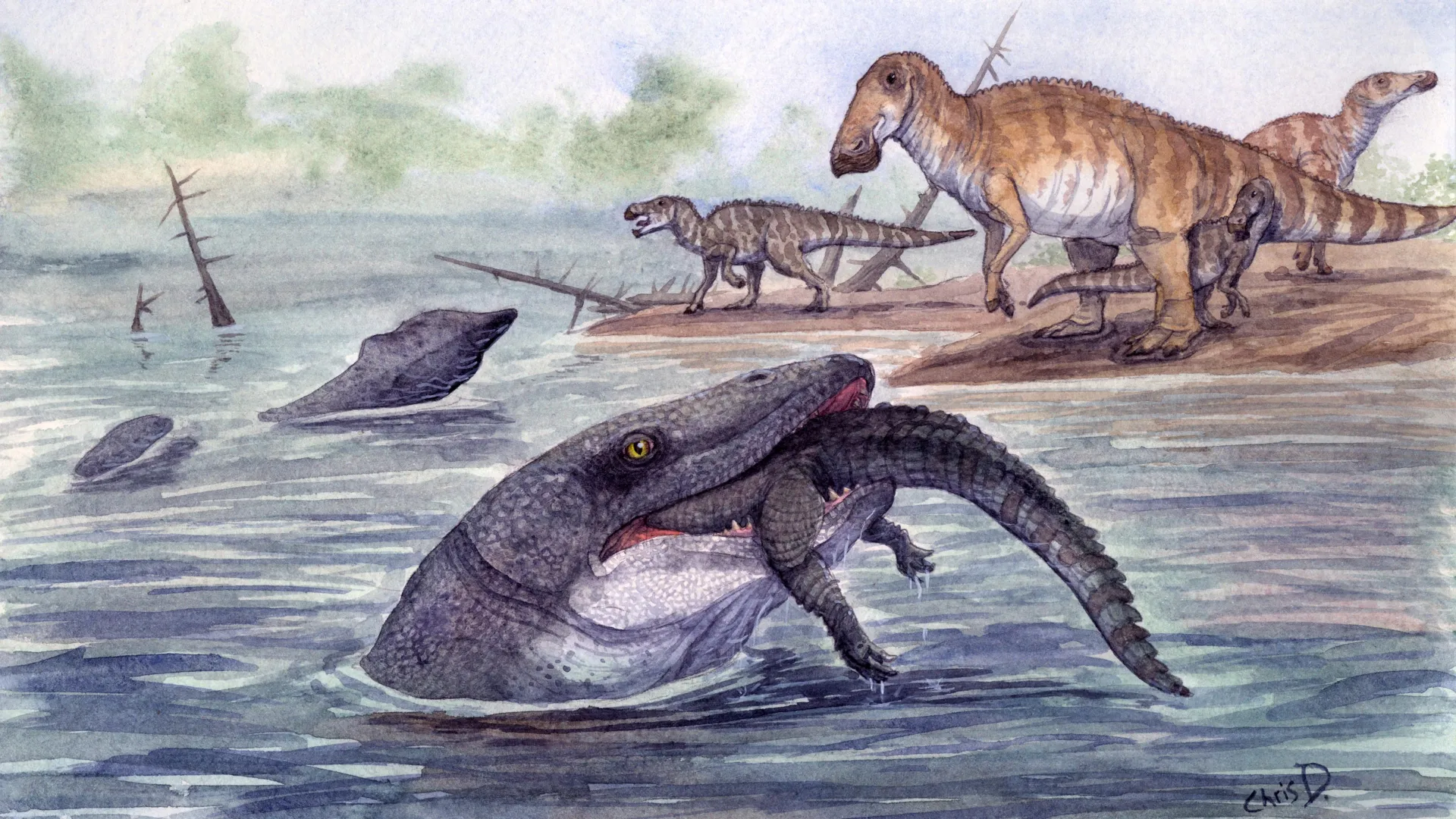
Mosasaurs, the colossal marine reptiles that dominated ancient oceans more than 66 million years ago, are now revealed to have extended their formidable presence far beyond the saltwater realms previously assumed. Groundbreaking new evidence, stemming from the meticulous analysis of a mosasaur tooth unearthed in North Dakota, presents compelling indicators that a subset of these apex predators successfully adapted to and inhabited freshwater river systems during the final million years preceding their extinction. This revelation, led by an international research team spearheaded by scientists at Uppsala University, dramatically reconfigures our understanding of mosasaur adaptability and the dynamic paleogeography of Late Cretaceous North America, painting a picture of these immense, bus-sized creatures – some growing up to 11 meters long – navigating ancient rivers.
The Unprecedented Discovery in North Dakota
The pivotal artifact, a robust mosasaur tooth, was meticulously uncovered in 2022 from a riverine deposit within North Dakota. This site, already a treasure trove for paleontologists, yielded an extraordinary fossil assemblage: alongside the mosasaur tooth, researchers found a tooth from a formidable Tyrannosaurus rex and a well-preserved jawbone belonging to a crocodylian. The region is also renowned for its abundance of fossils from the iconic duck-billed dinosaur Edmontosaurus. This unusual confluence of terrestrial giants, established river-dwelling predators, and a creature historically classified as exclusively marine immediately signaled a paleontological enigma. The presence of a giant marine reptile’s tooth in a freshwater river deposit directly challenged decades of scientific understanding about mosasaur ecology and habitat preferences.
Mosasaurs, derived from the Latin "Meuse lizard" (named after the Meuse River where the first fossil was found), were a diverse group of large, predatory marine squamates, distantly related to modern snakes and monitor lizards. Evolving around 98 million years ago, they rapidly diversified and became the dominant marine predators of the Late Cretaceous period, occupying ecological niches similar to modern-day orcas. Their streamlined bodies, powerful flippers, and massive jaws armed with sharp teeth made them formidable hunters of fish, ammonites, marine turtles, and even other mosasaurs. Fossil evidence of mosasaurs has been found globally, from North America and Europe to Africa and Antarctica, almost exclusively in marine sedimentary rocks, making the North Dakota river find particularly striking.
Unlocking Ancient Secrets: The Power of Isotope Analysis
To unravel the mystery of how a mosasaur tooth came to rest in a freshwater environment, the international research team, comprising scientists from the United States, Sweden, and the Netherlands, turned to the sophisticated technique of isotope analysis. This method involves examining the chemical composition of tooth enamel, which acts as a durable biological archive, recording an animal’s diet and the environmental conditions of its habitat throughout its life.
The critical advantage for the researchers was that the mosasaur tooth, the T. rex tooth, and the crocodylian jawbone all shared a similar geological age, dating back approximately 66 million years ago. This synchronicity allowed for direct comparative analysis of their chemical signatures, providing a precise snapshot of the local ecosystem during a pivotal moment in Earth’s history, just before the catastrophic Cretaceous-Paleogene (K-Pg) extinction event. The detailed isotopic work was primarily conducted at the Vrije Universiteit (VU) in Amsterdam, focusing on stable isotopes of oxygen, strontium, and carbon, each offering unique insights into the ancient world.
A Chemical Fingerprint of Freshwater Life
The results of the isotope analysis provided compelling evidence of the mosasaur’s freshwater existence. The mosasaur tooth exhibited unusually high levels of the lighter oxygen isotope (¹⁶O), a signature strongly associated with freshwater environments. In contrast, marine waters typically contain a higher proportion of the heavier oxygen isotope (¹⁸O). This difference arises from the hydrological cycle: freshwater, derived from precipitation, is generally enriched in ¹⁶O compared to seawater. Further corroboration came from strontium isotope ratios, which also pointed decisively towards a freshwater habitat, reinforcing the oxygen isotope findings.
Beyond habitat, carbon isotopes offered crucial clues about the mosasaur’s diet and behavior. "Carbon isotopes in teeth generally reflect what the animal ate," explained Melanie During, one of the study’s corresponding authors and a lead scientist at Uppsala University. "Many mosasaurs have low ¹³C values because they dive deep." Deep-diving marine animals often have lower ¹³C values due to their feeding on prey that exist in environments with different carbon cycling. However, the mosasaur tooth discovered alongside the T. rex tooth presented a stark contrast: it possessed a higher ¹³C value than any other known mosasaur, dinosaur, or crocodile. This unique carbon signature strongly suggests that this mosasaur did not engage in deep-water diving, and perhaps more intriguingly, that it may have occasionally fed on drowned dinosaurs—a novel dietary hypothesis for these marine reptiles.
During further elaborated on the broader implications of the findings: "The isotope signatures indicated that this mosasaur had inhabited this freshwater riverine environment. When we looked at two additional mosasaur teeth found at nearby, slightly older, sites in North Dakota, we saw similar freshwater signatures. These analyses show that mosasaurs lived in riverine environments in the final million years before going extinct." This replication across multiple specimens from the same region strengthens the conclusion, suggesting that this was not an isolated incident but rather a more widespread adaptation.
Shifting Seas: The Dynamic Western Interior Seaway
The findings not only establish the presence of mosasaurs in freshwater but also provide a plausible explanation for how such a dramatic lifestyle shift became possible. During the Late Cretaceous, North America was bisected by the Western Interior Seaway, a vast, shallow inland sea that stretched from the Gulf of Mexico to the Arctic Ocean. This epicontinental sea was a vibrant marine ecosystem, teeming with diverse life, including ammonites, sharks, plesiosaurs, and, of course, mosasaurs.
However, the research suggests that towards the very end of the Cretaceous period, the dynamics of this seaway began to change significantly. Increasing amounts of freshwater runoff from the surrounding landmasses, likely due to enhanced rainfall and river discharge, flowed into the Western Interior Seaway. Over time, this influx gradually altered the seaway’s salinity, transforming it from a fully marine environment to brackish conditions, and eventually, to areas that were predominantly freshwater. This process is analogous to modern-day conditions seen in the Gulf of Bothnia, where the Baltic Sea’s northernmost arm exhibits greatly reduced salinity due to massive freshwater input.
The researchers propose that this freshwater inundation led to the formation of a ‘halocline’ within the seaway. A halocline is a distinct vertical salinity gradient in water, where a layer of lighter, less dense freshwater forms on the surface, stratifying above denser, more saline saltwater below. The isotope data from other marine animals found in the region provided crucial support for this hypothesis. Per Ahlberg, a coauthor of the study and Dr. During’s promoter, noted, "For comparison with the mosasaur teeth, we also measured fossils from other marine animals and found a clear difference. All gill-breathing animals had isotope signatures linking them to brackish or salty water, while all lung-breathing animals lacked such signatures." This distinction is critical: gill-breathing animals are highly sensitive to salinity changes, and their presence in deeper, saltier layers indicated the persistence of marine conditions there. Mosasaurs, being lung-breathers, needed to surface regularly for air, making the upper, freshwater layer accessible and potentially more hospitable to them. This suggests mosasaurs actively inhabited this less saline surface layer, avoiding the deeper, more saline waters.
Adaptation in a Changing World
The researchers contend that the teeth studied unequivocally belonged to mosasaurs that had successfully adjusted to these novel environmental conditions. This capacity for large predators to shift between different habitats is not unprecedented in evolutionary history, underscoring the remarkable flexibility of life.
"Unlike the complex adaptation required to move from freshwater to marine habitats, the reverse adaptation is generally simpler," During explained. The physiological challenges of moving from a hypoosmotic (freshwater) to a hyperosmotic (saltwater) environment often involve complex kidney and gland adaptations to excrete excess salt. Conversely, adapting from saltwater to freshwater typically involves managing water retention, which can be less physiologically demanding for certain large, robust species.
Modern fauna offers compelling parallels to this ancient mosasaur adaptation. River dolphins, such as the Amazon river dolphin, are entirely freshwater-dwelling, despite their evolutionary lineage tracing back to marine ancestors. The estuarine crocodile (Crocodylus porosus), commonly known as the saltwater crocodile in Australia, exemplifies remarkable euryhalinity, regularly traversing between freshwater rivers, estuaries, and the open ocean, hunting prey wherever opportunities arise. Similarly, bull sharks (Carcharhinus leucas) are notorious for their ability to thrive in both marine and freshwater environments, often traveling hundreds of kilometers up rivers. These contemporary examples illustrate the ecological plasticity that large predators can exhibit when environmental pressures or opportunities arise. For mosasaurs, the changing Western Interior Seaway likely presented both a challenge and an opportunity to exploit new, abundant freshwater food sources.
A Colossal Predator in Riverine Realms
The discovery of mosasaur fossils in North Dakota, particularly in freshwater deposits, is exceptionally rare. Mosasaur fossils are abundant in marine deposits across North America, Europe, and Africa, spanning their evolutionary reign from approximately 98 to 66 million years ago. The scarcity of their remains in inland regions like North Dakota, especially in non-marine contexts, renders this particular finding extraordinarily significant.
The sheer size of the tooth provides a direct indication of the animal’s impressive dimensions, suggesting an individual that could have reached up to 11 meters in length—a length comparable to a modern city bus. This estimate is supported by earlier discoveries of mosasaur bones at a nearby site, which independently corroborate the presence of such massive individuals in the region. While the exact genus of the mosasaur cannot be definitively identified from a single tooth, its characteristics suggest it likely belonged to a prognathodontine mosasaur. Close relatives within the genus Prognathodon are recognized for their massive, powerful heads, robust jaws, and formidable teeth, indicating they were opportunistic and capable predators, well-equipped to tackle large prey.
"The size means that the animal would rival the largest killer whales, making it an extraordinary predator to encounter in riverine environments not previously associated with such giant marine reptiles," stated Ahlberg. This paints a vivid picture of an ancient North American river system where such an immense creature would have been the undisputed apex predator, potentially competing with or even preying on large crocodilians, and certainly impacting the freshwater fish populations and any terrestrial animals that ventured too close to the water’s edge.
Implications for Late Cretaceous Ecosystems and Beyond
This groundbreaking research significantly reshapes our understanding of Late Cretaceous ecosystems and the adaptability of their inhabitants. The presence of mosasaurs in freshwater rivers just before the K-Pg extinction event suggests a dynamic and perhaps desperate ecological response to rapidly changing environments. The Western Interior Seaway was not a static entity but a fluid, evolving landscape. This adaptability, while remarkable, ultimately did not save mosasaurs from the global catastrophe of the K-Pg event, which wiped out 75% of plant and animal species, including all non-avian dinosaurs and mosasaurs. However, it demonstrates their incredible resilience and capacity to exploit new niches in the face of environmental shifts.
The findings also stimulate new questions about the interactions between these freshwater mosasaurs and the other inhabitants of the river systems. Did they compete directly with the large crocodilians whose remains were found alongside them? How did their presence influence the distribution and behavior of other freshwater fauna? The suggestion of mosasaurs feeding on drowned dinosaurs opens up a fascinating avenue of research into predator-prey dynamics in these transitional environments. This could imply that mosasaurs were efficient scavengers as well as active hunters, capitalizing on any available food source in their new habitat.
Looking Ahead: New Avenues for Paleontological Research
This study not only resolves a specific paleontological puzzle but also opens up exciting new avenues for future research. Paleontologists may now begin to re-evaluate other mosasaur fossil sites, particularly those located near ancient freshwater inputs or in regions where similar environmental transitions might have occurred. The isotopic analysis technique, proven so effective here, can be applied to other marine reptile fossils to investigate potential freshwater excursions across different species and geological periods.
The research was carried out through a collaborative effort involving scientists from Uppsala University, in conjunction with Eastern West Virginia Community and Technical College in Moorefield, West Virginia, Vrije Universiteit Amsterdam, and the North Dakota Geological Survey. The article draws heavily on a chapter from Dr. Melanie During’s doctoral thesis, which she successfully defended at Uppsala University in November 2024, marking a significant contribution to the fields of paleontology and paleoecology. This discovery stands as a testament to the ongoing power of scientific inquiry and the enduring mysteries that Earth’s ancient past continues to hold.
