
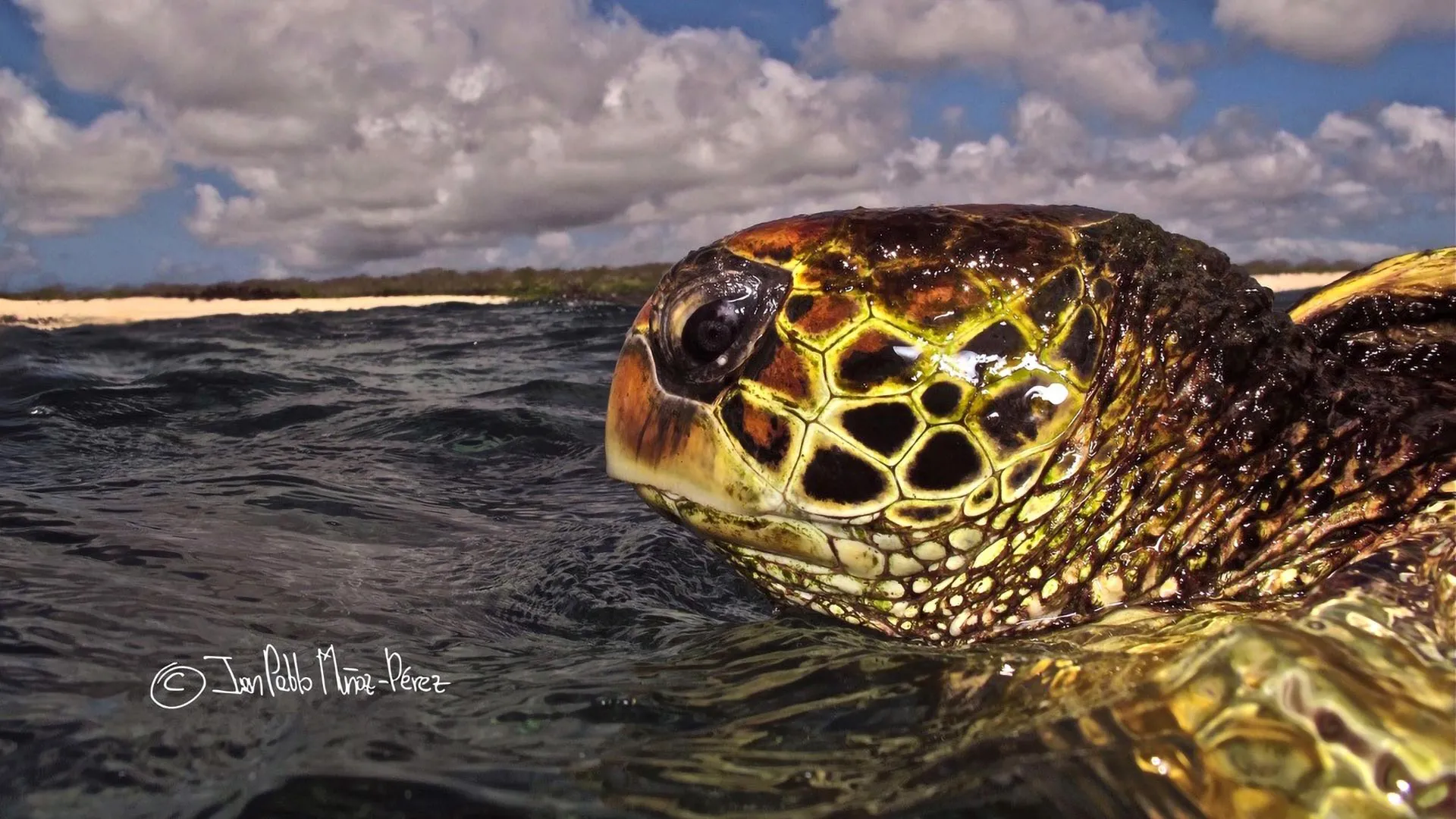
Sea turtles are globally renowned for undertaking colossal marine migrations. Leveraging an innate biological GPS powered by geomagnetic cues, solar orientation, and ocean currents, these marine reptiles routinely cross thousands of miles of open water to seek out feeding grounds before navigating back to their exact birth beaches to reproduce. This well-documented behavioral paradigm has long defined the life history of Chelonia mydas, the green sea turtle. However, a groundbreaking multi-year study published in Frontiers in Amphibian and Reptile Science has revealed a fascinating evolutionary anomaly within the pristine waters of the Galápagos Islands.
According to the new research, a specific population of green sea turtles residing in the archipelago exhibits an unexpectedly sedentary lifestyle. Rather than embarking on transoceanic odysseys across the Pacific Basin, these resident reptiles maintain remarkably restricted home ranges, challenging long-held assumptions regarding the migratory elasticity and behavioral predictability of the species.
Unraveling the Mystery of the Yellow Morph
The investigation centers on the "yellow-morph" green sea turtle, one of two genetically distinct forms of Chelonia mydas that inhabit the Galápagos Marine Reserve. Green sea turtles already occupy a unique ecological niche among the world’s seven extant sea turtle species. While juveniles transition through an omnivorous phase, adult green sea turtles are strictly herbivorous, subsisting almost entirely on marine algae and dense underwater meadows of seagrass.
Within the scientific community, scientists categorize the species into distinct morphological and genetic variants. Yellow-morph green sea turtles predominantly inhabit the tropical and subtropical waters of the western Pacific. Conversely, their "black-morph" counterparts are typically distributed across the eastern Pacific, ranging westward from the Americas and southward from southern California. The Galápagos archipelago stands as a rare geographic crossroads—the only known location globally where these two distinct forms co-occur, swimming in the same currents and grazing on identical marine flora.
Despite sharing dietary preferences, the two morphs display distinct developmental traits. Young yellow morphs exhibit significantly accelerated growth rates compared to black morphs. This physiological divergence suggests subtle, yet impactful, internal metabolic or genetic differences that researchers are only beginning to document and understand.
A Logistical Tracking Operation in the Galápagos
To decipher the spatial ecology of the elusive yellow morphs, an international team of scientists spearheaded by Dr. John W. Rowe, a professor at Alma College in the United States, initiated a comprehensive tracking study. The overarching objective was to quantify the spatial scale of their foraging territories, determine their movement patterns between islands, and evaluate their reliance on the vast 198,000-square-kilometer Galápagos Marine Reserve.
The fieldwork commenced in 2015. Researchers carefully captured nine adult yellow-morph green sea turtles in shallow coastal waters surrounding four separate islands within the archipelago. The cohort comprised seven males and two females. Following standard marine biology protocols, the team assigned descriptive nicknames to each animal and fitted them with advanced electronic satellite transmitters. These devices were linked to the low-orbit Argos satellite network, permitting real-time geolocation tracking.
The monitoring period extended for up to 418 days per animal, concluding organically when individual tracking tags eventually detached or exhausted their power reserves. The resulting telemetry data painted a clear and compelling picture of localized marine residency.
Mapping the Spatial Footprint and Seasonal Shifts
The tracking results overturned expectations. Rather than venturing into the open pelagic zones of the Pacific, the tagged turtles demonstrated an overwhelming preference for shallow, nearshore marine habitats. Although occasional exploratory movements took individual animals up to 25 kilometers away from the shoreline, the vast majority of their time was spent hugging the coastal contours of the Galápagos islands.
Spatial distribution varied significantly among the monitored subjects. Five of the nine turtles remained strictly anchored to the waters surrounding a single island for the duration of their tracking period. Others exhibited moderate cross-island movement: individuals designated as Bernardo and Sara routinely transited between Isabela and San Cristóbal islands, while Leandro traversed the marine corridor separating Isabela and Española.
The most ambitious traveler of the cohort, an individual named Ainoa, was initially tagged near San Cristóbal before systematically migrating westward to Santa Cruz and ultimately settling around Isabela.
Crucially, the telemetry data illuminated a distinct temporal pattern: inter-island movements were not random. Instead, transit between islands occurred exclusively during the cooler seasonal window spanning from April through October. On average, each individual maintained a calculated home range encompassing approximately 1,498 square kilometers, though the exact size of these territories fluctuated considerably from animal to animal.
The Significance of Resident Behavior
The central revelation of the study is the remarkable degree of site fidelity exhibited by these yellow-morph turtles. Over a three-year research window, none of the satellite-monitored turtles departed the boundaries of the Galápagos Marine Reserve—a behavioral footprint starkly at odds with the species’ reputation as long-distance oceanic commuters.
Nevertheless, researchers advise caution against broad generalizations, noting that the study captures a discrete temporal snapshot of the animals’ complex life cycles. Extended reproductive migrations could occur at later developmental stages or under specific biological triggers not captured within the multi-year observation window.
This caveat applies particularly to female yellow morphs. Because female yellow morphs have never been documented nesting on Galápagos beaches, scientists hypothesize that mature females must eventually undertake massive oceanic journeys to return to their ancestral natal beaches in the western Pacific.
This behavior contrasts sharply with the local black-morph population. Co-author Dr. Juan Pablo Muñoz Pérez, a professor at the Universidad San Francisco de Quito in Ecuador, noted the stark behavioral diversity within the same island chain. "Since female yellow-morph green sea turtles are not known to lay eggs on the beaches of the Galápagos, we believe that they will eventually leave the area to return to their natal beaches in the western Pacific," Muñoz Pérez explained. "In contrast, some female black-morph green turtles do nest in the Galápagos: depending on the individual, those may be year-round residents in the archipelago, travel to other nearby oceanic islands, or even to feeding grounds off Central and South America."
Conservation Implications for Marine Reserves
These behavioral insights carry profound implications for marine conservation strategy and resource management within the Galápagos Marine Reserve and beyond. Traditional marine protected areas are often designed around static geographic boundaries, assuming that resident species remain localized within a single protected zone. However, because these yellow-morph turtles routinely traverse open marine corridors between multiple islands, localized protection of a single feeding hotspot is insufficient to safeguard the population.
Environmental policymakers must account for the interconnected network of habitats that sustain these animals throughout their lifecycle. Protecting the integrity of shallow coastal foraging grounds across multiple islands—as well as the safe marine migration routes that link them—is paramount to preventing habitat fragmentation or degradation.
"Since individual turtles may rely on waters around multiple islands, the quality of habitat that is available for foraging should be maintained intact across all islands, and not allowed to degrade anywhere," Dr. Rowe emphasized.
As human pressures on marine ecosystems mount—ranging from climate-induced ocean warming to maritime traffic and pollution—understanding the fine-scale movements of resilient yet vulnerable populations like the Galápagos yellow-morph green sea turtles provides a vital roadmap for targeted conservation. Ensuring the uninterrupted health of these regional marine corridors will be essential to protecting one of the Pacific’s most unexpected behavioral adaptations.
