
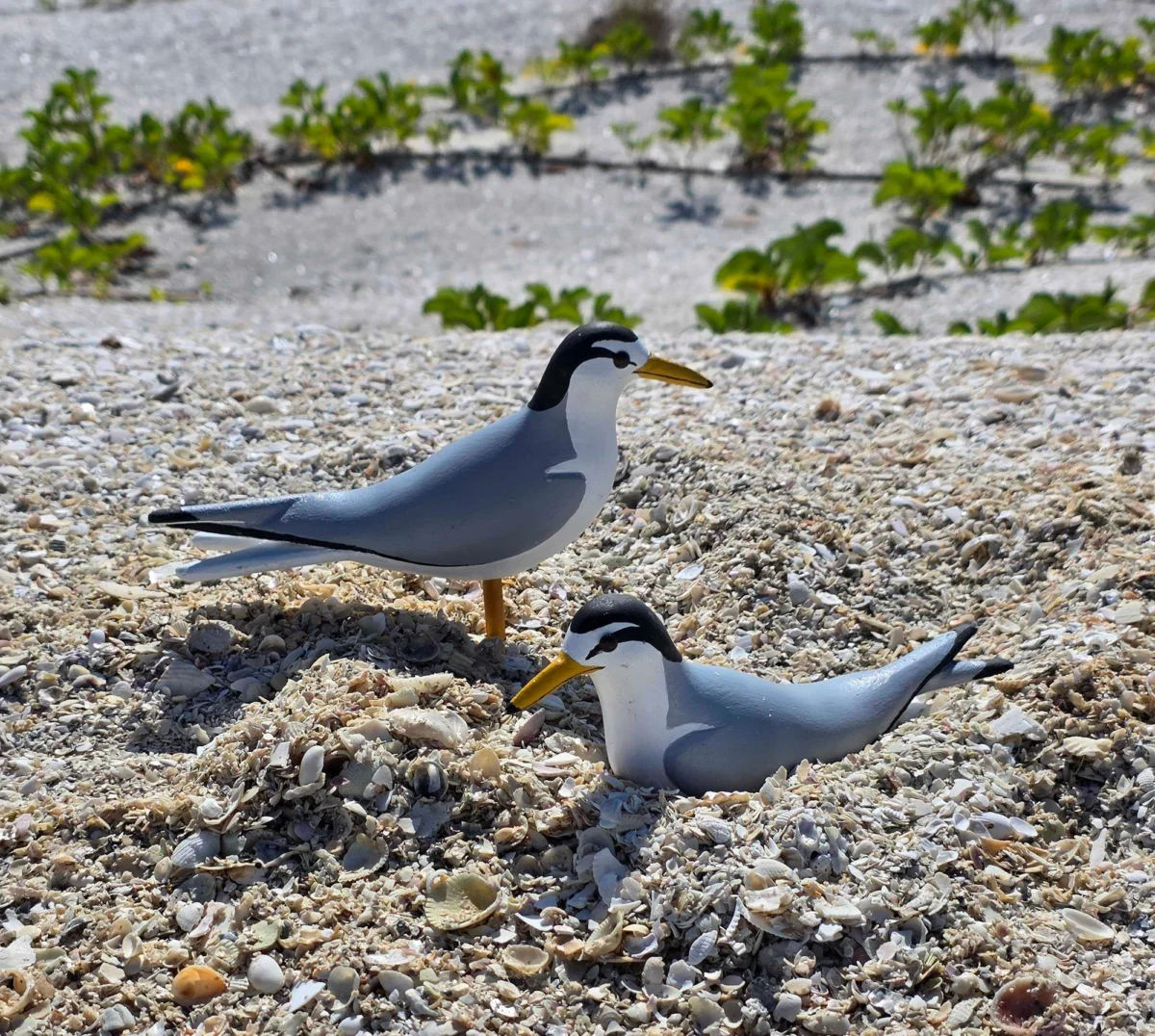
Least Terns, small, agile seabirds emblematic of healthy coastal ecosystems, are increasingly struggling to find suitable nesting grounds in Florida, a state renowned for its expansive beaches. These migratory birds, known for their distinctive calls and rapid flight, typically establish large, communal colonies directly on sandy shores, necessitating vast stretches of undisturbed, pristine habitat to successfully raise their young. The Sunshine State’s burgeoning development and intensifying human activity along its coastlines have dramatically reduced the availability of such vital nesting areas, placing significant pressure on Least Tern populations. In an innovative and deeply collaborative conservation effort, Audubon Florida has turned to a surprising, yet historically effective, tactic: deploying lifelike wooden decoys crafted by a dedicated artisan from New Hampshire to guide these vulnerable birds to protected, high-quality nesting sites.
The Plight of the Least Tern: A Vanishing Habitat Crisis
The Least Tern (Sternula antillarum) is the smallest tern species in North America, distinguished by its black cap, white forehead patch, and slender yellow-orange bill. It is a federally protected species, listed as threatened or endangered in several states, including Florida, where it faces numerous challenges. These challenges are multifaceted, stemming primarily from habitat loss, degradation, and disturbance. Coastal development, beachfront recreation, artificial lighting, and the impacts of climate change—including rising sea levels and more intense storm surges—all contribute to the scarcity of suitable nesting locations.
Least Terns are ground-nesting birds, laying their camouflaged eggs directly on the sand or shell fragments, making their nests highly vulnerable to predation, human disturbance, and tidal inundation. Their colonial nesting behavior, while offering some protection in numbers, also means that a single disturbance event can impact a large portion of a local population. The survival of their chicks, which are precocial and capable of moving shortly after hatching, is entirely dependent on the availability of safe, food-rich foraging grounds near their nesting sites. Audubon’s Southwest Florida Shorebird Program, recognizing the urgency of this situation, has been at the forefront of implementing creative solutions to safeguard these critical coastal residents.
The Science Behind the Decoys: Leveraging Avian Instincts
"We use Least Terns’ colonial-nesting behavior to our advantage by placing decoys that signal safe, suitable nesting areas as the birds arrive from their wintering areas and search for places to raise their young," explains Megan Hatten, project manager for Audubon’s Southwest Florida Shorebird Program. This strategy is rooted in ornithological understanding: many colonial-nesting bird species are drawn to areas where others of their kind are already present, interpreting these visual cues as indicators of safety, resource availability, and established breeding success. The presence of decoys can effectively create the illusion of a thriving colony, attracting prospecting birds to sites that have been carefully managed and protected by conservationists.
The use of decoys in bird conservation is not a novel concept. It has a proven track record, particularly in efforts to re-establish seabird colonies or to shift nesting populations away from threatened areas. A notable example, which directly inspired the current Florida initiative, involved the reestablishment of Tufted Puffins (Fratercula cirrhata) in Oregon. Following a significant decline in their numbers along the Pacific Northwest coast, conservationists successfully deployed puffin decoys and played recorded calls to lure the charismatic seabirds back to historic nesting islands, demonstrating the powerful influence of social attraction in avian ecology. This success story highlighted the potential for similar, carefully executed decoy programs to aid other vulnerable species, including the Least Tern.
A Craftsman’s Call to Conservation: Ed Brackett’s Journey
The critical need for authentic, high-quality decoys led Audubon Florida to an unexpected but invaluable partnership with Ed Brackett, a skilled woodcarver residing in New Hampshire. Brackett’s connection to bird conservation began serendipitously when he learned about the Tufted Puffin project through a National Audubon Society article. Intrigued by the application of his craft to such a vital cause, his subsequent online search revealed a similar effort underway for Least Terns in Florida. Without hesitation, he reached out to offer his services, bridging the geographical distance with a shared passion for wildlife.
Brackett’s journey into woodcarving is deeply personal and rooted in family tradition. "I’ve always been interested in art and crafts, especially woodcarving," Brackett recounts. His foundational art lessons in high school were later complemented by a pivotal bird decoy-carving class in the early 1980s, which he took alongside his father, a seasoned woodcarver himself. Life, as it often does, led Brackett down a different path for a time, as he dedicated years to an engineering career with a medical device manufacturer. However, the craft was never truly abandoned. In 2010, following the passing of his father, Brackett felt a profound call to return to his artistic roots. "He wanted me to take his tools and resume carving," Brackett says, and that is precisely what he did, honoring his father’s legacy by picking up where they had left off.
From Hobby to Habitat Hero: The Art of Accurate Replication
Brackett’s return to carving began with crafting various folk-art objects and replicating decoys from his father’s old books. This period of rediscovery eventually led him to seek further instruction, enrolling in another bird decoy carving class, this time under the tutelage of Bill Sarni of Hingham, Massachusetts. Sarni, a renowned decoy collector whose meticulously accurate work has frequently been published, instilled in Brackett an even greater appreciation for the precision and realism required in crafting effective decoys. One of Brackett’s early projects with Sarni was a copy of a Joe Lincoln Yellowlegs decoy. Joe Lincoln, a celebrated carver from the early 20th century, was widely acclaimed for his unique folk-art style that managed to capture the very essence and spirit of wild birds. This experience further refined Brackett’s technique and deepened his understanding of avian anatomy and behavior.
"I really enjoy doing it," Brackett affirms, underscoring the intrinsic satisfaction he derives from his craft. His creations extend beyond conservation projects; he also makes birds and other items for himself and his wife, who particularly cherishes an antique Common Loon decoy he crafted for her. He has also sold a select few pieces to friends, a testament to the appeal of his work. His dedication to accuracy is paramount, as the effectiveness of the decoys in attracting wild birds hinges on their convincing resemblance.
Audubon’s Strategic Approach in Florida and Brackett’s Expanding Contributions
Brackett’s contribution to Audubon Florida’s Least Tern project in 2026 saw him carve 15 meticulously detailed Least Tern decoys. These additions have been instrumental in the program’s efforts to establish new nesting sites. According to Megan Hatten, the decoys "are amazingly accurate and are working with limited success." This qualified success is a significant achievement in conservation, particularly given the myriad pressures Least Terns face. In late May, following the deployment of the decoys, Least Terns began nesting on Marco Island, not far from where Brackett’s wooden surrogates stood sentinel, offering a beacon of hope for the species.
This project with Audubon Florida is not Brackett’s first foray into conservation carving. He previously produced three American Oystercatcher decoys for the Oystercatcher Working Group’s banding program in Mexico, a critical effort to monitor and protect these striking shorebirds. He also crafted Piping Plover decoys for Mass Audubon, aiding in the conservation of another federally protected species that shares similar coastal habitat challenges with the Least Tern. These prior experiences honed his skills and reinforced his commitment to using his artistic talent for environmental good. Brackett remains open to similar projects, inviting conservation groups in need of decoys to contact him. While he generously donates his time, he notes that some projects may require material costs to be covered, a practical consideration for a craftsman whose work is both an art and a service.
The Art of Preservation: Crafting Decoys from Found Materials
Brackett’s creative process is a testament to sustainable craftsmanship. He frequently utilizes discarded wood scraps, often sourced from lumber yards, for the bodies of his bird decoys. American basswood is a preferred material due to its fine grain and ease of carving, but he also repurposes materials like torn-down fence posts, giving new life to otherwise discarded timber. Once the wood is shaped, he adds intricate details: tacks serve as lifelike eyes, dowels form slender legs, and specialized glues ensure the structural integrity of each piece. The carving complete, he applies acrylic paints with utmost care, striving for biological accuracy in every feather and hue. This meticulous attention to detail ensures that the decoys are not just works of art, but scientifically effective tools for conservation.
Having retired in 2020, Brackett now dedicates more time to his wood shop, which he affectionately refers to as his "sanctuary," located in his New Hampshire yard. His expertise is now also being shared with a new generation of enthusiasts at the Nantucket Historical Association, where he teaches wood projects. He harbors a hopeful ambition: to receive a new request for conservation decoys soon, specifically so he can enlist his students to assist with their production in his upcoming class this August. This would not only provide hands-on experience for his students but also further amplify his contribution to bird conservation.
Nurturing a Declining Craft: Inspiring Future Generations
The time invested in carving a bird decoy varies significantly. Brackett, with a chuckle, admits he "never keeps track," highlighting the immersive nature of his craft. The complexity and size of each decoy dictate the duration; a larger piece, such as a goose, can command a full week of dedicated work. Through his 16-hour class at the Nantucket Historical Association, students are guided through the process, culminating in the completion of their own decoys as they learn.
A demographic observation by Brackett sheds light on a broader trend: many of his students are retired, with some reaching their 80s. He notes the increasing difficulty in attracting younger individuals to the hobby, a challenge faced by many traditional crafts. While the New England Woodcarvers, a group he joined shortly after the pandemic, has seen its membership double, it still represents a fraction of its former numbers during its heyday. "I would encourage anyone interested in wood carving to join a group to get good instruction from fellow woodcarvers who can help you along," Brackett advises, emphasizing the importance of community and mentorship in preserving these valuable skills.
Broader Implications: Weaving Art, Community, and Conservation
The narrative of Ed Brackett and the Least Tern decoys extends beyond a simple story of craftsmanship and conservation; it underscores the profound interconnectedness of art, community, and ecological preservation. Bird decoy carving classes not only serve to keep a cherished traditional craft alive but also act as powerful conduits for bringing people together. Through the act of carving, individuals gain a deeper appreciation and understanding of birds—their anatomy, their behaviors, and their ecological significance. This intimate engagement is often the crucial first step toward inspiring tangible actions to protect them.
In this manner, the inherent charisma of avian species can be channeled to grow a broader network of conservation advocates. By engaging diverse constituencies, from seasoned artisans like Brackett to enthusiastic students, and across different generations, conservation efforts gain momentum and reach. The collaborative spirit demonstrated by Audubon Florida and Ed Brackett exemplifies how seemingly disparate fields can converge to address urgent environmental challenges. It highlights the power of individual skill, when aligned with a collective purpose, to create meaningful impact. Ultimately, such initiatives inspire new constituencies—and future generations—to act not only on behalf of birds but also for the health and sustainability of the shared ecosystems that support both wildlife and people. The wooden decoys, silent sentinels on Florida’s beaches, are more than just carved wood; they are symbols of hope, ingenuity, and the enduring human commitment to protecting the natural world.
