
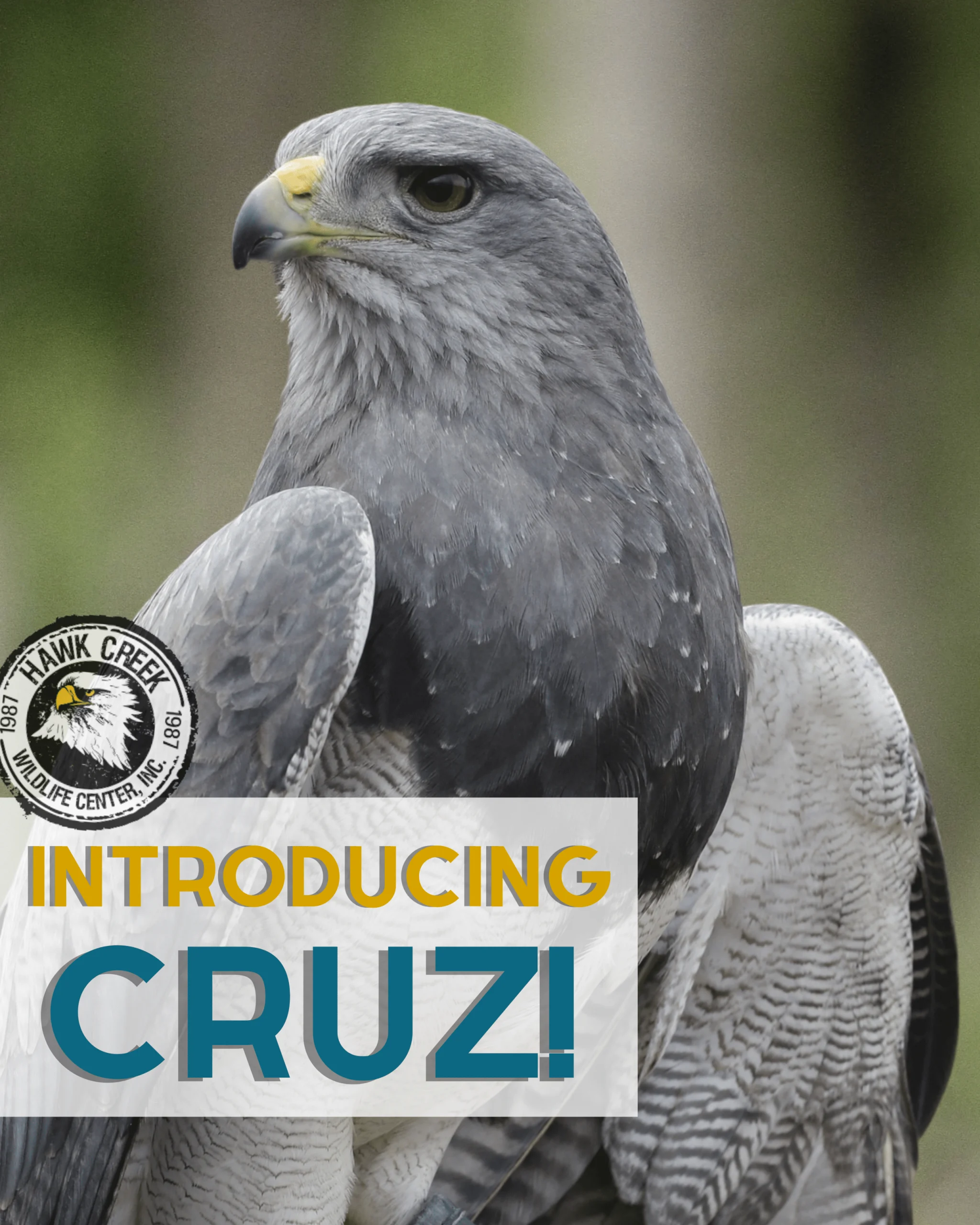
Hawk Creek, a renowned sanctuary dedicated to avian education and conservation, has officially introduced its newest resident, a striking Black-chested Buzzard-eagle, to the community. This majestic raptor, known by various monikers including the Chilean Blue Eagle, Patagonian Eagle, or Gray Buzzard Eagle, will be affectionately known at Hawk Creek as Cruz. The arrival of Cruz represents a significant opportunity for the public to engage with and learn about a species rarely encountered in North America, underscoring Hawk Creek’s commitment to showcasing global avian biodiversity and fostering a deeper understanding of critical conservation challenges.
A New Ambassador for South American Avian Life
The Black-chested Buzzard-eagle (Geranoaetus melanoleucus) is a formidable predator native to the expansive, high-altitude open country of South America, spanning from Venezuela and Colombia south to Tierra del Fuego. These birds are characterized by their impressive wingspan, keen eyesight, and agile flight, spending a considerable portion of their day soaring through the skies in search of sustenance. Their diet primarily consists of medium-sized vertebrates, with degus (a type of rodent endemic to South America) and invasive European hares being notable prey items. The introduction of Cruz to Hawk Creek provides a unique window into the ecological dynamics of South American grasslands and mountainous regions, highlighting the vital role these apex predators play in maintaining healthy ecosystems.
This remarkable acquisition was facilitated through a strategic partnership between Hawk Creek and leading eagle conservationists at Sia in Oklahoma. Sia, which stands for the Comanche Ethno-Ornithological Initiative, is a distinguished organization dedicated to the study, preservation, and cultural understanding of eagles. This collaboration not only enables Hawk Creek to host and exhibit exotic eagle species but also reinforces its dedication to supporting global eagle conservation initiatives. Through such partnerships, Hawk Creek aims to bridge geographical divides, bringing rare and understudied avian ambassadors to audiences who might otherwise never have the chance to observe them firsthand.
Cruz‘s arrival follows the successful introduction of other rare eagle species at Hawk Creek, including Jara, a Short-toed Snake Eagle (Circaetus gallicus), and Onyx, a Verreaux’s Eagle (Aquila verreauxii). These introductions have consistently drawn significant public interest, demonstrating a growing appetite for learning about the world’s diverse raptor populations and the threats they face. Each new resident serves as a powerful educational tool, sparking curiosity and encouraging dialogue about the importance of biodiversity and habitat preservation.
The Significance of the Sia Partnership and Wild Earth Event
The partnership with Sia is more than just an exchange of avian ambassadors; it is a testament to a shared vision for conservation and education. Sia’s expertise in ethno-ornithology, the study of the relationship between people and birds, offers a unique perspective on avian conservation that integrates cultural understanding with scientific research. This holistic approach is crucial for developing effective and sustainable conservation strategies, particularly for species that are not widely known or understood.
A pivotal figure in this collaboration is William "Two-Raven" Voelker, also known as Waha Thuweeka, a globally recognized eagle conservationist and a driving force behind Sia. Voelker’s extensive experience and profound knowledge of eagle behavior, ecology, and conservation challenges make him an invaluable asset to this initiative. His involvement signifies a deep commitment to educating the public and advocating for the protection of raptor populations worldwide.
To further amplify the educational impact of this partnership, Hawk Creek is hosting a special event, "Wild Earth," on May 13th. This event will feature Waha Thuweeka as the distinguished guest speaker. Attendees will have the unparalleled opportunity to hear directly from an expert on the intricacies of eagle conservation, gaining insights into the specific challenges faced by species like the Black-chested Buzzard-eagle, as well as broader threats impacting raptors across the globe. The event is expected to delve into topics such as habitat loss, the impact of climate change, and the role of community engagement in conservation efforts. This gathering aims to not only inform but also to inspire action, empowering individuals to become advocates for avian conservation within their own communities.
Supporting Data and Context for Black-chested Buzzard-eagles
The Black-chested Buzzard-eagle, Geranoaetus melanoleucus, is a large bird of prey with a significant ecological footprint. Adults typically measure between 60 to 75 centimeters (24 to 30 inches) in length with a wingspan ranging from 145 to 180 centimeters (57 to 71 inches). Their plumage is predominantly dark, with the characteristic black chest that gives them their common name, contrasting with lighter underparts and grayish upperparts. Males and females exhibit slight sexual dimorphism, with females generally being larger.
Their habitat preference for open areas, including grasslands, savannas, and mountainous regions up to 2,500 meters (approximately 8,200 feet) in elevation, makes them susceptible to habitat degradation and fragmentation. As these environments are often utilized for agriculture and livestock grazing, human encroachment can lead to reduced prey availability and increased conflicts. The inclusion of European hares in their diet is particularly noteworthy, as these are an introduced species in many parts of South America, and their presence can sometimes indicate ecological disruption. The Buzzard-eagle’s predatory role in controlling hare populations can, in some instances, be seen as a natural mechanism to mitigate the impact of invasive species.
While specific population data for Geranoaetus melanoleucus can be challenging to ascertain across its vast range, conservation assessments generally indicate stable or slightly declining populations in certain regions. Threats include direct persecution by humans, electrocution from power lines, and the aforementioned habitat loss. International conservation organizations, such as BirdLife International, categorize the species as "Least Concern" globally, but this broad classification can mask localized vulnerabilities. Partnerships like the one between Hawk Creek and Sia are therefore critical for raising awareness and driving targeted conservation efforts for species that may not be facing immediate extinction but require ongoing monitoring and protection.
Broader Implications for Conservation and Education
The introduction of Cruz and the collaboration with Sia have far-reaching implications for both avian conservation and public education. By bringing a species like the Black-chested Buzzard-eagle into a more accessible setting, Hawk Creek is fostering a sense of connection and responsibility among its visitors. This direct interaction can transform abstract conservation issues into tangible realities, inspiring a deeper commitment to protecting wildlife and their habitats.
The success of Hawk Creek’s model, which leverages partnerships to showcase rare species and engage expert educators, provides a blueprint for other zoological and conservation organizations. It demonstrates that by collaborating with specialized groups and focusing on underrepresented species, institutions can significantly enhance their educational impact and contribute meaningfully to global conservation efforts. The emphasis on ethno-ornithology, championed by Sia, also highlights the importance of integrating cultural perspectives into conservation, recognizing that local communities are often the most effective stewards of their natural heritage.
The "Wild Earth" event on May 13th is more than just a lecture; it is an opportunity for community engagement and knowledge dissemination. By providing a platform for experts like Waha Thuweeka to share their insights, Hawk Creek is facilitating a critical exchange of information that can empower attendees with the knowledge and motivation to support conservation initiatives. The event’s focus on global eagle conservation underscores the interconnectedness of ecosystems and the need for international cooperation in addressing environmental challenges.
A Look Ahead: Fostering Future Conservationists
The arrival of Cruz at Hawk Creek is not merely the addition of a new animal to an exhibit; it is the beginning of a new chapter in avian education and conservation advocacy. As visitors observe Cruz soaring or perched, they will be reminded of the vast and diverse world of raptors and the critical need to protect them. The ongoing partnership with Sia and the educational programming surrounding Cruz promise to cultivate a new generation of informed citizens and passionate conservationists, ensuring a brighter future for eagles and other wildlife across the globe. The ability to see and learn about such magnificent creatures up close, guided by the expertise of organizations like Sia, creates an indelible impression that can inspire lifelong commitment to environmental stewardship. This initiative at Hawk Creek serves as a powerful reminder that education, partnership, and direct engagement are fundamental to the success of any conservation endeavor.
