
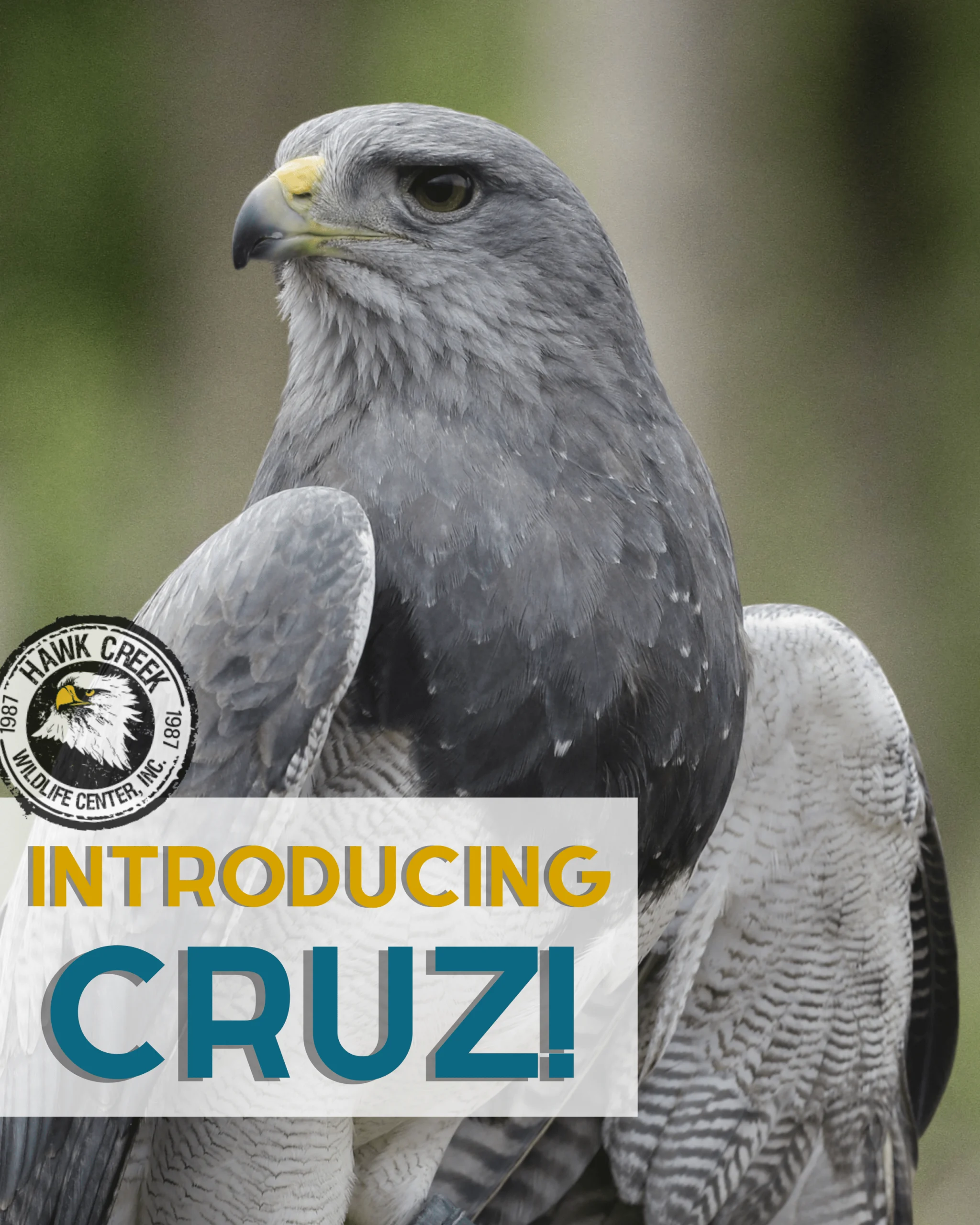
Hawk Creek is thrilled to announce the arrival of a magnificent new resident, a species recognized by a variety of names including the Black-chested Buzzard-eagle, Chilean Blue Eagle, Patagonian Eagle, or Gray Buzzard Eagle. Here at Hawk Creek, this impressive raptor will be affectionately known as Cruz. This introduction marks a significant step in Hawk Creek’s ongoing commitment to educating the public about understudied avian species and fostering a deeper appreciation for global biodiversity.
A Glimpse into the Life of Cruz and His Native Habitat
Cruz, a Black-chested Buzzard-eagle, is a striking bird of prey native to the elevated, open terrains of South America. These majestic raptors are characterized by their impressive wingspans and keen hunting prowess, spending a considerable portion of their day soaring through the skies in search of sustenance. Their diet primarily consists of small mammals, such as degus, and notably, invasive European hares, playing a crucial role in the ecological balance of their native environments.
The Black-chested Buzzard-eagle (scientific name Geranoaetus melanoleucus) is a large bird of prey found across a wide range of South America, from Venezuela and Colombia south to Tierra del Fuego. They typically inhabit open country, including grasslands, savannas, shrublands, and mountainous regions, often at elevations between 1,000 and 3,000 meters (approximately 3,300 to 9,800 feet). Their impressive size, with adults reaching lengths of 70-90 cm (28-35 inches) and wingspans of up to 2 meters (6.5 feet), makes them formidable predators. Their plumage is generally dark above with a distinctive black “vest” on the chest, contrasting with lighter underparts.
The species’ preference for open areas allows them to effectively utilize their keen eyesight to spot prey from high altitudes. Their hunting strategy often involves soaring and gliding, conserving energy while scanning the landscape. The inclusion of invasive European hares in their diet highlights the adaptability of these eagles and their potential role in controlling non-native populations, a phenomenon observed in various ecosystems globally.
A Partnership for Global Avian Conservation
The acquisition of Cruz and the opportunity to showcase this remarkable species to the public are the direct results of a valuable partnership between Hawk Creek and leading eagle conservationists at Sia in Oklahoma. Sia, an organization dedicated to the preservation and understanding of raptors, has been instrumental in facilitating this exchange, underscoring a shared vision for global eagle conservation.
This collaboration extends beyond the introduction of new species to the Hawk Creek facility. Through this ongoing partnership, Hawk Creek actively supports various eagle conservation programs operating on an international scale. This involvement allows Hawk Creek to contribute to vital research, habitat preservation, and anti-poaching initiatives that are critical for the survival of eagle populations worldwide. Furthermore, it provides a unique avenue for the public to observe and learn about eagle species that are rarely encountered in the United States, fostering a broader understanding of their ecological significance and conservation needs.
This partnership exemplifies a growing trend in zoological institutions and conservation organizations working together to achieve common goals. By pooling resources, expertise, and access to species, these collaborations amplify their impact and reach. The ability to house and exhibit species like Cruz allows educational institutions to provide tangible learning experiences that go beyond textbook descriptions and documentaries.
Expanding the Raptor Exhibit: A History of Notable Arrivals
Cruz‘s arrival is not an isolated event but rather a continuation of Hawk Creek’s dedication to presenting a diverse array of raptorial birds. The facility has previously welcomed other fascinating species through its partnership with Sia, significantly enriching its educational offerings. Among these notable arrivals are Jara, a Short-toed Snake Eagle (Circaetus gallicus), and Onyx, a Verreaux’s Eagle (Aquila verreauxii).
The Short-toed Snake Eagle, as its name suggests, is a specialized predator with a diet primarily composed of reptiles, particularly snakes. Found across parts of Europe, Asia, and Africa, Jara‘s presence at Hawk Creek offers a unique opportunity for visitors to learn about the intricate predator-prey relationships within different ecosystems. These eagles are known for their distinctive hunting technique, involving slow, deliberate flight at low altitudes to detect their elusive prey.
Verreaux’s Eagle, often referred to as the Black Eagle, is one of the largest and most powerful eagles in the world, renowned for its spectacular aerial acrobatics and its habitat in rocky, mountainous regions of Africa. Onyx‘s presence highlights the diversity of large raptors and their adaptations to challenging environments. These eagles are apex predators, playing a critical role in regulating populations of their prey, which often include rock hyraxes and various bird species.
The inclusion of these species demonstrates Hawk Creek’s commitment to showcasing the vast spectrum of raptor adaptations, hunting strategies, and ecological roles across different continents. Each new arrival is meticulously managed to ensure the highest standards of animal welfare and to provide an optimal learning environment for both the animals and the visiting public.
Wild Earth Event: A Deep Dive into Eagle Conservation
To further illuminate the importance of eagle conservation and to celebrate the arrival of Cruz, Hawk Creek is hosting a special event titled "Wild Earth." This event will feature a distinguished guest speaker, Global Eagle Conservationist Waha Thuweeka, widely known by his Comanche name, William “Two-Raven” Voelker. Mr. Voelker is a pivotal figure within Sia, the Comanche Ethno-Ornithological Initiative, an organization dedicated to the intersection of indigenous knowledge and modern ornithological research.
The Wild Earth event, scheduled for May 13th, promises an in-depth exploration of the challenges and triumphs in eagle conservation efforts worldwide. Mr. Voelker’s expertise, rooted in both scientific understanding and indigenous perspectives, is expected to offer a unique and comprehensive overview of raptor conservation. Attendees will gain insights into the critical factors affecting eagle populations, including habitat loss, climate change, and human-wildlife conflict. Furthermore, the event will likely touch upon the significance of cultural connections to birds of prey and the importance of traditional ecological knowledge in conservation strategies.
The Comanche Ethno-Ornithological Initiative, under Mr. Voelker’s guidance, aims to foster a deeper understanding and respect for birds, particularly raptors, within indigenous communities and beyond. Their work often involves community-based conservation projects, educational outreach, and the documentation of traditional ecological knowledge related to birds. The initiative’s focus on ethno-ornithology signifies a holistic approach to conservation, recognizing that human cultures and the natural world are inextricably linked.
The choice of a date for the Wild Earth event, May 13th, falls within the broader context of spring and early summer, a period often associated with nesting and fledging seasons for many avian species. This timing can lend a particular poignancy to discussions about conservation, as it highlights the ongoing cycles of life and the importance of ensuring healthy populations for future generations.
Supporting Data and Broader Implications
The introduction of species like Cruz and the organization of events like "Wild Earth" carry significant implications for public awareness and conservation efforts. Globally, eagle populations face diverse threats. For instance, the International Union for Conservation of Nature (IUCN) Red List classifies several eagle species as threatened or endangered. Habitat fragmentation due to agricultural expansion, deforestation, and urbanization is a primary driver of population decline for many raptors. Pollution, including pesticide use and lead poisoning from ammunition in hunting grounds, also poses a severe risk. Climate change exacerbates these issues by altering habitats and prey availability.
The presence of invasive species, such as the European hare mentioned in relation to Cruz‘s diet, presents a complex ecological dynamic. While eagles can play a role in controlling invasive populations, the introduction of any non-native species can disrupt existing food webs and ecosystem functions. Understanding these interactions is crucial for effective conservation management.
The partnership between Hawk Creek and Sia, exemplified by the arrival of Cruz, represents a model for how zoological institutions can contribute to global conservation. By providing a platform for education and engagement, they can inspire action and support for conservation initiatives worldwide. The number of visitors to facilities like Hawk Creek can translate into significant public outreach, reaching diverse demographics and fostering a sense of stewardship.
The economic impact of such initiatives, while not always quantifiable in immediate terms, contributes to a broader appreciation for natural heritage. Ecotourism and educational visits to wildlife centers generate revenue that can be reinvested in conservation. Moreover, the educational value of encountering these magnificent birds firsthand can inspire future generations of scientists, conservationists, and engaged citizens.
The educational value of showcasing understudied species is particularly noteworthy. Often, public awareness and conservation funding are disproportionately focused on charismatic megafauna. However, the intricate ecological roles played by species like the Black-chested Buzzard-eagle are vital for maintaining healthy ecosystems. By bringing these less familiar birds into public view, Hawk Creek and its partners are broadening the scope of conservation discourse and highlighting the interconnectedness of all species.
Future Outlook and Conservation Call to Action
The arrival of Cruz at Hawk Creek is more than just the addition of a new animal to an exhibit; it is a testament to the power of collaborative conservation and a catalyst for public engagement. The ongoing partnership with Sia and the upcoming Wild Earth event signify a proactive approach to environmental education.
As visitors learn about Cruz, Jara, and Onyx, they are invited to consider the broader implications of their presence and the conservation challenges faced by their wild counterparts. The knowledge gained from Mr. Voelker’s presentation on May 13th will undoubtedly equip attendees with a deeper understanding of how they can contribute to conservation efforts, whether through supporting relevant organizations, making sustainable choices in their daily lives, or advocating for environmental protection policies.
The long-term success of species conservation relies on sustained public interest and support. By providing opportunities for close observation and education, institutions like Hawk Creek play an indispensable role in cultivating this vital connection between humans and the natural world. The story of Cruz is just one chapter in the ongoing narrative of global biodiversity, a narrative that requires the active participation of communities and organizations worldwide to ensure a vibrant and sustainable future for all species.
