
The 2026 Manitoba Owl Expedition, a premier birding and conservation event, concluded on March 18 after a five-day intensive survey of the province’s diverse avian habitats, successfully documenting a wide array of rare and migratory species. This annual gathering, which draws enthusiasts and conservationists to the Canadian prairies and boreal transitions, serves as a critical observation window into the wintering patterns of North American raptors. Amidst a landscape characterized by sub-zero temperatures and vast snow-covered expanses, the 2026 cohort navigated the Red River Valley and the boreal fringes east of Winnipeg, recording significant sightings of Snowy Owls, Northern Hawk Owls, and the elusive Great Grey Owl. Beyond the pursuit of visual documentation, the expedition integrated educational components led by renowned experts, highlighting the ongoing challenges facing owl populations in the face of shifting climatic conditions and habitat loss.

Strategic Orientation and Conservation Advocacy
The expedition commenced on the evening of March 14 in Winnipeg, serving as a tactical briefing for the participants. The initial phase of the tour was designed to foster a cohesive group dynamic and establish the scientific objectives for the following days. A central highlight of the opening session was a keynote presentation by Dr. Jim Duncan, a leading authority on Great Grey Owl biology. Dr. Duncan was accompanied by Oska, a captive-bred Great Grey Owl used for educational outreach.
The presentation provided a deep dive into the conservation status of Strix nebulosa, the provincial bird of Manitoba. Dr. Duncan outlined the results of long-term nesting platform programs and the impact of rodent population cycles on owl reproductive success. For the participants, this session contextualized the visual sightings to come, transforming a birding tour into a citizen-science initiative. The presence of Oska allowed for a rare, close-quarter examination of the physiological adaptations—such as the massive facial disk used for sound amplification—that make these owls the apex predators of the boreal forest.

The Prairie Circuit: Snowy Owls of the Red River Valley
On March 15, the second day of the expedition, the focus shifted to the agricultural landscapes southwest of Winnipeg. This region, characterized by its flat topography and high visibility, is a primary wintering ground for Snowy Owls (Bubo scandiacus) migrating south from the Arctic tundra. The group’s trajectory took them through Oak Bluff and eastward toward Fannystelle, navigating a grid of gravel roads that bisect the frozen fields.
The first major sighting occurred just outside Fannystelle, where a Snowy Owl was observed perched on a low rise, a typical hunting posture for the species. As the group progressed toward Sanford and Domain, they recorded a total of three Snowy Owls. One individual was noted for its striking, nearly pure-white plumage, indicating an older male. In addition to the raptors, the prairie roads were teeming with Horned Larks and a single Snow Bunting, species that thrive in the wind-swept, open environments of the Manitoba winter.

The afternoon itinerary focused on the transition between urban and natural spaces within the city limits. A visit to FortWhyte Alive to inspect a Bald Eagle nest provided insight into the early stages of the raptor breeding season, although the nest was not yet active. In St. Vital Park, the group encountered a Pileated Woodpecker, North America’s largest woodpecker species, whose presence indicates a healthy stand of mature timber.
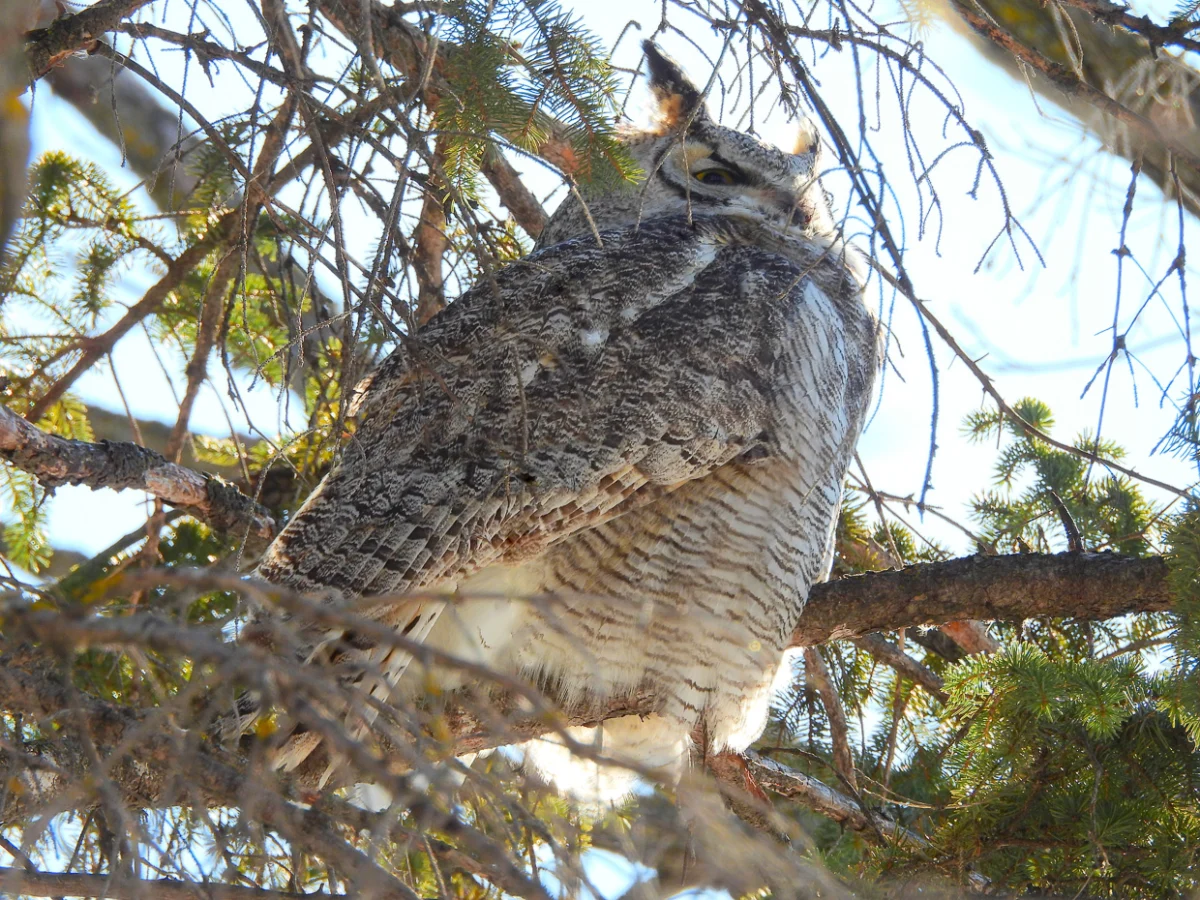
The day concluded with high-priority sightings in the northern reaches of the city. At Bunn’s Creek, a nesting pair of Great Horned Owls was observed. While the female remained stationary on the nest to protect her brood from the biting cold, the male was positioned nearby, maintaining a vigilant watch. The final success of the day occurred in Assiniboine Park, where a Northern Saw-whet Owl—a diminutive and highly nocturnal species—was discovered roosting in a dense conifer. The ability to locate such a well-camouflaged bird underscored the expertise of the expedition’s guides.

Boreal Incursion: The Northern Hawk Owl
Day three, March 16, saw the expedition head northeast toward the boreal forest transition zone along Highway 317. This habitat is significantly different from the open prairies, offering a higher density of coniferous and deciduous trees suitable for different owl species. The primary target for the day was the Northern Hawk Owl (Surnia ulula), a diurnal hunter known for its bold behavior and hawk-like profile.
The group successfully located a cooperative Northern Hawk Owl perched at the apex of a tree, providing extended viewing opportunities. Unlike many other owls, the Northern Hawk Owl relies heavily on visual cues during the day, making it a favorite for wildlife photographers. Following this sighting, the expedition moved toward Lac du Bonnet and Henry Bellin Road.

In this more forested region, the group visited a series of bird feeders that served as a microcosm of boreal avian life. Observations included Evening Grosbeaks, Black-capped Chickadees, Common Redpolls, and Blue Jays. A nearby sighting of Sharp-tailed Grouse added a gallinaceous component to the day’s tally. Despite the extreme cold, which necessitated frequent breaks, the group’s persistence was rewarded with a second encounter with the Northern Hawk Owl before returning to Winnipeg.
Adaptive Birding and the Impact of Weather
On March 17, the fourth day, the expedition’s leadership demonstrated tactical flexibility by adjusting the itinerary in response to local weather reports. The group elected to remain closer to the city and the southern agricultural zones to maximize sighting efficiency. This decision proved fruitful, as the region between La Salle and Rosenort yielded an additional six Snowy Owls.

The density of Snowy Owls in this corridor provided a unique opportunity for comparative observation. Participants were able to note the varying degrees of barring on the feathers, which helps in identifying the age and sex of the birds. In Rosenort, a covey of Grey Partridge—an introduced species that has become a staple of the Manitoba winter landscape—offered prolonged viewing at close range.
The afternoon was spent at Oak Hammock Marsh, a RAMSAR-recognized wetland of international importance. Although the marsh was largely frozen, the interpretive center provided a critical educational backdrop, detailing the marsh’s role as a major stopover on the Mississippi Flyway. Despite a burgeoning snowstorm and high winds, the group observed Redpolls and Red-winged Blackbirds at the marsh’s feeders. The day concluded with a celebratory dinner, where the group reflected on the cumulative data collected and the biological diversity witnessed over the preceding four days.

Data Integration and Regional Significance
The 2026 expedition concluded on March 18, with participants departing for their respective home regions. The data collected during the tour was formally uploaded to eBird, a global citizen-science database managed by the Cornell Lab of Ornithology. This contribution is vital for researchers tracking the "irruption" patterns of owls—years when high numbers of northern birds move south due to food shortages in their typical ranges.
Manitoba occupies a unique geographical position at the intersection of the prairie, boreal forest, and Arctic tundra biomes. This makes it one of the few places in the world where one can observe such a high concentration of owl species in a single week. The 2026 tour documented:

- Snowy Owls: Multiple sightings across the Red River Valley.
- Great Horned Owls: Active nesting pairs in urban riparian zones.
- Northern Hawk Owls: Successful documentation in the boreal transition.
- Northern Saw-whet Owls: Roosting behavior in urban parks.
- Great Grey Owls: Educational and conservation-focused interaction.
Broader Implications for Avian Conservation
The success of the 2026 Manitoba Owl Expedition highlights the growing importance of birding tourism as a tool for conservation. By bringing economic value to local communities—evidenced by the group’s stays in Winnipeg and Lac du Bonnet—the tour incentivizes the preservation of critical habitats like Oak Hammock Marsh and the remaining stands of mature forest in urban areas.
Furthermore, the expedition underscores the impact of climate change on wintering birds. The extreme weather conditions experienced during the tour—ranging from sunny prairie days to blinding snow at the marsh—are a reminder of the harsh realities these species face. Fluctuations in snow depth can impact an owl’s ability to hunt voles and other small mammals, while unseasonable thaws can lead to icing that further complicates survival.

The collaborative nature of the event, involving professional biologists like Jim Duncan and dedicated amateur observers, ensures that the knowledge gained is disseminated widely. As habitat fragmentation continues to threaten the corridors between the Arctic and the southern prairies, the documentation provided by such expeditions becomes an essential baseline for future environmental policy and land management in Manitoba.
The 2026 tour stands as a testament to the resilience of both the wildlife and the observers who seek to understand them. Through a combination of scientific rigor, expert guidance, and a commitment to conservation, the expedition has once again solidified Manitoba’s reputation as a world-class destination for avian study and a stronghold for the majestic owls of the north.
