
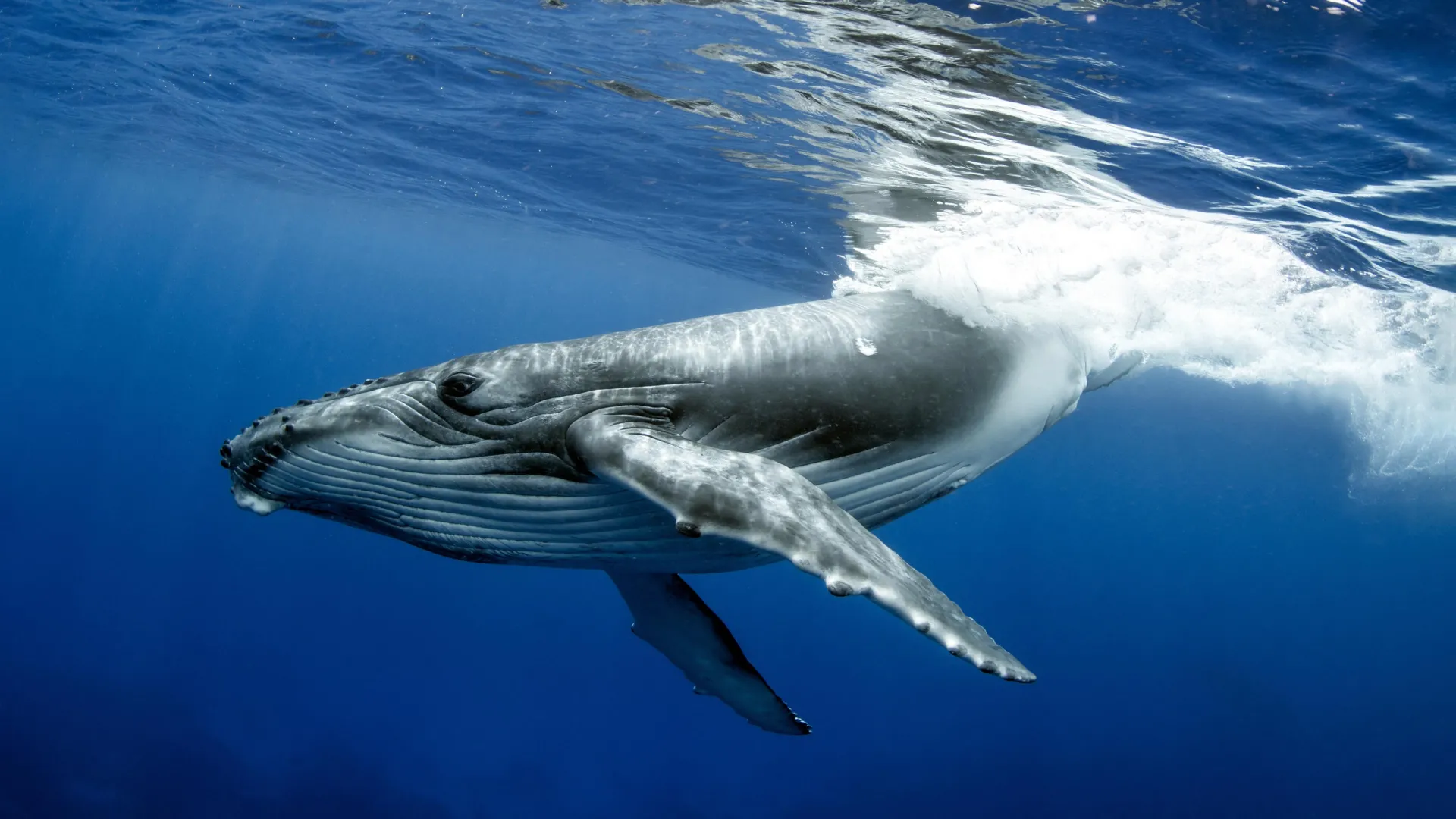
In a landmark discovery reshaping our understanding of marine megafauna movements, scientists have documented an extraordinary feat of humpback whale migration, confirming for the first time that individuals traveled between distant breeding grounds in eastern Australia and Brazil. This incredible journey spanned more than 14,000 kilometers of open ocean, establishing a new record for the longest confirmed distance ever recorded between sightings of individual humpback whales anywhere in the world. The findings underscore the remarkable navigational capabilities and resilience of these magnificent creatures, while also highlighting the critical role of long-term research and international collaboration in unraveling the mysteries of the deep sea.
The revelation stems from decades of meticulous photo-identification efforts, where researchers compare unique markings on whale tails, known as flukes, to track individuals across vast oceanic expanses. This arduous yet rewarding process has connected observations made by different people, in different eras, and across two distinct oceans—the South Pacific and the South Atlantic—to piece together a truly global odyssey.
Unraveling the Mystery: The Humpback’s Global Roam
Humpback whales (Megaptera novaeangliae) are renowned for their epic annual migrations, typically traveling thousands of kilometers from nutrient-rich polar feeding grounds to warmer, tropical or subtropical waters for breeding and calving. The eastern Australian humpback population, for instance, migrates along the country’s eastern coastline, utilizing breeding grounds off Queensland, while the Brazilian population frequents the Abrolhos Bank off the coast of Bahia. These populations are generally considered distinct, adhering to their respective ocean basins. The idea of an individual traversing the entire breadth of the Southern Ocean to switch from one major ocean basin’s breeding grounds to another has long been hypothesized but lacked empirical evidence until now.
This study provides the first definitive proof of such trans-oceanic movement, challenging previous assumptions about population boundaries and migratory fidelity. It suggests a fluidity in migration patterns that, while rare, could have profound implications for genetic exchange and population dynamics across species-wide scales.
Two Whales, Two Record-Breaking Journeys
The groundbreaking discovery hinges on the documented travels of two specific humpback whales, each contributing to the new understanding of their species’ potential for extreme mobility.
The first whale, identified through its unique fluke patterns, was initially photographed in Hervey Bay, Queensland, Australia, in 2007. Hervey Bay is a well-known whale watching destination and a crucial aggregation point for eastern Australian humpbacks. The same individual was sighted again in the same area six years later, in 2013, indicating its continued use of the Australian breeding grounds. What makes its story extraordinary is its subsequent appearance near São Paulo, Brazil, in 2019. This sighting, a full twelve years after its initial documentation in Australia, confirmed a minimum straight-line distance of approximately 14,200 kilometers between its last Australian sighting and its Brazilian re-sighting. To put this into perspective, this distance is roughly equivalent to traveling from Sydney, Australia, to London, United Kingdom. Scientists acknowledge that the whale’s actual travel path would have been considerably longer, as only the start and end points of its remarkable journey were recorded, with the precise migratory route remaining an enigma.
Even more remarkable was the journey of the second whale. This individual was first photographed in 2003 at Brazil’s Abrolhos Bank, a critical nursery area for humpback whales off the coast of Bahia. At the time of its initial sighting, it was observed swimming within a lively group of nine adult whales, suggesting active participation in the Brazilian breeding ecosystem. Twenty-two years later, in a sighting recorded in September 2025, the same whale was documented alone in Hervey Bay, Australia. This unprecedented trans-oceanic crossing established a new record for the longest known movement of an individual humpback whale, spanning an astounding minimum straight-line distance of 15,100 kilometers. The sheer passage of time between sightings, combined with the immense distance and the complete change of ocean basin, underscores the extraordinary nature of this individual’s journey.
The Power of Decades-Long Research and Citizen Science
These incredible findings were not the result of a single expedition but rather the culmination of decades of dedicated research and a testament to the power of international collaboration and citizen science. The study drew upon an extensive dataset comprising 19,283 high-quality fluke photographs collected between 1984 and 2025. These images originated from diverse sources across eastern Australia and Latin America, including both professional marine researchers and an invaluable network of citizen scientists.
The methodology behind identifying individual whales relies on the fact that each humpback possesses unique patterns of pigmentation, scars, and nicks on the underside of its tail fluke—much like a human fingerprint. These distinct markings allow scientists to identify and track individual whales over their lifetime, sometimes across decades. Researchers utilized the global whale tracking platform Happywhale, which serves as a central repository for these photographic submissions. This platform employs sophisticated automated image recognition software to compare tens of thousands of photographs, flagging potential matches. Following this initial automated screening, human experts meticulously reviewed every possible match to confirm the identities of the whales, ensuring the integrity and accuracy of the data.
Stephanie Stack, a PhD Candidate at Griffith University and a co-author of the study, emphasized the foundational importance of sustained effort: "Discoveries like this are only possible because of investment into long-term multi-decadal research programs and international collaboration. These whales were photographed decades apart, by different people, in opposite parts of the world, separated by two different oceans, and yet we can connect their journey." Her statement highlights the serendipitous yet scientifically rigorous nature of the discovery, where individual observations, disparate in time and location, converged to reveal a larger narrative.
Dr. Cristina Castro, lead researcher from the Pacific Whale Foundation, further elaborated on the crucial role of public involvement: "This kind of research highlights the value of citizen science. Every photo contributes to our understanding of whale biology and, in this case, helped uncover one of the most extreme movements ever recorded." Citizen science initiatives, by engaging the public in data collection, dramatically expand the geographical and temporal reach of scientific studies, enabling researchers to amass datasets of a scale that would be otherwise unattainable. The Happywhale platform exemplifies this synergy, transforming casual whale watchers into active contributors to global marine science.
Rarity and Significance: Why These Crossings Matter
Despite the stunning distances involved, researchers stressed the extreme rarity of these trans-oceanic migrations. Across more than four decades of data encompassing nearly 20,000 identified humpback whales, only these two individuals were found to have traversed the vast expanse between the two breeding regions. This represents a minuscule fraction—just 0.01 percent—of the total whales included in the records. This extreme infrequency suggests that such journeys are exceptional events rather than regular migratory patterns for the vast majority of humpbacks.
However, scientists contend that even these rare movements hold significant long-term implications for the health and resilience of global humpback whale populations. As Ms. Stack explained, "Despite their rarity, these exchanges matter for the long-term health of whale populations. Occasional individuals moving between distant breeding grounds can help maintain genetic diversity across populations and may even carry new song styles from one region to another—humpback whale songs are known to spread culturally across ocean basins, much like music trends in human populations."
Genetic Diversity and Cultural Exchange
The concept of genetic diversity is fundamental to species survival. A diverse gene pool provides a population with greater resilience against diseases, environmental changes, and other stressors. Should a population become too isolated and inbred, it becomes more vulnerable. The occasional influx of new genetic material from a distant population, even if from only a few individuals, can replenish and diversify the gene pool, bolstering the long-term viability of both populations involved.
Beyond genetics, humpback whales are celebrated for their complex and evolving songs. These intricate vocalizations are primarily produced by males and are believed to play a role in courtship and communication. What is particularly fascinating is that these songs are not static; they evolve over time, with new "themes" and "phrases" emerging and spreading culturally across populations. The finding that whales can traverse entire ocean basins provides a concrete mechanism for the cultural transmission of these songs, much like musical genres or fashion trends disseminate across human societies. A whale learning a new song in one breeding ground could potentially introduce it to a completely different population thousands of kilometers away, fostering a remarkable form of cultural exchange across oceanic divides.
The Southern Ocean Exchange Hypothesis and Climate Change
The findings lend crucial support to what researchers term the "Southern Ocean Exchange" hypothesis. This idea posits that humpback whales from different breeding populations, such as those from eastern Australia and Brazil, may occasionally meet and mix in shared Antarctic feeding areas. After their feeding season, some whales might then embark on a different migration route than their original one, eventually settling in a completely new breeding region. The Southern Ocean, with its rich krill grounds, serves as a crucial summer feeding ground for multiple humpback populations from different parts of the world. This mixing pot provides a plausible scenario for individuals to become disoriented or simply choose a different path back to breeding grounds, leading to these extraordinary trans-oceanic journeys.
Furthermore, researchers believe that climate change could potentially make these rare crossings more common in the future. The Antarctic environment is undergoing rapid transformations, including shifts in sea ice distribution and changes in the availability and distribution of Antarctic krill—the whales’ primary food source. As their vital feeding grounds are altered, whales may be forced to adapt their migration patterns, potentially exploring new routes or even entirely new breeding regions. An increase in such extreme movements could signify a broader ecological response to a changing climate, highlighting the interconnectedness of global ecosystems and the adaptive capacity of marine life. While this could potentially increase genetic exchange, it also introduces uncertainties and potential energetic costs for the whales involved.
Conservation Implications and Future Research
This study offers profound insights for conservation efforts globally. As humpback whale populations continue their recovery from the devastating impact of commercial whaling, understanding the dynamics of population connectivity becomes increasingly vital. If populations are not as isolated as previously thought, conservation strategies need to account for this broader interconnectedness. Management decisions in one region could, indirectly, affect populations thousands of kilometers away. The study underscores the need for continued international collaboration in marine research and conservation, recognizing that the ocean’s boundaries are often invisible to its inhabitants.
The research, "First evidence of bidirectional exchange between distant humpback whale breeding populations in eastern Australia and Brazil," published in Royal Society Open Science, opens new avenues for future investigation. Scientists will undoubtedly delve deeper into the genetic makeup of these populations to quantify the extent of gene flow, and advanced satellite tagging technologies could potentially offer real-time tracking of such epic journeys, revealing the precise routes and challenges faced by these oceanic wanderers. The enduring mystery of the humpback whale continues to unfold, revealing a species far more complex and globally interconnected than once imagined.
