
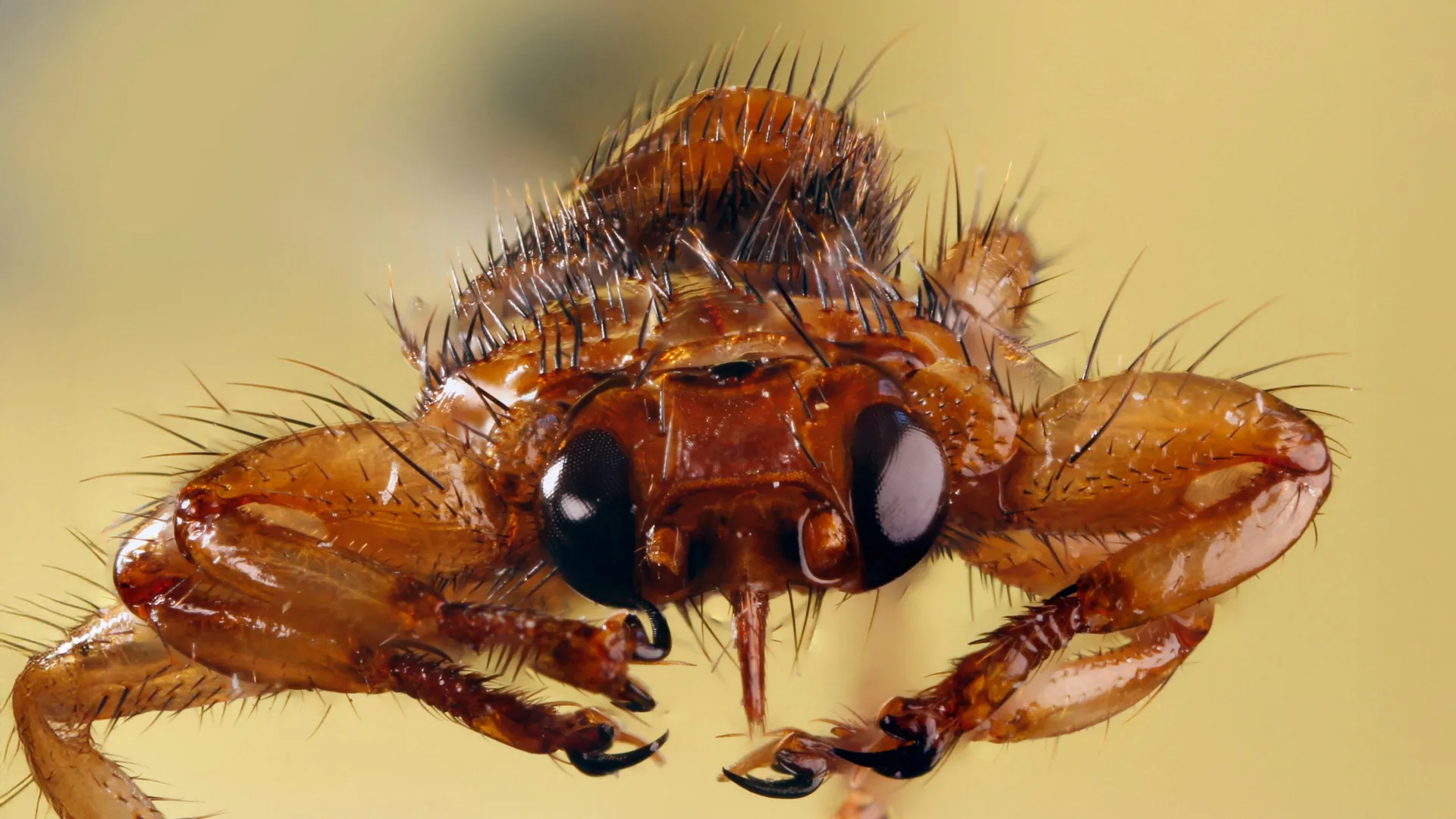
New research has unveiled a remarkable adaptation in a widespread blood-feeding fly, commonly known as the deer ked, revealing that these insects significantly diminish their visual capabilities after successfully locating a host and committing to a sessile, parasitic existence. This profound physiological shift, identified by an international team of scientists, suggests a strategic reallocation of metabolic resources, moving away from energetically expensive sensory systems once their function becomes redundant in their new, highly specialized lifestyle.
The Deer Ked: A Global Enigma with a Dual Lifestyle
Deer keds (genus Lipoptena and Neolipoptena), often mistaken for ticks due to their flattened bodies and blood-feeding habits, are fascinating ectoparasites found across a vast geographical range spanning Europe, Asia, Africa, and the Americas. Their life cycle is characterized by a stark dichotomy: an initial free-flying, highly mobile phase dedicated to host-seeking, followed by a permanent, sedentary parasitic phase. As winged adults, these flies are agile hunters, relying heavily on both flight and acute vision to locate suitable mammalian hosts, predominantly deer. However, they are opportunistic feeders and have been known to infest humans, livestock, and other mammals, causing irritation and, in some cases, transmitting pathogens. The sight of these small, reddish-brown flies rapidly crawling through hair or fur is a common, if unwelcome, experience for anyone spending time in wooded areas during their active season.
The moment a deer ked successfully lands on a host marks a pivotal and irreversible transformation in its life. The insect deliberately sheds its wings, often within minutes of settling, signifying a complete abandonment of flight. From this point onward, its existence is confined to the host’s fur, where it navigates through dense hair, feeds on blood, and reproduces, never again returning to the aerial world. This dramatic behavioral and morphological change – from a winged hunter to a wingless, permanent parasite – represents an extreme example of adaptive specialization in the insect kingdom.
Unveiling Sensory Adaptation: A Focus on Vision
Scientists from Aberystwyth University in the UK and the University of Florence in Italy have delved into the biological underpinnings of this profound lifestyle shift, specifically investigating its impact on the fly’s sensory system. Their collaborative research, published in the Journal of Experimental Biology, reveals that the deer ked’s major behavioral and physical transformation is intricately linked to fundamental changes in its sensory biology, particularly its visual apparatus. The core hypothesis driving their investigation was that the energetically costly system of vision would be optimized or even downsized once its primary function – long-range host detection – was no longer required.
The Energetic Equation of Vision: Why Less Can Be More
Vision, while indispensable for many animals, is one of the most energetically demanding sensory modalities. The development and maintenance of complex eyes, the intricate neural processing required to interpret visual information, and the constant activity of photoreceptor cells all consume significant amounts of metabolic energy. For a free-flying insect like the deer ked, actively searching for a host in a vast environment, this energy investment is entirely justified. Acute vision allows them to detect host movement, shape, and contrast against the background, guiding their flight and ensuring successful host acquisition.
However, once a deer ked has secured its position on a host, its visual needs diminish dramatically. Its world shrinks from open skies and distant landscapes to the dense, dark, and often labyrinthine environment of mammalian fur. In this microhabitat, long-range vision offers little to no advantage. Instead, other sensory inputs, such as tactile cues, chemoreception (smell), and thermoreception (heat detection), become paramount for navigating the fur, locating suitable feeding sites, and finding mates. Evolution, a master of efficiency, favors organisms that allocate their limited energy resources to functions that provide the greatest fitness benefit. Therefore, the researchers posited that the deer ked would likely reduce its investment in vision, redirecting precious energy towards other critical functions like digestion, immune response, and reproduction, which are essential for its long-term survival and propagation as a permanent parasite.
Dr. Roger Santer from the Department of Life Sciences at Aberystwyth University, who spearheaded the study, articulated this evolutionary principle: "Vision plays a vital role in animal behavior, but it is also energetically expensive. Evolution favors sensory systems that are efficiently matched to an animal’s way of life. Some blood-feeding flies rely heavily on vision, while others live permanently on hosts and have little need for it. Deer keds are especially interesting because they switch between these two lifestyles." This unique life history makes the deer ked an ideal model organism for studying sensory plasticity and adaptive evolution.
Methodology: Peering into the Genes of Sight
To meticulously investigate how deer keds adapt to this dramatic transition, the research team adopted a comparative approach. They studied deer keds at two distinct points in their life cycle:
- Host-seeking adults: These were winged flies actively searching for hosts, representing the stage where vision is crucial.
- Parasitic adults: These were wingless flies collected directly from deer, having already adopted their permanent parasitic lifestyle.
The core of their investigation focused on genes associated with visual sensitivity, specifically a class of genes known as opsins. Opsins are light-sensitive proteins found in the photoreceptor cells of the eye, playing a fundamental role in converting light into electrical signals that the brain interprets as vision. The level of activity (expression) of opsin genes directly correlates with the functional capacity and sensitivity of an animal’s visual system.
By employing sophisticated molecular techniques, the researchers quantified and compared the activity of these opsin genes in both groups of flies. This allowed them to precisely determine how the insects’ visual systems responded at a genetic level to their abrupt and profound change in lifestyle.
Key Findings: Halving Visual Investment for a New World
The results of the genetic analysis were striking and provided clear evidence of visual adaptation. The team discovered that the visual system of a flying, host-seeking deer ked is highly developed, remarkably similar to that of other highly visual blood-feeding insects, such as the tsetse fly. Tsetse flies (genus Glossina), infamous vectors of African trypanosomiasis (sleeping sickness), are renowned for their acute vision, which they use to meticulously hunt out mammal hosts in the vast African landscapes. This comparison underscores the initial high investment in vision by deer keds during their host-seeking phase.
However, the picture changed dramatically once the deer ked became an ectoparasite. The study revealed a significant reduction in the activity of opsin genes in wingless, parasitic adults – approximately half the level observed in their winged counterparts. Dr. Santer elaborated on this finding: "We found that a flying deer ked’s visual system is much like that of a tsetse fly, which famously hunt out mammal hosts in Africa. However, after a deer ked loses its wings and becomes an ectoparasite, activity of its opsin genes reduces to around half the previous level. This suggests that the flies do not lose vision entirely, but that their visual sensitivity is reduced. We think the fly might be sacrificing sight to conserve energy for functions such as digestion and reproduction."
This reduction in opsin gene activity does not imply complete blindness. Instead, it signifies a scaling back of visual capabilities. The flies likely retain some residual light perception, which might still be useful for rudimentary tasks within the fur, such as detecting overall light/dark cycles or distinguishing gross changes in illumination. However, their ability to discern fine details, detect motion from afar, or navigate complex visual landscapes is profoundly diminished. The energy saved from maintaining a highly sensitive visual system is then presumably reallocated to other biological processes crucial for parasitic life, such as continuous blood digestion, robust immune responses against host defenses, and high reproductive output.
Evolutionary Imperative: Optimizing for a Niche
The deer ked’s adaptation provides a compelling illustration of evolutionary optimization. Shedding wings, while seemingly drastic, eliminates a structure that would be cumbersome and prone to damage within dense fur, simultaneously preventing the insect from inadvertently leaving its host. The concomitant reduction in visual sensitivity further refines this specialization. It’s a testament to the power of natural selection to fine-tune an organism’s biology to perfectly suit its ecological niche.
This strategy of "use it or lose it" in sensory systems is not unique to deer keds but is particularly striking due to the abruptness and extent of the change. Other parasites, such as many species of lice and fleas, are ancestrally wingless and often exhibit reduced or absent eyes, having evolved within a permanently parasitic context. The deer ked, however, offers a rare glimpse into the dynamic process of sensory system modification within an individual’s lifetime as it transitions between two radically different modes of existence.
Comparative Parasitology: Diverse Strategies for Blood-Feeding
The deer ked’s sensory trade-off provides valuable context when compared to other blood-feeding arthropods. For instance, ticks, another group of ectoparasites, are entirely wingless and generally have very simple eyes or are eyeless, relying heavily on olfaction (smell) and thermoreception to detect hosts from vegetation. Fleas, also wingless, possess simple eyes but are more reliant on vibrations and chemical cues. Mosquitoes and tsetse flies, conversely, are highly visual and maintain their complex eyes throughout their adult lives, as they continuously engage in host-seeking flights.
The deer ked’s unique life history, encompassing both highly visual flight and a visually reduced parasitic phase, positions it as a bridge between these extremes. It highlights the diversity of adaptive strategies that have evolved to facilitate blood-feeding and parasitic survival, each tailored to the specific environmental challenges and opportunities presented by their respective lifestyles.
Broader Scientific Implications: From Fundamental Biology to Pest Control
The study’s findings, published in a leading journal for experimental biology, carry significant implications for several fields of scientific inquiry:
-
Fundamental Parasite Biology and Evolution: This research enhances our understanding of the intricate mechanisms underlying host-parasite interactions and the evolutionary pressures that drive adaptive changes in sensory systems. It offers a clear example of how resource allocation decisions are made at a molecular level to maximize fitness in highly specialized ecological niches. This could inform broader theories on the evolution of parasitism and the plasticity of sensory organs.
-
Sensory Ecology: The deer ked serves as an excellent model for studying sensory ecology, the field that investigates how organisms perceive and respond to their environment. It demonstrates how sensory systems are not static but dynamic, capable of undergoing profound functional and genetic alterations in response to behavioral and ecological shifts. Future research might explore whether other sensory modalities, such as olfaction or mechanoreception, are similarly upregulated or altered to compensate for reduced vision.
-
Potential for Pest Control Strategies: While deer keds are primarily a nuisance, their bites can be irritating, and they are known to carry bacterial pathogens like Bartonella species. A deeper understanding of their sensory biology, particularly their host-seeking cues and post-settlement adaptations, could contribute to improved monitoring and control strategies. For instance, knowing which sensory inputs are most critical at different life stages could lead to the development of more targeted traps or repellents. If the initial host-seeking phase is heavily reliant on specific visual cues, traps designed to mimic these cues could be more effective. Conversely, understanding the sensory world of the settled parasite might reveal vulnerabilities that could be exploited for on-host treatments.
Future Research Directions
The current study opens several avenues for future investigation. Researchers might explore:
- The precise neural mechanisms underlying the reduction in visual sensitivity.
- Whether other sensory systems (e.g., olfaction, touch, heat detection) are upregulated or altered in the wingless parasitic stage to compensate for the visual trade-off.
- The hormonal or genetic triggers that initiate wing shedding and opsin gene downregulation.
- The potential for epigenetic modifications to play a role in this adaptive plasticity.
- The ecological impact of deer keds on their host populations and the broader ecosystem, particularly concerning pathogen transmission.
In conclusion, the research on deer keds offers a compelling narrative of evolutionary efficiency. By shedding both its wings and a significant portion of its visual acuity, the deer ked embodies a highly successful strategy for life as a permanent parasite. This remarkable adaptation underscores the dynamic nature of sensory evolution and provides invaluable insights into how organisms optimize their biology to thrive in even the most specialized and demanding ecological roles.
