
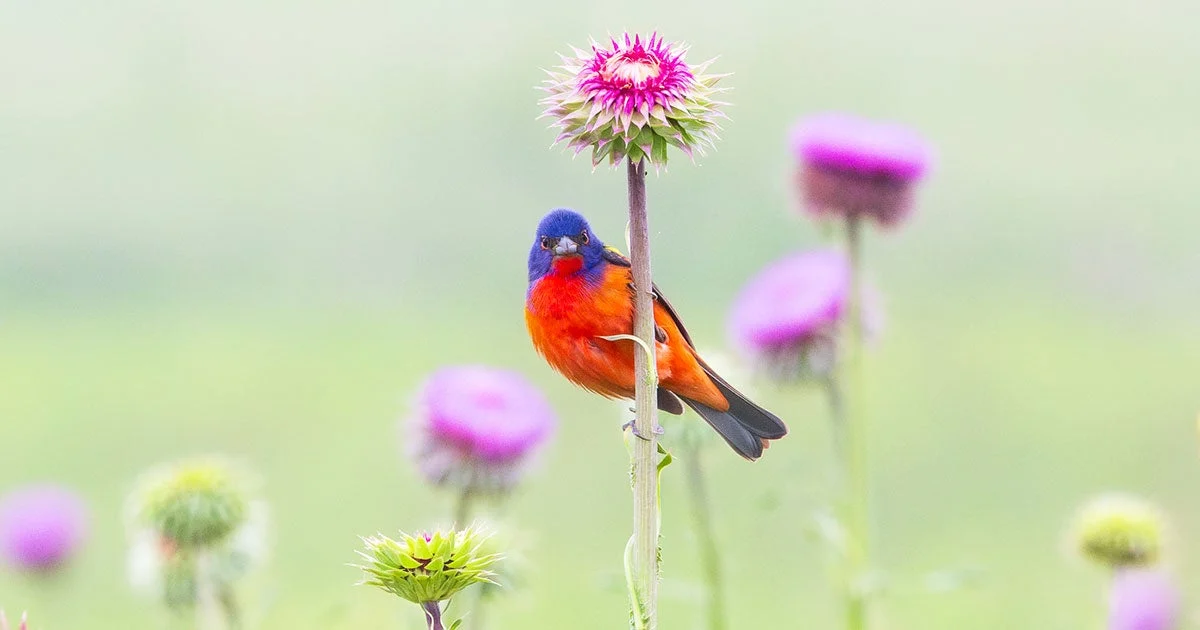
In an era increasingly saturated with digitally generated content, the Painted Bunting stands as a vibrant testament to nature’s unparalleled artistry, prompting a moment of genuine wonder: Is that bird real? Fortunately, the answer is a resounding yes. Male Painted Buntings, adorned with an almost impossibly brilliant palette of primary colors—deep blue on the head, green on the back, scarlet on the underside, and crimson wing patches—are not only unequivocally real but also as breathtaking in person as they appear in high-resolution photographs and detailed field guides. Their female counterparts, though lacking the males’ multi-hued extravagance, possess their own understated beauty with a striking luminescent yellow-green plumage that makes them equally captivating.
This avian marvel, a highly sought-after "grail bird" for birdwatchers across the United States, is found predominantly throughout the Southeast, extending westward through Texas. Despite its intense coloration, the Painted Bunting’s elusive nature often makes it a challenging subject to observe in its natural habitat. Yet, it remains a common resident across its two distinct breeding territories, frequently gracing backyard feeders and demonstrating a remarkable fidelity by returning to the same locations year after year. The species offers a unique window into avian biology, migration patterns, and the ongoing challenges faced by migratory birds in a rapidly changing world.
A Living Rainbow: Unveiling the Painted Bunting’s Splendor
The sheer intensity of the male Painted Bunting’s plumage is a phenomenon that defies easy explanation. Its head, a vivid indigo, transitions into a lime-green back, a vibrant red rump, and a chest of fiery scarlet. This kaleidoscope of colors, far from being a digital enhancement, is a natural masterpiece, a product of structural color and pigmentation that has evolved over millennia. Female Painted Buntings, while less flamboyant, showcase a delicate yet luminous yellow-green that provides excellent camouflage within dense foliage, a testament to the diverse evolutionary pressures acting on sexes within the same species. This sexual dimorphism is a common trait among many bird species, often linked to breeding displays and predator avoidance.
Habitat and Elusiveness: A Challenge for Birdwatchers
Despite their striking appearance and willingness to visit human-provided feeders, Painted Buntings can be surprisingly difficult to spot in the field. Their preferred habitat consists of low, dense vegetation, making them creatures of the undergrowth. They frequent woodland edges, marshlands, thickets, and even suburban yards abundant with shrubbery. This preference for concealment serves as a defense mechanism against predators, allowing them to blend into the complex tapestry of their environment. Birdwatchers often rely on their distinctive vocalizations—a sharp, metallic chirp—to locate them, a sound that cuts through the ambient noise of their dense habitats. This adaptation highlights the intricate ways species interact with their environment, balancing visibility for mating with the necessity of remaining hidden for survival.
Foraging Strategies: Ingenuity in the Wild
Painted Buntings are not merely passive consumers of readily available seeds. When food sources on the ground or at feeders are scarce, they exhibit remarkable ingenuity in their foraging techniques. They are known to be industrious, employing clever methods to access sustenance. For instance, when faced with plants too delicate or weak-stemmed to perch on, a bunting will skillfully pull the stem down to the ground, hold it firmly in place with one foot, and then meticulously remove the seeds. This demonstrates a level of problem-solving and tool-like behavior not commonly observed in all passerine species. Furthermore, they have been documented extracting insects from spiderwebs, showcasing their adaptability and opportunistic feeding habits, supplementing their primary granivorous diet with protein-rich invertebrates, particularly during breeding season.
A Family Affair: The New World Buntings
The Painted Bunting (Passerina ciris) belongs to the family Cardinalidae, commonly known as the cardinal family, which includes grosbeaks and other buntings. Specifically, it is a member of the genus Passerina, often referred to as the New World buntings. This genus includes several other visually stunning species such as the Indigo Bunting (P. cyanea), the Lazuli Bunting (P. amoena), the Varied Bunting (P. versicolor), the Rose-bellied Bunting (P. rositae), and the Orange-breasted Bunting (P. leclancherii). Historically, during the nascent stages of ornithological nomenclature in North America, the terms "bunting," "sparrow," and "finch" were often used interchangeably for any small, seed-eating bird possessing a thick, conical bill suitable for cracking seeds. However, modern taxonomy, informed by genetic and morphological studies, has refined these classifications, providing a more precise definition for the "bunting" appellation, typically referring to the vibrant Passerina species and a few others within the Old World.
Territoriality and Aggression: The Darker Side of Beauty
Beneath their dazzling exterior, male Painted Buntings exhibit a fierce territoriality, particularly during the breeding season. This period, typically from April to August, sees males engaging in aggressive confrontations to defend their nesting sites and secure mates. These altercations can be surprisingly brutal, involving intense pecking and scratching, occasionally leading to severe injury or even death for the combatants. Observations have also documented males tackling flying females out of the air and pulling out their feathers, a behavior that ornithologists interpret as a form of mate guarding or dominance display. This aggression extends beyond their own species; Painted Buntings are known to chase away other birds, including Field Sparrows, Chipping Sparrows, and even other bunting species, from their territories, underscoring their competitive nature in resource defense. This aggressive behavior is a critical aspect of their reproductive strategy, ensuring access to prime nesting locations and successful breeding opportunities.
The Enigma of Molting: A Double Transformation
All birds undergo molting, the process of replacing old, worn feathers with new ones. However, young Painted Buntings exhibit an unusual and complex molting pattern during their first year of life. They engage in a distinctive "double molt" during their initial autumn. The first molt occurs just a few days after fledging, when they replace their juvenile downy plumage with a more robust set of feathers. This is followed by a second, more extensive molt approximately a month or more later. Both of these initial molts result in a yellow-green plumage that closely resembles that of an adult female, providing camouflage during a vulnerable developmental stage. Young males do not acquire their brilliant, multi-colored adult plumage until their second autumn. Once this spectacular adult coloration is achieved, males retain their vibrant hues year-round, making them one of the few passerine species to maintain such vividness outside of the breeding season.
Migration and Molt-Migration: A Tale of Two Populations
The Painted Bunting’s migratory patterns reveal further complexities. During the breeding season, the species divides into two geographically distinct populations: an eastern population and a western population. These populations exhibit fascinating differences in their molting strategies during migration. Eastern buntings typically undergo their complete annual molt at their breeding grounds before embarking on their southward migration to wintering grounds in Florida, Cuba, and parts of Central America. In contrast, the western population engages in a phenomenon known as "molt-migration." These birds travel considerable distances out of their direct migratory path to specific molting locations, primarily in Northwest Mexico, before continuing to their wintering grounds in Mexico and Central America.
Molt-migration, while well-documented in certain waterfowl species, was historically considered less common among songbirds. However, recent research, including studies supported by Audubon, suggests that this strategy is far more prevalent in songbirds than previously realized. This specialized migration pattern allows birds to undertake the energetically demanding process of molting in areas that offer abundant food resources and reduced predation risk, optimizing their physiological condition for the subsequent long-distance migration. Scientists are actively studying these distinct population-specific strategies to better understand the evolutionary drivers and ecological implications of such complex migratory behaviors.
Global Recognition: Names Across Cultures
The Painted Bunting’s striking appearance has not only captivated ornithologists but has also inspired a rich tapestry of alternate names across various cultures and languages, reflecting its widespread appeal. In many Spanish-speaking countries, it is affectionately known as the "Sietecolores" or "Siete Colores," literally translating to "seven colors," a direct homage to its perceived multi-hued splendor. In Cuba, its delicate beauty earned it the moniker "Mariposa," or "butterfly," evoking its graceful flight and vibrant appearance. Historically, Francophones in Louisiana referred to the species as "Nonpareil," a French term meaning "without equal," a name that beautifully encapsulates its unique visual appeal and continues to be used in some contexts today. Even beyond its natural geographic range, the bird has captured imaginations: Finnish speakers call it "Sateenkaarikardinaali," roughly translating to "rainbow cardinal," while the Dutch refer to it as "Purpergors," meaning "purple bunting." While some of these names, like "purple bunting," might not be entirely accurate in describing its full spectrum of colors, they all underscore the profound impact this species has had on human perception of natural beauty.
Conservation Concerns: Beauty’s Burden
Despite its widespread distribution and relatively common status, the Painted Bunting faces significant conservation challenges. While currently listed as a species of "Least Concern" by the International Union for Conservation of Nature (IUCN), scientists have documented notable population declines in specific regions, raising alarms among conservationists. One of the primary drivers of these declines is habitat destruction, particularly the loss of the crucial woodlands, shrublands, and thickets where they breed and forage. Urban expansion, agricultural intensification, and coastal development all contribute to the fragmentation and degradation of their essential habitats.
Furthermore, the species’ vibrant plumage, which endears it to bird lovers, also makes it a prime target for illegal wildlife trafficking. In its wintering grounds across Florida, Central America, Mexico, and the Caribbean, male Painted Buntings are highly sought after as cage birds for their striking looks and melodious song. This illicit trade poses a serious threat to wild populations. A major undercover investigation into South Florida’s illegal songbird market in the 2000s, known as "Operation Bunting," was specifically named after the species due to the alarming number of individuals disappearing from the wild, as observed by biologists studying their populations. This operation highlighted the scale and sophistication of the black market for these beautiful birds, underscoring the need for robust enforcement and international cooperation.
Scientific Endeavors: Tracing Migratory Paths
To better understand and mitigate the threats facing Painted Buntings, American researchers are collaborating with scientists in their wintering grounds to trace the birds’ intricate migratory paths. By employing techniques such as geolocators and stable isotope analysis, researchers aim to identify specific bottlenecks and high-risk areas along their migration routes and in their non-breeding territories. This collaborative international effort is crucial for developing comprehensive conservation strategies that address challenges across their entire annual cycle, from breeding to migration and wintering. Understanding the specific pressures faced in different geographical regions allows for targeted interventions, such as habitat restoration projects in critical stopover sites or enhanced anti-trafficking measures in key wintering areas. Conservationists emphasize that effective protection requires a holistic approach that transcends national borders.
Resilience and Longevity: The Story of Old Man Bunting
Amidst the perils of migration and the threats of habitat loss and trafficking, individual Painted Buntings occasionally demonstrate remarkable resilience and longevity. In 2023, one such bird, affectionately dubbed "Old Man Bunting," made headlines after returning to a familiar backyard in South Carolina at the impressive age of 14. This achievement tied the record for the oldest-known wild Painted Bunting, a testament to its survival against numerous odds. While the average lifespan for wild Painted Buntings is considerably shorter, typically around 2-3 years, this exceptional individual highlighted the potential for longevity under favorable conditions. In the relatively safe and controlled environment of captivity, one Painted Bunting was documented to have lived for nearly 18 years, further illustrating the species’ inherent robustness when protected from the myriad challenges of the wild.
The Painted Bunting, with its dazzling colors and complex life history, serves as a powerful emblem of nature’s enduring beauty and fragility. Its story is a microcosm of the broader challenges facing migratory birds globally—habitat degradation, illegal trade, and the impacts of climate change. As a "grail bird" for enthusiasts and a subject of intensive scientific study, its continued existence and thriving populations depend on sustained conservation efforts, international cooperation, and a collective appreciation for the real and spectacular wonders of the natural world. Protecting the Painted Bunting means safeguarding the intricate ecosystems it inhabits and preserving a living, breathing masterpiece for future generations.
