
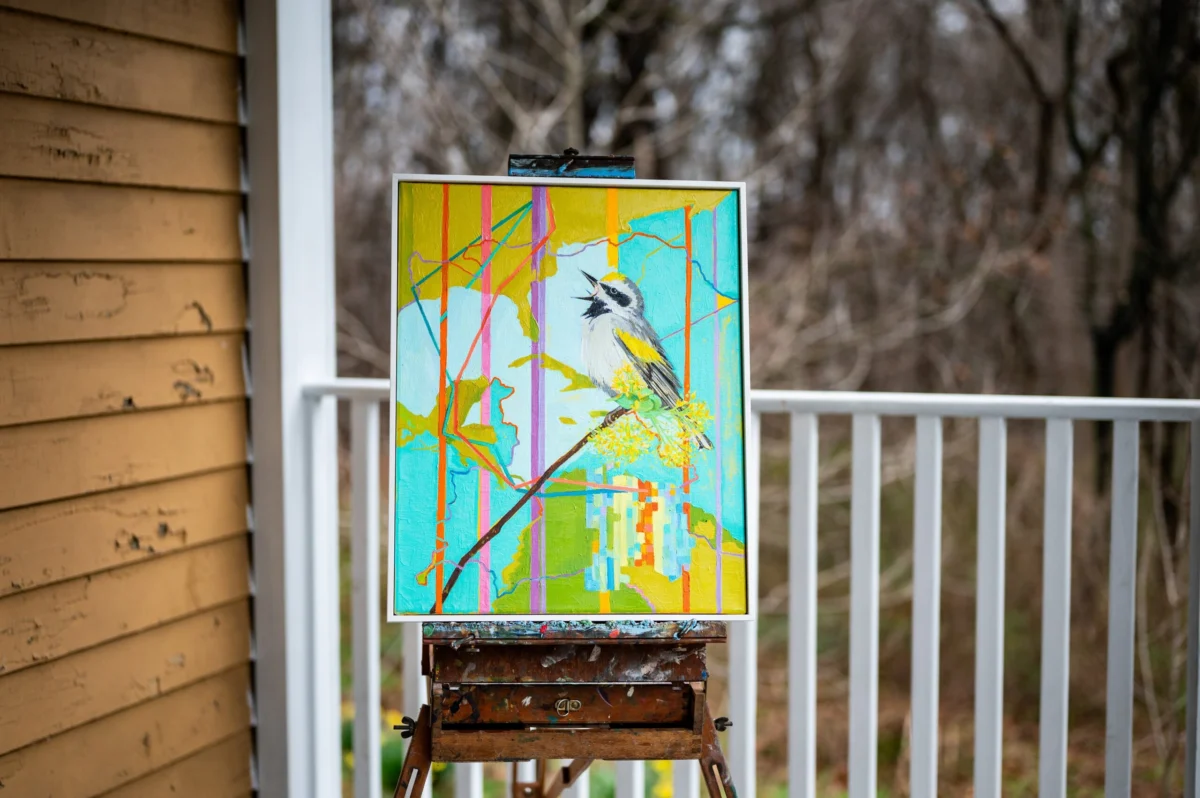
Artist Deirdre Murphy has unveiled a captivating new work, "Trill for Tomorrow," a strikingly lifelike portrait of a Golden-winged Warbler singing out over a vibrant, layered background of colorful maps and scientific data. This painting, currently on display at the John James Audubon Center at Mill Grove in Pennsylvania, exemplifies Murphy’s distinctive approach to art-making, where rigorous scientific inquiry underpins profound artistic expression. The Philadelphia-based artist, known for her ecology-centric practice, frequently collaborates with researchers and delves into extensive data sets to inform her compelling canvases, bridging the often-disparate worlds of art and science.
A Symphony of Science and Pigment: Deirdre Murphy’s Conservation Art
Deirdre Murphy’s artistic methodology transcends traditional studio practice, initiating her creative process not with a blank canvas, but with scientific consultation and archival research. Her work is a testament to the power of interdisciplinary engagement, transforming complex ecological data into visually stunning narratives that aim to foster deeper public understanding and engagement with environmental issues. "Trill for Tomorrow" is a prime example of this synthesis, depicting a species, the Golden-winged Warbler, that serves as a poignant symbol of conservation challenges and opportunities.
The painting presents a male Golden-winged Warbler (Vermivora chrysoptera) with exquisite detail: its distinctive black throat patch and eye mask, bright yellow wing bars, and the subtle textures of its plumage. Poised on a maple branch, the bird is captured in a dynamic pose, head thrown back and chest lifted, mid-song—a high-pitched "seee-bzzz, bzzz" that resonates with urgency and life. This vibrant avian subject is set against a background that pulses with abstract colors and geographic lines, remixes of academic sources that illustrate the bird’s range and migration routes. The juxtaposition of a meticulously rendered natural subject with abstract scientific visualization creates a kaleidoscopic collage, inviting viewers to appreciate both the aesthetic beauty of the bird and the intricate ecological systems it inhabits.
Murphy’s intention with this piece extends beyond mere aesthetic appreciation. By choosing a species classified as "near threatened" rather than "endangered," she seeks to evoke a sense of proactive hope rather than despair. Her goal is to empower viewers, moving them beyond the "anxiety" and "helplessness" often associated with irreversible environmental loss, towards a conviction that collective and individual action can still make a tangible difference.
Immersive Research: Bridging the Easel and the Archive
The journey to create "Trill for Tomorrow" began far from Murphy’s easel, deep within the scientific archives of the Academy of Natural Sciences at Drexel University. This institution houses an extensive ornithological collection, a treasure trove of specimens meticulously preserved over centuries. Murphy’s initial steps involved immersing herself in this collection, specifically examining dozens of Golden-winged Warbler specimens. This direct engagement with the physical artifacts of natural history is central to her process, offering insights that no photograph or digital image could fully convey.
-
A Century of Specimens: Connecting with the Past
Armed with a magnifying glass, Murphy meticulously studied the preserved warblers. This close examination allowed her to discern minute details: the subtle variations in feather shape and texture across different parts of the bird’s body, the precise iridescence of certain plumes, and the delicate structure of its bill and feet. These are details often lost in two-dimensional representations, but crucial for rendering a truly lifelike portrait. The specimens, some dating back at least a century and a half, were not just objects of study but also conduits to a deeper connection. As Murphy described, holding the small warbler in her hands evoked a "visceral connection to this ephemeral being, and this tenderness, this finiteness." This tactile and emotional engagement with the birds’ physical forms, collected by generations of naturalists, ornithologists, and zoologists, imbued her artistic vision with a profound sense of reverence and responsibility. It was a direct link to the past, reminding her of the long history of human interaction with and study of these delicate creatures.
-
The Warbler’s Call: Capturing Behavior and Spirit
During her time at the Academy, Murphy established a mini-studio, where she began sketching the warblers using colored pencils and watercolors. These initial studies were crucial for capturing the essential forms and colors before transitioning to the final oil-on-canvas medium. Her research also included vital consultations with Nate Rice, the Associate Curator of the ornithology collection. Rice provided invaluable insights into the Golden-winged Warbler’s behavior, particularly its distinctive singing posture. He described how the birds "throw back their heads, lift their chests," emitting their characteristic "seee-bzzz, bzzz" call. This description immediately piqued Murphy’s artistic interest, seeing in this proud stance a powerful communicative message: "Sound the alarm." She subsequently sought out a photograph of a Golden-winged Warbler in this specific pose to serve as a reference for her final painting, ensuring that the artwork conveyed both scientific accuracy and symbolic depth. This deliberate choice of posture amplifies the painting’s underlying conservation message, transforming a mere depiction into an urgent plea.
Data into Design: Visualizing Ecology on Canvas
Deirdre Murphy’s role as a research-driven studio artist extends beyond examining specimens; she is also a faculty member at Lehigh University, where her interdisciplinary approach is actively fostered. Her long-standing interest in science has led her to collaborate regularly with a diverse array of scientific experts, including ornithologists, behavioral biologists, and botanists. For "Trill for Tomorrow," this collaboration involved a deep dive into geographical and ecological data.
-
The Aesthetic of Scientific Data
Murphy meticulously studied maps and data visualizations pertaining to the Golden-winged Warbler’s species range and complex migration routes. These birds undertake arduous journeys, breeding in specific habitats within the Great Lakes region and the Appalachian Mountains of the eastern U.S. and Canada, then traveling thousands of miles south to their wintering grounds in Central and northern South America, particularly in countries like Colombia, Venezuela, Ecuador, and Peru. The scientific visualizations of these routes—with their intricate lines, shaded areas, and sometimes unconventional color palettes—became a wellspring of inspiration for Murphy. She found a unique aesthetic in the "quirky" ways scientists choose to visualize their data, often borrowing the "oddly weird" colors and textures to incorporate into the abstract background of her portrait. This remixing of academic sources into the artistic composition not only grounds the artwork in scientific reality but also offers viewers a fresh, visually engaging perspective on the data itself. The final result is a fusion of precise avian depiction with a dynamic, almost kaleidoscopic collage of geographical outlines, such as the familiar shape of the Gulf, interwoven with bright, abstract lines that represent the complex, often invisible, pathways of migration and habitat.
The Golden-winged Warbler: A Species at a Crossroads
The Golden-winged Warbler, the subject of Murphy’s poignant artwork, is more than just a beautiful bird; it is a sentinel species, its declining populations signaling broader ecological concerns. Understanding its biology and the threats it faces is crucial to appreciating the full impact of "Trill for Tomorrow."
-
A Profile of Vermivora chrysoptera
The Golden-winged Warbler is a small, striking songbird, measuring about 4.5 to 5 inches in length with a wingspan of approximately 7.5 inches. Males are particularly distinctive, boasting a bright yellow cap, a prominent black throat patch, and a broad black stripe extending from the bill through the eye. Their wings display a vibrant yellow patch, contrasting with an olive-gray back and white underparts. Females share similar markings but with a duller black or gray throat patch. These birds are renowned for their unique song, a buzzy, high-pitched "seee-bzzz, bzzz" often described as a series of distinct notes followed by a rapid trill.
Their preferred breeding habitat consists of early-successional forests, a mosaic of young, shrubby woodlands, regenerating clear-cuts, old fields, and wetlands. These specific habitats, often created by disturbances like logging, fires, or abandonment of agricultural land, provide the dense cover for nesting and foraging that the warblers require. They typically nest on or near the ground, concealing their nests within thick vegetation. Their diet primarily consists of insects, especially caterpillars, during the breeding season, supplemented by spiders and berries. In their tropical wintering grounds, they forage for insects in the mid-story of humid forests.
-
Decades of Decline: Unpacking the Threats
The conservation status of the Golden-winged Warbler is a matter of significant concern. The International Union for Conservation of Nature (IUCN) Red List classifies the species as "Near Threatened." However, this classification belies a more alarming trend: populations have experienced a precipitous decline across much of their range in recent decades. Scientific estimates suggest a population drop of approximately 60-70% since the mid-20th century, with some localized declines being even more severe.
Multiple factors contribute to this dramatic reduction:
-
Habitat Loss and Degradation: This is widely considered the primary driver of the Golden-winged Warbler’s decline. In breeding areas, the maturation of early-successional forests into mature woodlands reduces the shrubby habitats they depend on. Changes in land-use practices, such as urbanization, agricultural expansion, and fire suppression, also limit the availability of suitable young forest habitats. In their wintering grounds in Central and South America, deforestation for agriculture, cattle ranching, and human development poses a significant threat to the humid tropical forests they rely on.
-
Hybridization with Blue-winged Warblers: Where the ranges of Golden-winged Warblers and their close relatives, Blue-winged Warblers (Vermivora cyanoptera), overlap, hybridization is a significant issue. Blue-winged Warblers, which are expanding their range northward, tend to outcompete Golden-winged Warblers, leading to a phenomenon known as competitive exclusion. The hybrids, such as "Brewster’s Warbler" and "Lawrence’s Warbler," are often less reproductively successful, further contributing to the decline of pure Golden-winged Warblers.
-
Pesticide Use: The widespread use of insecticides, both in breeding and wintering grounds, can reduce the availability of insect prey, impacting the warblers’ ability to successfully breed and raise young.
-
Climate Change: Shifting weather patterns, altered migration cues, and changes in the timing of insect emergence due to climate change can disrupt the delicate ecological balance that these migratory birds depend on.
-
Collisions with Structures: Like many migratory birds, Golden-winged Warblers face risks of colliding with windows of homes and commercial buildings, as well as communication towers, particularly during nocturnal migration.
The cumulative effect of these threats has pushed the Golden-winged Warbler to a critical juncture, making it a focal point for conservation efforts across its range.
-
A Call to Action: Art as an Agent of Change
Murphy’s choice to depict a species at a "tipping point" rather than one already "doomed" is a deliberate artistic and philosophical statement. She understands the "anxiety" and "helplessness" that can accompany the news of endangered species and seeks to counteract that with a message of hope and empowerment.
-
Beyond Despair: Cultivating Hope Through Art
"I know the anxiety that comes with that," Murphy says, referring to the feeling of "something’s already gone" or "something’s almost ready to disappear." Her painting, therefore, functions as a visual prompt for agency. By highlighting a species whose fate is not yet sealed, she suggests that proactive engagement can still alter its trajectory. The vibrant colors and dynamic pose of the warbler in "Trill for Tomorrow" radiate vitality, an assertion that life persists and can be protected. This perspective aligns with a growing movement in environmental communication that advocates for framing conservation challenges in ways that inspire action rather than paralyzing fear.
-
Collaborative Conservation: A Multifaceted Approach
The conservation of the Golden-winged Warbler is a complex undertaking that involves a wide array of stakeholders and initiatives. A significant part of the effort focuses on habitat restoration, particularly in the Appalachian Mountains and Great Lakes region. Private landowners, often in collaboration with organizations like the National Audubon Society, the U.S. Fish and Wildlife Service, and various state wildlife agencies, have restored thousands of acres of the birds’ preferred early-successional forest habitat. These efforts involve land management techniques such as prescribed burning, selective timber harvesting to create young forest patches, and planting native vegetation. These interventions are crucial for maintaining the specific habitat mosaic that Golden-winged Warblers require for breeding success. Furthermore, international collaborations are essential to protect their wintering grounds and migratory flyways, recognizing that these birds are a shared resource across continents.
-
The Power of Individual Stewardship
Murphy emphasizes that individual actions, though seemingly small, can collectively contribute to significant conservation outcomes. She points to accessible ways for people to help, such as planting native pollinator gardens, which provide vital food sources and habitat for insects that warblers and other birds feed on. Another simple yet effective measure is to take steps to prevent bird window strikes. This can involve applying decals, screens, or tapes to windows, especially those that reflect sky or vegetation, thereby reducing the risk of collisions that kill millions of birds annually. Such actions, Murphy believes, foster a sense of personal responsibility and connection to the natural world. "To do the right thing is the only thing to do," she states, encapsulating her overarching message: "Be a good person—leave this planet better than we found it." This ethical imperative forms the core of her artistic advocacy.
The Exhibition and Its Broader Resonance
"Trill for Tomorrow" is not just a painting; it is a catalyst for conversation and a call to action. Its current exhibition at the John James Audubon Center at Mill Grove in Pennsylvania is particularly fitting, given the center’s dedication to conservation and education, echoing the legacy of its namesake, the renowned ornithologist and artist.
-
Art, Science, and Public Engagement
The presence of Murphy’s work in such a prominent conservation-focused venue underscores the growing recognition of art’s role in science communication and public engagement. Institutions like the Audubon Center understand that visual art can reach audiences in ways that scientific papers or data visualizations often cannot. It can evoke empathy, spark curiosity, and make complex ecological issues emotionally resonant and personally relevant. Nate Rice, the Associate Curator at Drexel, would likely commend Murphy’s ability to translate the scientific value of specimen collections into compelling public art, highlighting how such collaborations elevate the profile of scientific research and its societal importance. Similarly, Lehigh University would likely champion Murphy’s work as an exemplar of interdisciplinary excellence, showcasing how faculty can bridge academic disciplines to address pressing global challenges.
The exhibition’s timing, in Summer 2026, positions it within a critical period for environmental awareness, aligning with ongoing efforts to address biodiversity loss and climate change. It offers a tangible, beautiful entry point for individuals to connect with the plight of migratory birds and the broader health of ecosystems. By presenting the Golden-winged Warbler not as a lost cause but as a species that can still be saved through concerted effort, Murphy’s art provides a powerful counter-narrative to environmental fatalism. It suggests that knowledge, combined with compassionate action, can indeed sculpt a more hopeful future for our planet and its inhabitants.
This piece originally ran in the Summer 2026 issue. To receive our print magazine, become a member by making a donation today.
