
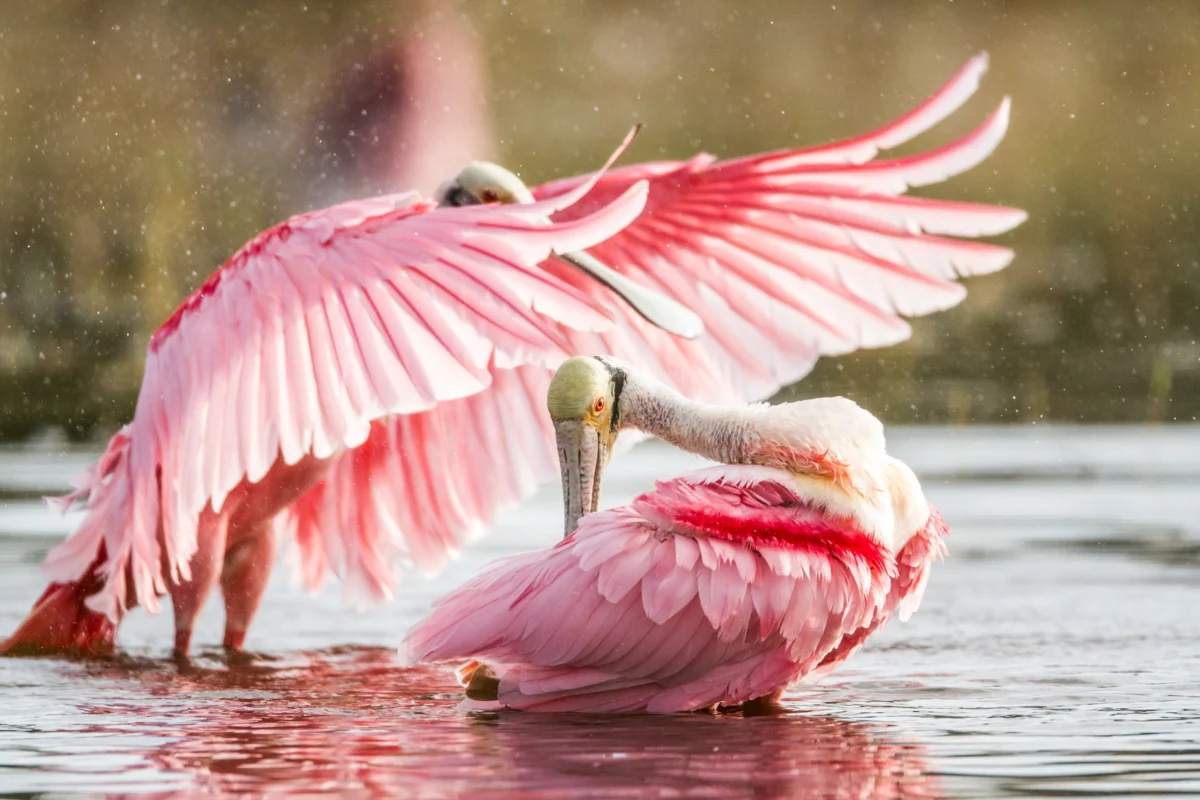
Pink is an exceptionally rare hue in the avian world of North America, where the vast majority of plumage is dominated by browns, grays, blacks, and yellows. Among the thousands of bird species documented across the continent, fewer than a dozen exhibit prominent pink coloration. This scarcity makes sightings of these birds not only a visual delight for casual observers but a significant event for ornithologists and dedicated birders. The presence of these colors is not merely aesthetic; it is a complex result of dietary intake, structural light refraction, and intricate genetic expressions. Understanding why these birds display such vibrant tones requires a look at the biology, ecology, and environmental factors that govern their existence in the wild.
The phenomenon of pink plumage arises through three distinct biological pathways. For the most iconic pink waders—the American Flamingo and the Roseate Spoonbill—the color is derived from their diet. These birds consume crustaceans and microorganisms that feed on algae containing carotenoids, the same pigments that provide the orange hue to carrots and the red to tomatoes. In contrast, the iridescent pink displayed by hummingbirds is a result of structural coloration. Microscopic, pancake-shaped structures within their feather barbules refract light, creating a shimmering effect that changes as the bird moves. Finally, for the finch family, the pink and red hues are a product of metabolic processes and genomic expression, often signaling the health and fitness of the individual to potential mates.
Chronology and Historical Context of Pink Avian Populations
The presence of the American Flamingo in the United States has long been a subject of debate among wildlife biologists. For decades, the prevailing consensus was that while historical records dating back to the 1800s indicated the presence of flamingos in Florida, there was no evidence of a self-sustaining, resident breeding population. These birds were often dismissed as escapees from private collections or transient visitors blown off course by tropical storms.
However, the last decade has seen a shift in this narrative. Following a series of powerful hurricane seasons, ornithologists observed an uptick in the number of American Flamingos remaining in Florida year-round. This suggests a potential recolonization of the region. In 2023, reports of increased sightings in the Everglades and the Florida Keys indicated that these birds are not merely wandering vagrants but are actively selecting these environments for long-term survival. This behavioral shift may reflect broader ecological changes in the Everglades, where ongoing restoration efforts have improved water quality and prey availability, creating a more hospitable environment for these waders.
Parallel to the flamingo’s resurgence, the Roseate Spoonbill has demonstrated a distinct expansion of its range. Once largely restricted to the southern fringes of the Gulf Coast, the species has been observed moving northward. Audubon researchers have noted that this expansion serves as a bio-indicator of shifting environmental conditions. As wetlands change due to climate-driven temperature shifts, the spoonbill’s movement provides valuable data on how coastal ecosystems are adapting to new pressures.
The Biology of Pink: Structural vs. Pigmentary Coloration
The mechanisms behind these colors offer a window into avian evolution. The American Flamingo and the Roseate Spoonbill represent the most dramatic examples of pigmentary coloration. The intensity of their pink is intrinsically linked to the health of their local ecosystem. If a spoonbill or flamingo is found in an area with a declining population of small crustaceans or algae, their plumage often dulls, moving from a vibrant rose to a faded, pale white. This serves as a real-time health report of the wetlands they inhabit.
The hummingbird species, such as the Anna’s, Calliope, and Broad-tailed, operate on a completely different physiological plane. Their "pink" is not a pigment, but a structural illusion. The gorget—the patch of feathers on the throat—is composed of tiny, layered structures that act like a prism. When light hits these feathers at specific angles, it reflects only the pink or magenta spectrum. This allows these birds to display dull colors when inactive and brilliant, blinding flashes of color during courtship displays or territorial defense, providing a tactical advantage in the competitive world of hummingbird social hierarchies.
Finches, including the Purple, Cassin’s, and the rare Rosy-Finches, occupy a middle ground. Their color is derived from the ingestion of pigments, but these are processed and deposited into the feathers through complex genetic pathways. The "irruption" events, where birds like the Purple Finch move south in massive numbers during years of poor food supply in the boreal forests, provide scientists with opportunities to study the impact of nutrition on plumage quality. Data from these events suggest that male finches with the most intense pink coloration are often the most successful in securing breeding territories, supporting the "honest signal" theory of evolution, where bright colors serve as an indicator of superior genetic fitness.
Distribution and Habitat Analysis
The distribution of these birds is highly specific, reflecting their specialized ecological requirements. The Rosy-Finches—Black, Brown-capped, and Gray-crowned—are perhaps the most elusive. They reside at the highest elevations of the Rocky Mountains and the Great Basin, environments where few other avian species can survive. Their range is shrinking in response to rising temperatures at high altitudes, making them a focal point for climate change researchers.
Data from citizen science platforms like eBird have been instrumental in mapping these populations. For instance, the Sandia Crest in New Mexico has been identified as a critical site where the ranges of all three Rosy-Finch species overlap, making it a unique laboratory for observing these birds in a single location. Conversely, the Anna’s Hummingbird has successfully adapted to human-modified landscapes. Originally restricted to the Pacific Coast, it has expanded its range significantly, fueled by the widespread installation of backyard feeders and the planting of non-native, nectar-rich flora in suburban gardens.
Official Perspectives and Conservation Implications
Conservation groups, including the National Audubon Society, emphasize that while these birds are visually striking, their presence serves a functional purpose in the broader environmental tapestry. The expansion of the Roseate Spoonbill, for example, is monitored closely because it highlights the necessity of protected estuaries. Official reports indicate that the restoration of the Everglades is not only benefiting the spoonbill but also providing a buffer against storm surges for human communities.
The case of the American Flamingo serves as a reminder of the unpredictability of avian migration. Wildlife officials are now grappling with how to manage these "new" residents. There is a delicate balance to be maintained: acknowledging the return of a native species while ensuring that human interaction—such as photography and birdwatching tourism—does not disrupt their potential nesting sites. The recommendation from field experts is clear: observe from a distance, utilize ethical birding practices, and support the preservation of the wetlands that provide these birds with their vital food sources.
Data-Driven Management and Future Outlook
Looking toward the future, the conservation of North America’s pink birds will depend on the management of two primary resources: habitat and data. For the finches, the maintenance of coniferous forests and the protection of natural food sources like sunflower and safflower seeds are critical, especially during winters where food may be scarce. For the hummingbirds, the focus remains on the proliferation of native plant species that provide high-quality nectar, which is more sustainable than relying solely on artificial sugar-water feeders.
The broader implication of these findings is that avian coloration is a dynamic trait. As climate change alters the availability of carotenoid-rich foods, or as rising temperatures shift the range of high-altitude species, the "pink" birds of North America may see their populations fluctuate in ways that reflect the overall health of the continent’s ecosystems. The study of these birds is, therefore, not merely a pursuit of beauty, but an essential component of ecological monitoring. By tracking these species, researchers can gain early warning signs of ecosystem degradation, allowing for more precise and effective conservation interventions.
As the scientific community continues to gather data through tagging, remote sensing, and public reporting, the mystery surrounding these species is slowly being replaced by a robust understanding of their needs. Whether it is the high-mountain survival of the Rosy-Finch or the coastal resilience of the Spoonbill, these birds act as sentinels of the environment, reminding us that every vibrant hue in nature is a reflection of the intricate and often fragile balance of the world we share. Their continued presence is a testament to the success of current conservation efforts and a challenge to maintain the landscapes that allow them to flourish for future generations to observe.
