

Woodpeckers are a testament to nature’s engineering marvels, showcasing an extraordinary array of adaptations that enable them to thrive in a niche that would be utterly punishing for most other avian species. These persistent inhabitants of our woodlands and backyards are not only a source of consistent entertainment but also a compelling study in biological resilience. Their ability to withstand the repeated, high-impact forces associated with their characteristic foraging behavior is a subject of ongoing scientific fascination, highlighting a remarkable evolutionary trajectory.
The Pounding Paradox: Unpacking Woodpecker Resilience
The primary activity that defines woodpeckers – excavating cavities in trees – involves their heads striking wood at astonishing speeds, often reaching up to 13 miles per hour. This rapid impact generates forces of approximately 10 Gs, a magnitude that would cause severe brain trauma in many other birds and is significantly more likely to result in a concussion for a human than for a woodpecker. To put this into perspective, imagine repeatedly and deliberately striking your head against a solid surface at speeds approaching those of a fast-moving vehicle; this is the daily reality for a woodpecker engaged in its work.
Scientific inquiry into this phenomenon has revealed a suite of sophisticated adaptations that protect the woodpecker’s delicate brain. Central to this resilience is a unique cranial structure found only in woodpeckers. Their skulls are characterized by lightweight, spongy bone that is highly porous and filled with air. This air-filled structure acts as a natural shock absorber. Furthermore, this lightweight bone is reinforced by an intricate meshwork of bony struts, providing exceptional strength without adding excessive weight.
A crucial element in this protective system is the relative size of the woodpecker’s brain to its skull. Compared to many other bird species, a woodpecker’s brain is proportionally smaller, and the space within the skull is more tightly managed. This arrangement minimizes the potential for the brain to move freely and impact against the cranial walls during the violent jolts of hammering. This compact fit effectively reduces the risk of concussive injury, a stark contrast to the more susceptible brains of other birds.
The Unwavering Chisel: Maintaining a Durable Bill
The question of how a woodpecker’s bill, subjected to such relentless abrasion and impact, avoids wearing down to a useless stub is equally remarkable. While it is true that wear does occur, a specialized biological mechanism is at play. The cells at the tip of the woodpecker’s bill are in a constant state of regeneration, actively replacing the material lost through hammering. This continuous renewal ensures that the bill remains robust and effective. Moreover, the chisel-like shape of the bill, combined with the constant wear, results in a self-sharpening effect. Each blow delivered to the wood helps to maintain the sharp, pointed edge necessary for efficient excavation, a perfect example of form following function in the natural world.
Nature’s Protective Gear: Safeguarding Against Debris
The vigorous excavation process inevitably results in the creation of significant amounts of airborne debris. Woodpeckers have evolved their own sophisticated personal protective equipment to safeguard their senses. To prevent wood particles and dust from entering their respiratory system, they possess specialized tufts of stiff feathers that grow over their nostrils, acting as a natural filter or "dust mask."
In addition to respiratory protection, woodpeckers have also developed a unique defense for their eyes. They possess a nictitating membrane, often referred to as a "third eyelid." This transparent or semi-transparent membrane sweeps across the eye from the side, much like a windshield wiper, clearing away debris and protecting the cornea from injury without obscuring vision entirely. This specialized eyelid is crucial for maintaining ocular health during the arduous task of carving into trees.
A Welcoming Presence: Attracting Woodpeckers to Your Backyard
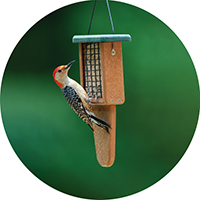
The resilience and intriguing adaptations of woodpeckers make them a captivating addition to any backyard ecosystem. These birds, often seen as symbols of persistence and hard work, can be actively encouraged to visit by providing appropriate food sources. Wild Birds Unlimited (WBU) offers a range of specialized feeders and foods designed to attract various woodpecker species.

High-energy options such as WBU suet and no-melt dough are particularly appealing, providing essential fats and nutrients. Bark Butter products, a proprietary blend developed by WBU, are also a favorite among woodpeckers, offering a sticky, protein-rich food source that adheres well to tree trunks and feeder surfaces. For those who prefer seed-based offerings, shelled peanuts and specialized blends like the TreeNutty® Plus Blend are excellent choices. Furthermore, WBU offers a dedicated Woodpecker Cylinder, a specially formulated seed block that is highly attractive to these birds.
By offering these carefully selected food items, backyard bird enthusiasts can foster a closer connection with these fascinating creatures, gaining an up-close perspective on their dynamic behaviors and remarkable adaptations.
The Evolutionary Context and Broader Ecological Role
The adaptations of woodpeckers are not merely isolated biological curiosities; they are the result of millions of years of co-evolution with forest ecosystems. As trees have evolved various forms of defense, such as tough bark and sap, woodpeckers have, in turn, developed the specialized tools and physiology to overcome these challenges. This intricate relationship underscores the dynamic nature of ecological systems, where species continually adapt and respond to one another.
Woodpeckers play a vital role in forest health beyond their own survival. The cavities they excavate provide essential habitat for a multitude of other species, including squirrels, bats, owls, and numerous smaller birds that do not possess the ability to create their own nesting sites. These abandoned cavities become critical microhabitats, contributing significantly to biodiversity within woodland environments. Therefore, the "punishing existence" of a woodpecker translates into a vital service for the broader ecological community.

Scientific Inquiry and Ongoing Research
The study of woodpecker adaptations continues to be a fertile ground for scientific research. Ornithologists and biomechanical engineers collaborate to further understand the precise mechanics of their hammering, the structural integrity of their skulls, and the regenerative properties of their bills. Advanced imaging techniques, such as high-speed videography and CT scans, are employed to capture and analyze the forces involved during excavation.
Recent studies have explored the role of hyoid bone structure, which wraps around the skull and acts as a natural "seatbelt" for the tongue, also potentially contributing to shock absorption. The intricate interplay between these various anatomical features is a testament to the power of natural selection in shaping highly specialized organisms.
Implications for Conservation and Education
Understanding the unique biological needs and challenges faced by woodpeckers has direct implications for conservation efforts. Protecting mature forests that provide ample opportunities for cavity excavation is paramount. Furthermore, educational initiatives that highlight the remarkable adaptations of these birds can foster greater appreciation for avian biodiversity and the importance of preserving natural habitats.
Organizations like Wild Birds Unlimited actively engage in educational outreach, utilizing resources such as their podcast, "Nature Centered," to inform the public about the wonders of birds and their ecological significance. Episodes dedicated to woodpeckers, like the "Wonderful Woodpeckers" installment, serve to demystify these often-misunderstood creatures and encourage greater engagement with the natural world. By fostering this connection, the hope is to inspire a generation of stewards who will champion the conservation of these and other vital species.

A Look Ahead: The Future of Woodpecker Studies
As scientific understanding advances, future research may delve deeper into the genetic basis of these remarkable adaptations. Identifying the specific genes responsible for the unique bone structure, beak regeneration, and specialized feather growth could offer insights into evolutionary processes and potentially even have applications in fields such as biomaterials engineering.
The continued observation and study of woodpeckers will undoubtedly reveal further layers of complexity and wonder within these already extraordinary birds. Their story is a powerful reminder of the ingenuity of life on Earth and the profound interconnectedness of all living things within their respective ecosystems. The woodpecker, a bird that transforms hardship into a remarkable feat of biological engineering, remains a compelling subject for both scientific exploration and public admiration.
