
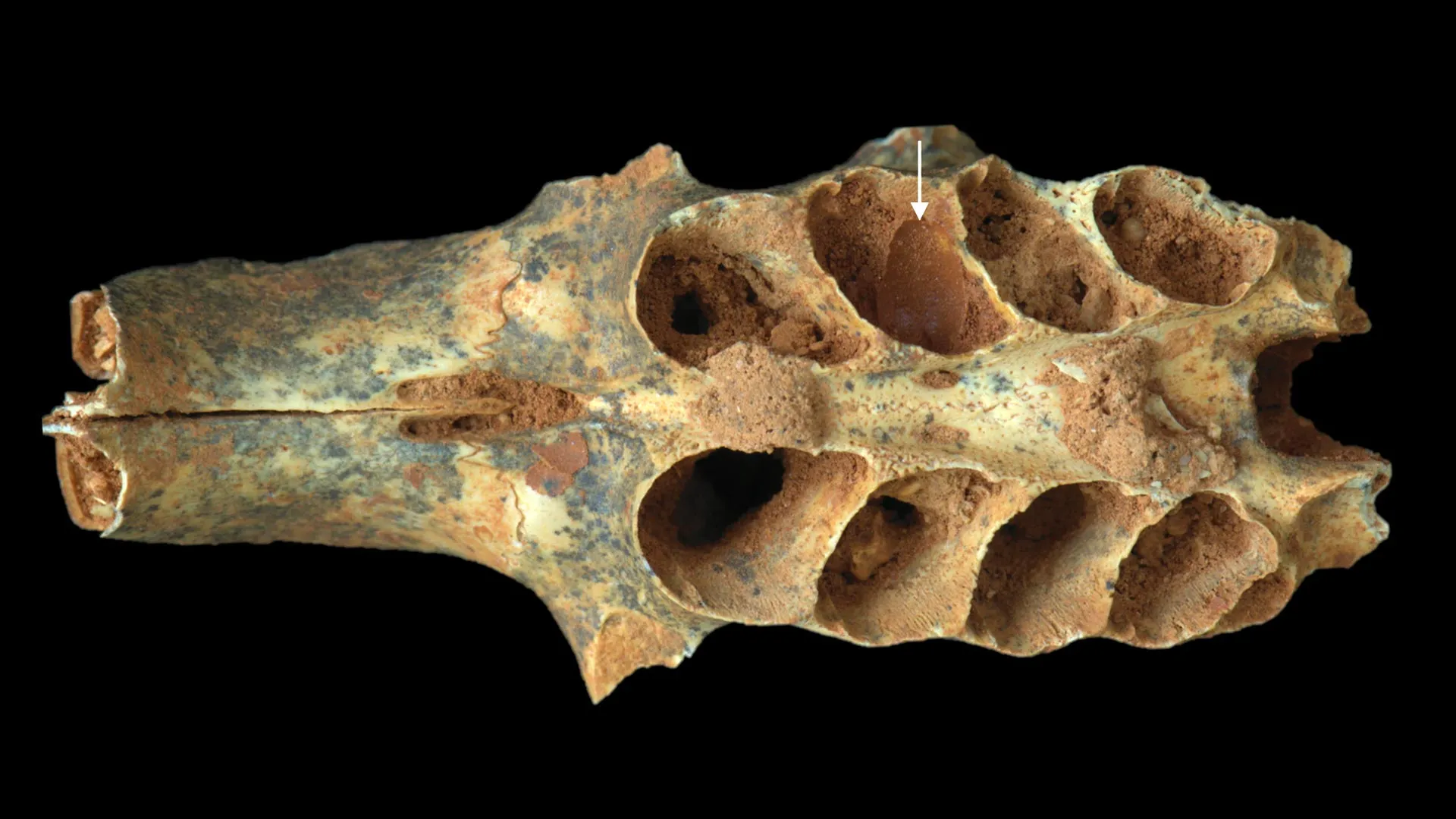
Around 20,000 years ago, a limestone cave on the Caribbean island of Hispaniola served as a generational roost for owls, which regularly expelled pellets containing the skeletal remains of their prey. These discarded bones, initially a testament to an ancient food web, unexpectedly became a vital resource for an entirely different group of animals: ancient bees. A groundbreaking new study, published in the peer-reviewed journal Royal Society Open Science, presents the first known evidence of bees utilizing the empty tooth sockets in fossilized mammalian jaws as miniature, protective nests for their offspring. This remarkable discovery unveils an previously undocumented nesting strategy, pushing the boundaries of our understanding of ancient insect behavior and ecological interdependence.
The revelation marks a significant milestone in paleontology and entomology, challenging previous assumptions about the ingenuity and adaptability of ancient insect life. Before this study, no evidence suggested that bees, or indeed any insects, would employ the skeletal remains of larger animals in such a sophisticated and deliberate manner for reproduction. The intricate mud structures found within these bone cavities offer a unique window into the resourcefulness of solitary bees in an environment where conventional nesting sites may have been scarce.
A Fossil-Rich Karst Landscape: Hispaniola’s Ancient Ecosystem Revealed
The Caribbean island of Hispaniola, politically divided between Haiti and the Dominican Republic, is renowned for its extensive network of thousands of limestone caves. This karst topography, characterized by soluble bedrock, creates a landscape riddled with sinkholes, caverns, and subterranean passages. Lazaro Viñola López, a postdoctoral researcher at the Field Museum in Chicago and the study’s lead author, emphasizes the prevalence of these geological features, stating, "In some areas, you’ll find a different sinkhole every 100 meters." This unique geological setting has historically acted as a natural trap and preservative for countless organisms, creating an unparalleled archive of ancient life. The alkaline environment within these caves is particularly conducive to fossilization, minimizing decay and protecting delicate remains from erosion and scavengers.
The specific cave central to this study had long been recognized as an exceptionally rich fossil deposit by Juan Almonte Milan, the esteemed curator of paleobiology at the Dominican Republic’s Museo Nacional de Historia Natural. Milan’s decades of dedicated exploration and research in the region laid the foundational knowledge for subsequent investigations. Viñola López and his colleagues embarked on their detailed exploration of the site during his PhD research at the University of Florida and the Florida Museum of Natural History, a journey that would ultimately lead to this remarkable finding.
Accessing the heart of this ancient ecosystem required specialized techniques. Viñola López recounts the initial descent: "The initial descent into the cave isn’t too deep — we would tie a rope to the side and then rappel down." The entrance itself presented a glimpse into the cave’s vibrant, albeit subterranean, present-day ecology, with the reflective eyes of tarantulas often visible in the darkness. However, it was after traversing a ten-meter-long underground tunnel that the true paleontological treasures began to emerge. The cave’s interior revealed multiple fossil layers, meticulously separated by carbonate deposits. These layers, formed during ancient rainy periods, acted as chronological markers, preserving snapshots of life over millennia, offering a rare stratigraphic record.
The vast majority of the recovered remains belonged to various rodent species, reflecting their prominent role in the ancient Hispaniolan food chain. However, the fossil assemblage was far from monolithic, also including a diverse array of sloths, birds, reptiles, and many other animals, collectively representing more than 50 distinct species. This incredible biodiversity underscores the cave’s significance as a repository of Hispaniola’s paleo-fauna, providing invaluable data for reconstructing the island’s pre-Columbian ecosystems.
The Owl’s Legacy: A Cradle for Ancient Nests
The overarching narrative derived from these stratified fossil deposits painted a vivid picture of the cave’s long-term utility. "We think that this was a cave where owls lived for many generations, maybe for hundreds or thousands of years," explains Viñola López. Owls, being raptors, are known for their habit of swallowing prey whole or in large pieces and later regurgitating indigestible parts, such as bones, fur, or feathers, in compact pellets. These owl pellets, accumulating over vast stretches of time, created an incredibly rich bone bed within the cave, a veritable graveyard of small mammals and other creatures.
The fossil record within the cave not only included the bones of the animals consumed by the owls but also the remains of the owls themselves, providing direct evidence of their sustained presence. Furthermore, the discovery of larger animals like turtles and crocodiles, likely victims of accidental falls into the cave, added further layers to the complex tapestry of this ancient environment. The continuous deposition of bones, largely undisturbed by external forces and naturally sheltered by the cave’s microclimate, created a unique substrate that would eventually become an unexpected resource for another creature, thousands of years later.
Serendipity in the Sockets: Unearthing the Bee Nests
The pivotal discovery emerged not from a targeted search for insect traces, but from the meticulous, often painstaking, process of fossil preparation. Lazaro Viñola López was primarily engaged in the study of the mammalian bones, particularly those left behind by the ancient owls. It was during the routine cleaning and examination of these fossil specimens that his keen eye detected something highly unusual.
Several jawbones, stripped of their teeth over millennia through natural decay and the actions of microorganisms, contained smooth, distinct deposits inside their empty tooth sockets. These formations were conspicuously different from the naturally accumulated sediment that typically fills such voids. "It was a smooth surface, and almost concave. That’s not how sediment normally fills in, and I kept seeing it in multiple specimens. I was like, ‘Okay, there’s something weird here,’" Viñola López recalls, describing the moment of insight. The morphology of these structures immediately triggered a memory, a flicker of recognition from a past experience. "It reminded me of the wasp nest."
This crucial observational link stemmed from an earlier undergraduate fossil excavation in Montana. During that expedition, another paleontologist had introduced him to fossilized wasp cocoons – small, meticulously crafted mud chambers where developing wasp larvae would mature into adults. The striking resemblance between these known insect structures and the enigmatic deposits within the Hispaniolan fossil jaws provided the initial hypothesis: these were not geological formations, but biological constructions. This moment underscored the interdisciplinary nature of paleontology and the importance of broad biological knowledge, often gained through diverse field experiences, in interpreting ancient traces.
Unveiling Ancient Bee Architecture: Scientific Confirmation
With the hypothesis in hand, the research team embarked on a rigorous scientific investigation to confirm the nature of these mysterious structures. The primary challenge was to examine the compacted material within the tooth sockets without causing any damage to the invaluable fossils or the delicate internal structures. This led them to employ advanced imaging techniques, specifically Computed Tomography (CT) scanning. CT scanning is a non-invasive method that uses X-rays to create cross-sectional images, which can then be assembled into detailed 3D models.
CT scanning proved to be an ideal method, generating highly detailed, three-dimensional images of the internal composition of the fossils. This non-destructive approach allowed the researchers to virtually dissect the specimens, revealing the intricate architecture of the deposits without physical intervention. The results were conclusive: the internal structures of these deposits precisely matched the known mud nests built by various modern solitary bee species. The characteristic shape, internal segmentation, and construction material were all consistent with such insect architecture.
Further strengthening the identification, some of the nests even preserved microscopic grains of ancient pollen. This was a critical piece of evidence. Mother bees, particularly solitary species, are known to provision their nests with a mixture of pollen and nectar – a nutrient-rich "bee bread" – to serve as the primary food source for their developing larvae. The presence of pollen unequivocally confirmed the identity of the builders as bees and offered direct insight into their ancient provisioning behavior, detailing their diet and ecological role.
The researchers theorize that these ancient bees meticulously constructed each tiny nest, which typically measured less than the size of a pencil eraser, by mixing dirt with their saliva. This paste-like material would have been ideal for forming and sealing the robust, protective chambers. The decision to nest within the hollowed-out tooth sockets of larger animals was likely a highly adaptive strategy. Such a confined, bony space would have offered superior protection against a range of predators, particularly parasitic wasps, which often target vulnerable insect larvae. This demonstrates an exceptional level of resourcefulness and opportunistic behavior in an environment that may have presented limited conventional nesting options, highlighting the selective pressures at play in this unique habitat.
Osnidum almontei: A New Trace Fossil and Its Legacy
While the discovery provided irrefutable evidence of ancient bee activity, the researchers did not find any fossilized bee bodies within the nests. This absence, however, is not surprising given the challenging conditions for insect preservation. The cave’s warm, humid environment, while excellent for bone preservation in some respects, is generally poor for the delicate exoskeletons and soft tissues of insects, which degrade rapidly through microbial action or desiccation.
Despite the lack of direct biological remains of the bees themselves, the nest structures were sufficiently distinct and well-preserved to warrant their own taxonomic classification. In paleontology, traces of past life, such as footprints, burrows, or nests, are classified as "ichnofossils" or "trace fossils." These provide invaluable insights into the behavior and ecology of extinct organisms, even when the organisms themselves are not preserved. Ichnofossils offer a unique perspective on organismal activity and interaction with their environment, often revealing details about gait, feeding, or, in this case, nesting strategies.
The fossil nests were formally named Osnidum almontei. This scientific designation serves as a profound tribute to Juan Almonte Milan, whose pioneering work in identifying the cave and his decades of dedicated research as one of Hispaniola’s leading paleontologists were instrumental to this discovery. The naming acknowledges his invaluable contribution to the understanding of the region’s ancient past, honoring a career dedicated to unraveling the island’s paleontological secrets.
The precise species of bee responsible for these ancient constructions remains unknown. As Viñola López notes, "Since we didn’t find any of the bees’ bodies, it’s possible that they belonged to a species that’s still alive today – there’s very little known about the ecology of many of the bees on these islands." However, the broader context of the cave’s fossil record suggests another possibility. Many of the vertebrate species whose bones are preserved in the cave are now extinct, raising the distinct probability that the industrious bees that created these nests might also represent an extinct lineage, adding another layer of lost biodiversity to Hispaniola’s ancient history. Further research into extant solitary bee species on Hispaniola could potentially reveal living relatives exhibiting similar adaptable nesting behaviors.
Broader Implications: Unprecedented Nesting and Ecological Adaptation
This study represents the first documented instance globally of bees utilizing animal bones as nesting sites. This singular finding significantly expands our understanding of the ecological flexibility and adaptive strategies employed by ancient insects. Viñola López posits that a confluence of specific environmental factors in Hispaniola likely facilitated this unique behavior.
Hispaniola’s karst landscape, while rich in caves, is typically characterized by very little topsoil. This scarcity of suitable substrate would have made traditional underground nesting sites, favored by many solitary bee species, a limited commodity. Concurrently, the same environment provided an extraordinary alternative: generations of owls continuously deposited bones throughout the cave system. These bones, with their numerous hollow tooth sockets, offered an abundant, readily available, and perhaps even superior, nesting resource for solitary bees. This represents a remarkable example of ecological opportunism, where one species’ waste product became another’s essential resource, demonstrating a sophisticated form of indirect mutualism in an ancient ecosystem.
The discovery also highlights the astonishing diversity and "weirdness" of bee nesting behaviors, challenging common perceptions often dominated by the communal structures of honey bees or paper wasps. While these social insects build large, intricate colonies, the vast majority of bee species – over 20,000 worldwide – are solitary. These solitary bees exhibit an incredible array of nesting strategies: some burrow into wood or the ground, others utilize pre-existing cavities, and some, like certain species in Europe and Africa, even construct their nests within empty snail shells. The Osnidum almontei nests now add fossilized bone cavities to this already impressive repertoire, underscoring the evolutionary pressures that can drive such unique adaptations in resource utilization.
Viñola López underscores a crucial broader lesson for the paleontological community: "This discovery shows how weird bees can be – they can surprise you. But it also shows that when you’re looking at fossils, you have to be very careful." He reflects that without his prior experience recognizing fossilized wasp nests during his undergraduate studies, he might have inadvertently cleaned away the unusual sediment, dismissing it as inconsequential during fossil preparation. This emphasizes the vital role of broad biological knowledge, keen observation, and the willingness to question anomalies in paleontological practice.
This emphasizes the critical importance of a holistic approach in paleontological research. Even when the primary focus is on larger, vertebrate animals, paleontologists must remain vigilant for "trace fossils" – the subtle but informative imprints and structures left behind by invertebrates like insects. These seemingly minor details can unlock profound insights into entire ancient ecosystems, revealing complex interactions and adaptive behaviors that would otherwise remain hidden. Understanding the role of insects, often overlooked due to their small size, is fundamental to reconstructing the full ecological narrative of any given period and place. The Osnidum almontei nests are a powerful reminder that some of the most extraordinary stories of ancient life are often found in the most unexpected places, urging researchers to pay meticulous attention to every detail in the fossil record.
