
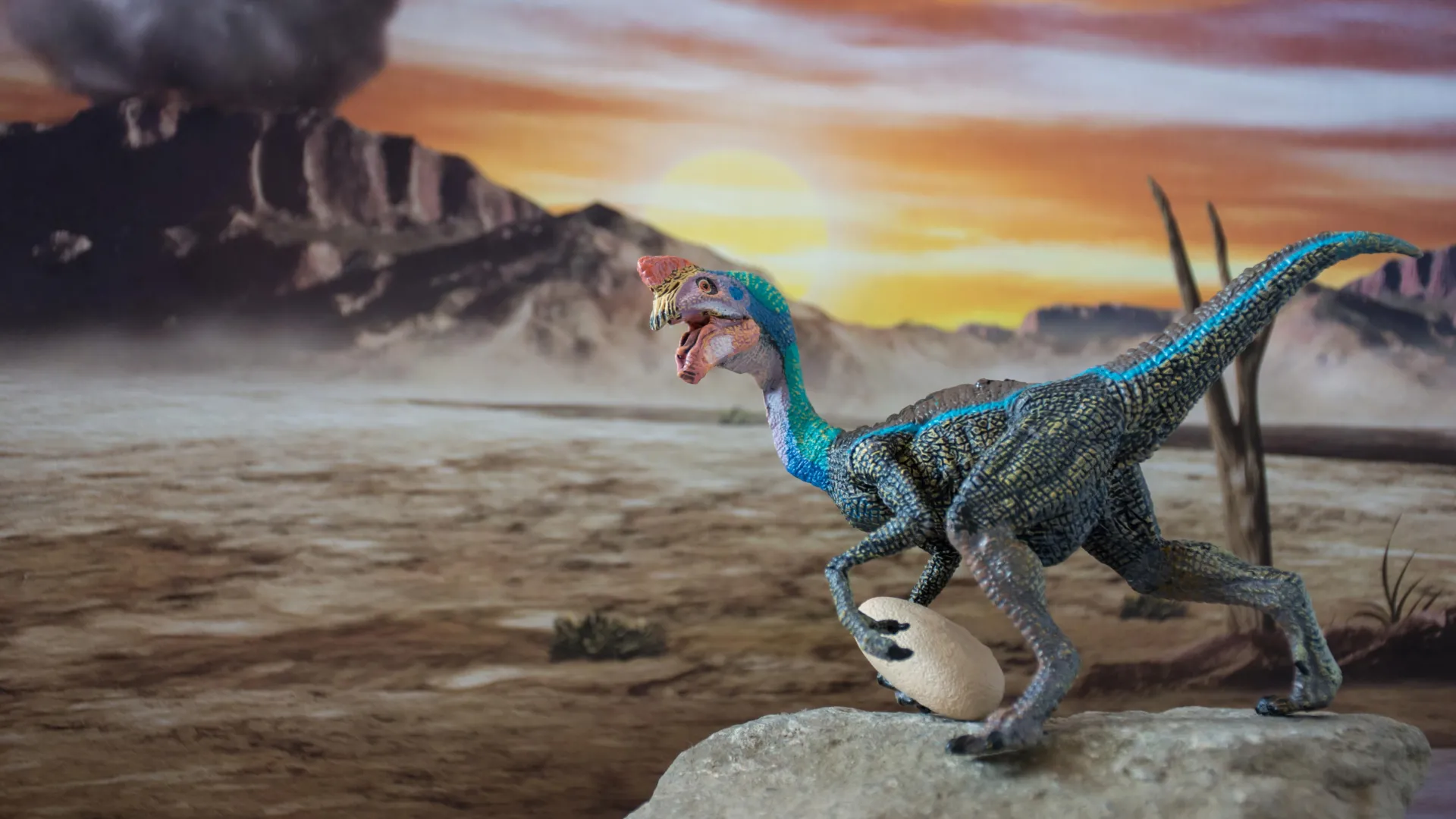
The debate over how non-avian dinosaurs brought their young into the world has long captivated paleontologists, bridging the gap between cold-blooded reptiles and warm-blooded birds. For decades, researchers have puzzled over the reproductive habits of oviraptors—feathered, bird-like dinosaurs that walked the Earth during the Late Cretaceous Period. While fossil evidence has consistently shown these creatures brooding atop clutches of eggs, the precise thermal dynamics of how those eggs were warmed remained an evolutionary enigma. Did these creatures sit on their nests like modern robins and eagles, or did they rely more heavily on environmental heat sources like modern crocodiles and sea turtles?
A groundbreaking study recently published in the scientific journal Frontiers in Ecology and Evolution offers a compelling new perspective. By pairing physical experiments with advanced computer simulations, an innovative research team in Taiwan has shed light on the mechanics of oviraptor brooding. The findings suggest that these prehistoric animals relied on a cooperative system of parental warmth and ambient solar energy—a hybrid incubation strategy that highlights a fascinating chapter in the evolutionary transition from reptiles to modern avian species.
The Path from Fossil Discovery to Experimental Paleontology
To understand the scope of the recent study, it is necessary to examine the historical context of oviraptor research. Living approximately 100 to 66 million years ago primarily in what is now modern-day Mongolia and China, oviraptors were small-to-medium-sized theropod dinosaurs. Characterized by their toothless, beak-like jaws, long necks, and frequent cranial crests, these animals were versatile omnivores, consuming everything from plants and seeds to small animals and eggs.
The very name "ovipactor," meaning "egg thief," stems from a historical misidentification. When the first fossil of the genus was unearthed in the 1920s, it was discovered directly above a nest of fossilized eggs, leading researchers to conclude that the animal had been caught in the act of raiding a nest belonging to another species. It took decades of subsequent fossil discoveries—many revealing adult skeletons preserved in careful brooding postures directly atop clutches of their own eggs—to correct the record. Paleontologists realized that these animals were not thieves, but dedicated parents safeguarding and tending to their developing progeny.
Despite these anatomical discoveries, the internal thermal mechanics of how these dinosaurs warmed their eggs remained purely speculative. Unlike modern birds, which possess specialized physiological adaptations for direct heat transfer, oviraptors possessed skeletal structures and nest designs that complicated simple analogies to modern avian brooding. To bridge this knowledge gap, a team of researchers led by Dr. Tzu-Ruei Yang, an associate curator of vertebrate paleontology at Taiwan’s National Museum of Natural Science, and first author Chun-Yu Su—who was a student at Washington High School in Taichung when the project was undertaken—decided to physically reconstruct the ancient nesting environment.
Recreating an Ancient Nursery: Methodology and Material Engineering
The research team centered their investigation on Heyuannia huangi, a well-documented species of oviraptor that inhabited the territory of modern-day China approximately 70 to 66 million years ago. A typical adult Heyuannia huangi measured roughly 1.5 meters in length and tipped the scales at an estimated 20 kilograms. Crucially, fossil records indicate that these animals constructed semi-open nests arranged in intricate, double-ringed patterns containing numerous elongated eggs.
Replicating this prehistoric nursery required an ingenious blend of paleontology, engineering, and material science. Because no living creature produces eggs morphologically identical to those of an oviraptor, the research team had to manufacture custom proxies. They cast artificial eggs out of resin, meticulously matching the size, shape, and layout of the double-ringed fossil clutches.
To represent the brooding adult, the team constructed a life-sized anatomical model of the dinosaur. The core framework was built from wood and lightweight polystyrene foam, over which layers of cotton, cloth, and bubble paper were meticulously draped to simulate the soft tissues, musculature, and insulating feathers of a living oviraptor.
"Part of the difficulty lies in reconstructing oviraptor incubation realistically," noted Chun-Yu Su during discussions of the methodology. "For example, their eggs are unlike those of any living species, so we invented the resin eggs to approximate real oviraptor eggs as best as we could."
With the physical model and artificial nest assembled, the researchers subjected the setup to various simulated environmental conditions, measuring how heat transferred from the model dinosaur and the surrounding environment to the interior of the resin eggs.
Solar Power and the Dynamics of Outer-Ring Variation
The experimental results revealed critical insights into how environmental variables influenced the thermal development of the eggs. Most notably, the study demonstrated that the position of the brooding adult relative to the nest played a decisive role in regulating egg temperatures, but that this effectiveness was heavily dictated by ambient weather conditions.
Under cooler simulated environmental conditions, eggs located in the outer ring of the nest—further away from the central body mass of the brooding adult—experienced significant temperature variances. The data showed temperature disparities of up to 6 degrees Celsius between the inner and outer eggs. In a biological context, such a pronounced thermal gap would have likely resulted in asynchronous hatching, a developmental phenomenon where eggs within the same clutch hatch at noticeably different times over a span of days or weeks.
Conversely, when the researchers simulated warmer environmental conditions, the temperature gap between the inner and outer rings dropped precipitously to just 0.6 degrees Celsius. This dramatic stabilization indicates that oviraptors residing in warmer climates relied heavily on ambient environmental heat—specifically sunlight striking the semi-open nests—to supplement the thermal output of the brooding parent.
"It’s unlikely that large dinosaurs sat atop their clutches. Supposedly, they used the heat of the sun or soil to hatch their eggs, like turtles," explained Dr. Tzu-Ruei Yang. "Since oviraptor clutches are open to the air, heat from the sun likely mattered much more than heat from the soil."
Oviraptors Versus Modern Birds: A Paradigm Shift in Incubation Efficiency
To contextualize their findings, the research team compared the thermal performance of the oviraptor model with the brooding strategies observed in modern avian species.
Modern birds rely almost exclusively on what biologists term thermoregulatory contact incubation (TCI). This specialized reproductive strategy depends upon three rigorous criteria: the incubating parent must make direct physical contact with every individual egg, the parent must act as the primary and nearly exclusive heat source for the clutch, and the parent must maintain all eggs within a tightly regulated, narrow temperature range to ensure uniform development.
The physical and anatomical constraints of oviraptors prevented them from fulfilling these strict requirements. Due to their body proportions, skeletal morphology, and the wide, semi-open layout of their nests, adult oviraptors could not achieve direct physical contact with every egg in the multi-tiered rings simultaneously.
"Oviraptors may not have been able to conduct TCI as modern birds do," Su observed. Instead, the physical evidence and thermal simulations point toward a cooperative model where the dinosaur and the sun acted as "co-incubators."
While this shared thermal strategy yielded a lower overall incubation efficiency compared to the sophisticated TCI systems of modern birds, the researchers caution against viewing this difference through a teleological lens of evolutionary progress. The lower efficiency score does not imply that oviraptors were poorly adapted; rather, it reflects a transitional evolutionary stage between fully buried, reptile-style nests and the highly intimate brooding behaviors of modern avian descendants.
"Modern birds aren’t ‘better’ at hatching eggs," Dr. Yang emphasized. "Instead, birds living today and oviraptors have a very different way of incubation or, more specifically, brooding. Nothing is better or worse. It just depends on the environment."
Broader Implications for Paleontology and Future Research
The publication of this study marks a significant methodological step forward for vertebrate paleontology. By successfully combining physical artifact reconstruction with computational heat-transfer modeling, the Taiwanese research team has demonstrated a viable framework for investigating complex biological behaviors that leave no direct fossilized trace. While the researchers readily acknowledge that Earth’s modern atmospheric and climatic conditions differ substantially from those of the Late Cretaceous, and that oviraptors likely required longer overall incubation periods than modern birds, the study provides a robust empirical foundation for future inquiry.
Furthermore, the project carries a profound symbolic resonance within the global scientific community. By conducting world-class paleontological research in Taiwan—a region famously devoid of native dinosaur fossils—the team has underscored the reality that modern scientific discovery is no longer bound solely by geography, but rather by ingenuity, interdisciplinary collaboration, and technological innovation.
"It also truly is an encouragement for all students, especially in Taiwan," Dr. Yang concluded. "There are no dinosaur fossils in Taiwan, but that does not mean that we cannot do dinosaur studies."
As researchers continue to refine computer simulations and experiment with novel proxy materials, the hazy window into the Late Cretaceous continues to clear. The image of the oviraptor standing guard over its clutch now comes into sharper focus: not as a clumsy reptile attempting to mimic a bird, nor as a fully fledged avian parent, but as a sophisticated transitional creature sharing parental duties with the ancient sun.
