
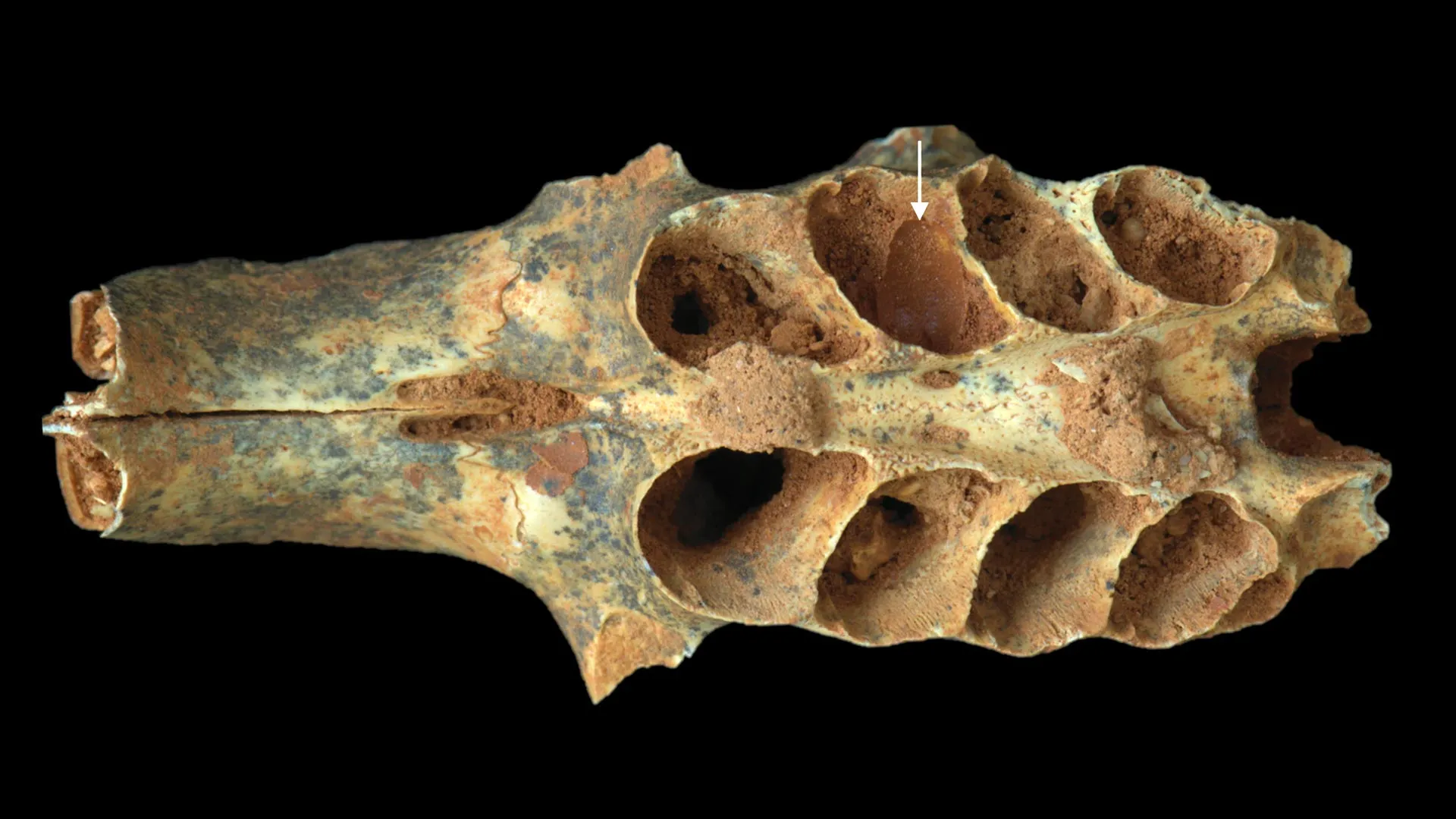
Deep inside a limestone cave on the Caribbean island of Hispaniola, an extraordinary prehistoric ecosystem has yielded a biological discovery that challenges long-held assumptions about insect behavior and fossil preservation. According to a landmark study recently published in the scientific journal Royal Society Open Science, ancient solitary bees utilized the fossilized tooth sockets of rodent jaws as micro-nursery chambers for their offspring some 20,000 years ago. This revelation marks the first documented evidence in the paleontological record of insects employing vertebrate skeletal remains as structural cavities for laying eggs, adding a fascinating chapter to the evolutionary history of insect-mammal interactions during the Late Pleistocene epoch.
The research was spearheaded by Lazaro Viñola López, a postdoctoral researcher at the Field Museum in Chicago, alongside an international team of paleontologists. The discovery unfolded during the analysis of a remarkably dense fossil deposit originally identified by Juan Almonte Milan, curator of paleobiology at the Dominican Republic’s Museo Nacional de Historia Natural. By examining micro-structures hidden inside the hollow cavities of ancient mammal jaws, the researchers uncovered an ingenious, highly specialized nesting strategy previously unknown to science.
The Setting: A Tapestry of Pleistocene Biodiversity
To understand how this unique biological interaction occurred, scientists must first reconstruct the environment of Hispaniola—the island shared by modern-day Haiti and the Dominican Republic—during the Late Pleistocene. Approximately 20,000 years ago, the region’s topography was defined by extensive karst landscapes characterized by porous limestone formations riddled with sinkholes and subterranean caverns.
According to field descriptions from the research team, descending into these limestone archives requires navigating vertical drops of roughly ten meters into dark subterranean passages. Beyond the immediate threshold, where arachnids such as tarantulas inhabit the rocky walls, these caves function as extraordinary natural traps and repositories. Over millennia, the cave examined in this study accumulated multiple distinct sedimentary strata separated by carbonate crusts, which formed during ancient periods of heavy rainfall.
The primary architects of this fossil assemblage were predatory birds. For generations spanning hundreds or potentially thousands of years, owls used the cave as a roosting site. Upon returning from nocturnal hunts, the raptors regurgitated indigestible materials in the form of pellets containing the skeletal remains of their prey. Consequently, the cave floor and lower recesses became saturated with an immense density of bones.
While the majority of the recovered specimens belong to small rodents, the deposit also preserves the remains of now-extinct ground sloths, diverse bird species, reptiles, and occasional larger vertebrates such as turtles and crocodiles that accidentally tumbled into the subterranean chambers. In total, the fossiliferous layers represent more than 50 distinct animal species, providing modern scientists with a high-resolution snapshot of an ancient Caribbean ecosystem.
Uncovering the Mystery in the Tooth Sockets
The breakthrough discovery occurred almost by accident. While cleaning and sorting mammalian jawbones recovered from the owl pellets, lead author Lazaro Viñola López noticed structural anomalies within the empty tooth sockets. Rather than containing standard wind-blown sediment or mineralized debris washed in by water, several specimens featured smooth, concave deposits lining the tiny cavities.
The unusual consistency and geometry of these internal linings immediately signaled that natural geological accumulation was not responsible for their presence. Drawing upon academic experience gained during an undergraduate fossil excavation in Montana—where a colleague had demonstrated the characteristics of fossilized wasp cocoons—Viñola López suspected an entomological origin. The hardened mud structures closely mirrored chambers constructed by insects to shelter developing larvae.
To investigate this hypothesis without compromising the structural integrity of the delicate fossils, the research team employed high-resolution computed tomography (CT) scanning. The non-destructive imaging technique allowed scientists to peer inside the bone matrix in three dimensions, generating digital cross-sections of the mysterious internal chambers.
The scans confirmed that the structures bore an exact morphological resemblance to the mud-based nests built by modern solitary bees. Furthermore, microscopic analysis revealed preserved grains of ancient pollen trapped within the sediment matrices. This pollen served as a vital protein-rich food source gathered by mother bees to nourish their hatching larvae, confirming the biological function of the micro-structures.
Botanical and Behavioral Implications of Solitary Bees
The discovery sheds light on the lesser-known behavioral ecology of solitary bees, which vastly outnumber their social counterparts, such as honeybees and bumblebees, in terms of species diversity. Unlike social insects that construct elaborate, communal hives, solitary bees lead independent lives. Female solitary bees typically seek out pre-existing cavities—such as hollow plant stems, burrows in the soil, or fissures in wood—where they provision a small chamber with pollen and nectar, lay a single egg, and seal the space.
In some regions of modern Africa and Europe, specialized solitary bee species have adapted to unconventional micro-habitats, such as utilizing empty snail shells to rear their young. However, the utilization of vertebrate skeletal elements, specifically mammalian tooth sockets, had never been recorded in either the modern biological literature or the fossil record prior to this study.
Measuring smaller than a standard pencil eraser, each individual nest required precise architectural effort. The research team hypothesizes that the mother bees manufactured the tiny chambers by mixing fine regional soil particles with their own saliva to create a durable, cement-like mud. Placing these nurseries deep within the hollow sockets of larger animal bones offered significant evolutionary advantages, shielding the fragile offspring from environmental fluctuations and potential predators such as parasitic wasps.
Taxonomic Classification and the Mystery of the Missing Bees
Because the warm and humid climatic conditions characteristic of Caribbean caves rapidly accelerate the decomposition of delicate organic tissues, no fossilized bee bodies were recovered from the interior of the nests. Without physical specimens of the insects themselves, assigning the structures to a precise biological species remains challenging.
Nevertheless, the distinct architecture and context of the trace fossils warranted formal scientific classification. The research team designated the newly identified ichnospecies Osnidum almontei. The taxonomic name honors Juan Almonte Milan, whose foundational work in identifying and preserving the fossil resources of the Dominican Republic made the discovery possible.
While the exact species responsible for constructing Osnidum almontei cannot be definitively identified, researchers have advanced two primary hypotheses. Given how little is currently documented regarding the ecology and distribution of many native Caribbean bee populations, it is plausible that the nesting lineage survives today. Alternatively, because the ecosystem surrounding the cave featured numerous vertebrate species that are now entirely extinct, the bee species itself may have vanished along with the specialized habitats of the Late Pleistocene.
Environmental Pressures Driving Evolutionary Ingenuity
Paleontologists emphasize that this unprecedented nesting behavior was likely shaped by severe environmental constraints. Geological surveys of the Hispaniola study site indicate that the surrounding limestone terrain possesses very little traditional soil cover. This scarcity of arable earth would have severely limited the availability of subterranean nesting sites typically favored by ground-nesting bees.
Simultaneously, the continuous ecological activity of the resident owl populations introduced an abundant, highly concentrated supply of alternative cavities. By capitalizing on the millions of microscopic voids left behind in skeletal remains, the ancient bees demonstrated remarkable behavioral plasticity, turning the discarded refuse of local predators into safe nurseries for the next generation.
Broader Impacts on Paleontological Methodology
Beyond expanding our understanding of prehistoric insect behavior, the study carries important methodological implications for the broader scientific community. Researchers point out that vertebrate paleontologists frequently focus exclusively on larger skeletal remains, occasionally treating adhering sediments as matrix to be cleaned away and discarded.
The identification of Osnidum almontei highlights the necessity of interdisciplinary observation in fossil preparation. By remaining vigilant for trace fossils—such as insect nests, burrow casts, and gnaw marks—scientists can extract complex ecological data regarding invertebrate communities that are otherwise absent from the fossil record.
Ultimately, the revelation that Pleistocene bees once raised their young inside the jaws of rodent prey underscores the interconnectedness of ancient ecosystems. It demonstrates that evolutionary survival often hinges on behavioral innovation, transforming the smallest fragments of the past into vital cradles of new life.
