
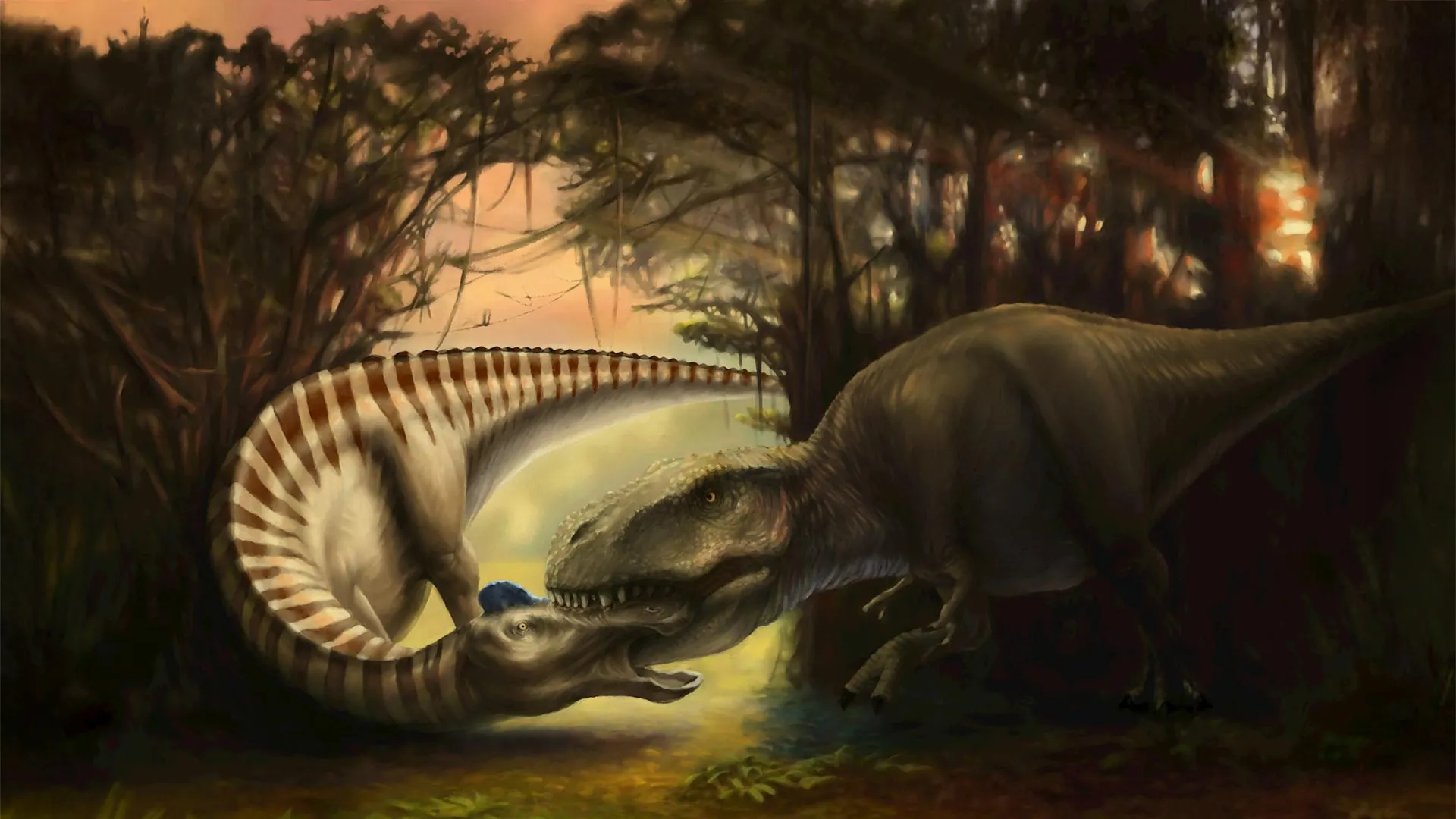
A remarkable fossil housed within the paleontology collections at Montana State University’s Museum of the Rockies is offering scientists an unusually detailed glimpse into the predatory mechanics of Tyrannosaurus. The specimen, centered around a tyrannosaur tooth still physically embedded in the facial bone of another dinosaur, forms the basis of a newly published study spearheaded by researchers from Montana State University and Canada’s University of Alberta. Published in the peer-reviewed scientific journal PeerJ, the research sheds new light on the behaviors of North America’s apex predator during the twilight of the Age of Dinosaurs.
Dating back approximately 66 million years to the late Maastrichtian stage of the Cretaceous period, the ecosystem of what is now modern-day Montana was dominated by some of the largest terrestrial animals to ever walk the Earth. In this humid, heavily forested floodplain environment, the apex predator Tyrannosaurus shared a landscape with massive herbivorous dinosaurs, including the heavily armored, three-horned Triceratops and the massive, duck-billed Edmontosaurus. For decades, paleontologists have debated whether Tyrannosaurus was an active apex predator or merely an opportunistic scavenger. While numerous fossils bear the unmistakable score marks of tyrannosaur teeth, discovering a tooth physically lodged within the bone of a prey animal provides rare, direct physical evidence of predatory interaction.
The Unearthing of an Exceptional Specimen
The story of this extraordinary fossil began in 2005, when a field expedition operating in the Hell Creek Formation of eastern Montana uncovered a nearly complete Edmontosaurus skull. The excavation took place on public lands managed by the United States Department of the Interior’s Bureau of Land Management, an agency that frequently collaborates with academic institutions to preserve significant paleontological resources. Following its extraction, preparation, and curation, the fossil was transferred to the permanent collections of the Museum of the Rockies in Bozeman, Montana.
Today, the skull is exhibited as a centerpiece in the museum’s prominent Hall of Horns and Teeth. While studying the cranium, researchers noted an anomalous feature: a broken tyrannosaur tooth remains firmly wedged into the nasal region of the duck-billed dinosaur’s skull. This pivotal observation prompted a collaborative investigation led by Taia Wyenberg-Henzler, a doctoral student at the University of Alberta, working alongside Dr. John Scannella, the Curator of Paleontology at the Museum of the Rockies.
"Although bite marks on bones are relatively common, finding an embedded tooth is extremely rare," noted Wyenberg-Henzler during discussions surrounding the publication of the study. "The great thing about an embedded tooth, particularly in a skull, is it gives you the identity of not only who was bitten but also who did the biting. This allowed us to paint a picture of what happened to this Edmontosaurus, kind of like Cretaceous crime scene investigators."
Reconstructing the Attack Through Advanced Imaging
To definitively identify the species responsible for the bite, the research team conducted a rigorous comparative analysis. They systematically matched the dimensions, serration density, and morphology of the embedded tooth against the known dental profiles of every carnivorous dinosaur species documented within the Hell Creek Formation. The results pointed exclusively to Tyrannosaurus.
To gain a non-destructive look at the internal architecture of the bite, the researchers transported the delicate fossil to Advanced Medical Imaging at Bozeman Health Deaconess Hospital. There, medical-grade computed tomography (CT) scans were performed. These high-resolution scans allowed the team to visualize the depth of the penetration, the angle of the impact, and the precise manner in which the serrated tip of the tyrannosaur tooth became structurally trapped within the dense bone of the Edmontosaurus nasal cavity.
"A fossil like this is extra exciting because it captures a behavior: a tyrannosaur biting into this duckbill’s face," explained Dr. John Scannella. "The skull shows no signs of healing around the tyrannosaur tooth, so it may have already been dead when it was bitten, or it may be dead because it was bitten." The absence of bone remodeling—the biological process by which living bone heals and grows around a foreign object or injury—indicates that the traumatic event occurred either immediately prior to the animal’s death or post-mortem. However, the positioning and force required to snap a robust tyrannosaur tooth off at the root strongly support a violent, active confrontation.
Chronology of the Hell Creek Ecosystem
To contextualize the find, paleontologists look closely at the geological timeline of the Hell Creek Formation, a famous stratigraphic sequence spanning parts of Montana, North Dakota, South Dakota, and Wyoming.
- Approximately 68 to 66 million years ago: The Hell Creek ecosystem thrives as a coastal lowland bordering the Western Interior Seaway, characterized by meandering rivers, broad floodplains, and sub-tropical to temperate forests.
- Approximately 66 million years ago: The specific individual Edmontosaurus lives, interacts with its herd, and encounters a mature Tyrannosaurus rex in a fatal face-to-face confrontation, leaving a broken tooth embedded in its nasal bone.
- 2005: Field paleontologists discover the fossilized skull during routine excavations in eastern Montana on land managed by the Bureau of Land Management.
- Post-2005 to Present: The specimen is curated, prepared, and placed on public display at the Museum of the Rockies, eventually drawing the attention of researchers Taia Wyenberg-Henzler and John Scannella.
- Recent: The collaborative team utilizes medical CT scanning and comparative anatomy to complete their study, culminating in formal publication in the scientific journal PeerJ.
Insights into Tyrannosaurid Biomechanics and Behavior
The angle and location of the embedded tooth provide critical data regarding the behavioral ecology of Tyrannosaurus. According to Wyenberg-Henzler, the orientation of the bite on the nose of the Edmontosaurus strongly suggests a direct, frontal engagement. Such face-to-face combat dynamics are typically observed in modern predatory encounters where a predator actively attempts to subdue, incapacitate, or kill resisting prey.
Furthermore, the structural failure of the tooth—resulting in the apex snapping off and remaining embedded within the victim’s bone—underscores the immense physical forces generated during a tyrannosaur bite. Previous biomechanical studies have estimated that an adult Tyrannosaurus rex possessed a bite force exceeding 12,000 pounds (over 53,000 Newtons), capable of crushing bone and stripping flesh with ease. The sheer pressure required to fracture a heavily enameled, banana-sized tooth against another bone points to the employment of lethal force.
"Looking at the way the tooth is embedded in the nose of the Edmontosaurus suggests that it met its attacker face-to-face, something that usually happens to an animal that was killed by a predator," Wyenberg-Henzler stated. "The amount of force necessary for a tooth to have become broken off in bone also points to the use of deadly force. For me, this paints a terrifying picture of the last moments of this Edmontosaurus."
Broader Scientific Implications and Future Research
For generations, the lifestyle of Tyrannosaurus has been a subject of intense academic debate. While early twentieth-century depictions largely cast the animal as an active predator, subsequent hypotheses in the late twentieth century argued that its massive size, relatively small arms, and olfactory adaptations might indicate a scavenger-dominated niche. Over the last two decades, however, an accumulation of fossil evidence—including healed bite marks on living prey species like Triceratops and Edmontosaurus, as well as fossilized stomach contents—has firmly tipped scientific consensus back toward active predation.
The discovery and analysis of the Museum of the Rockies specimen add a vital, empirical data point to this ongoing discussion. By preserving a direct physical artifact of the predator-prey dynamic, the fossil bridges the gap between theoretical biomechanics and observable behavior in the fossil record.
Institutions such as the Museum of the Rockies and the University of Alberta continue to emphasize the importance of public lands management and institutional collaboration in making such discoveries possible. Specimens recovered from formations like Hell Creek serve as archives of ancient ecosystems, preserved through geological processes to provide modern researchers with windows into a world that vanished 66 million years ago. As imaging technologies continue to advance, paleontologists anticipate that further re-examinations of existing museum collections will yield additional micro-details about the daily struggles, predatory strategies, and ecological relationships of the last non-avian dinosaurs.
