
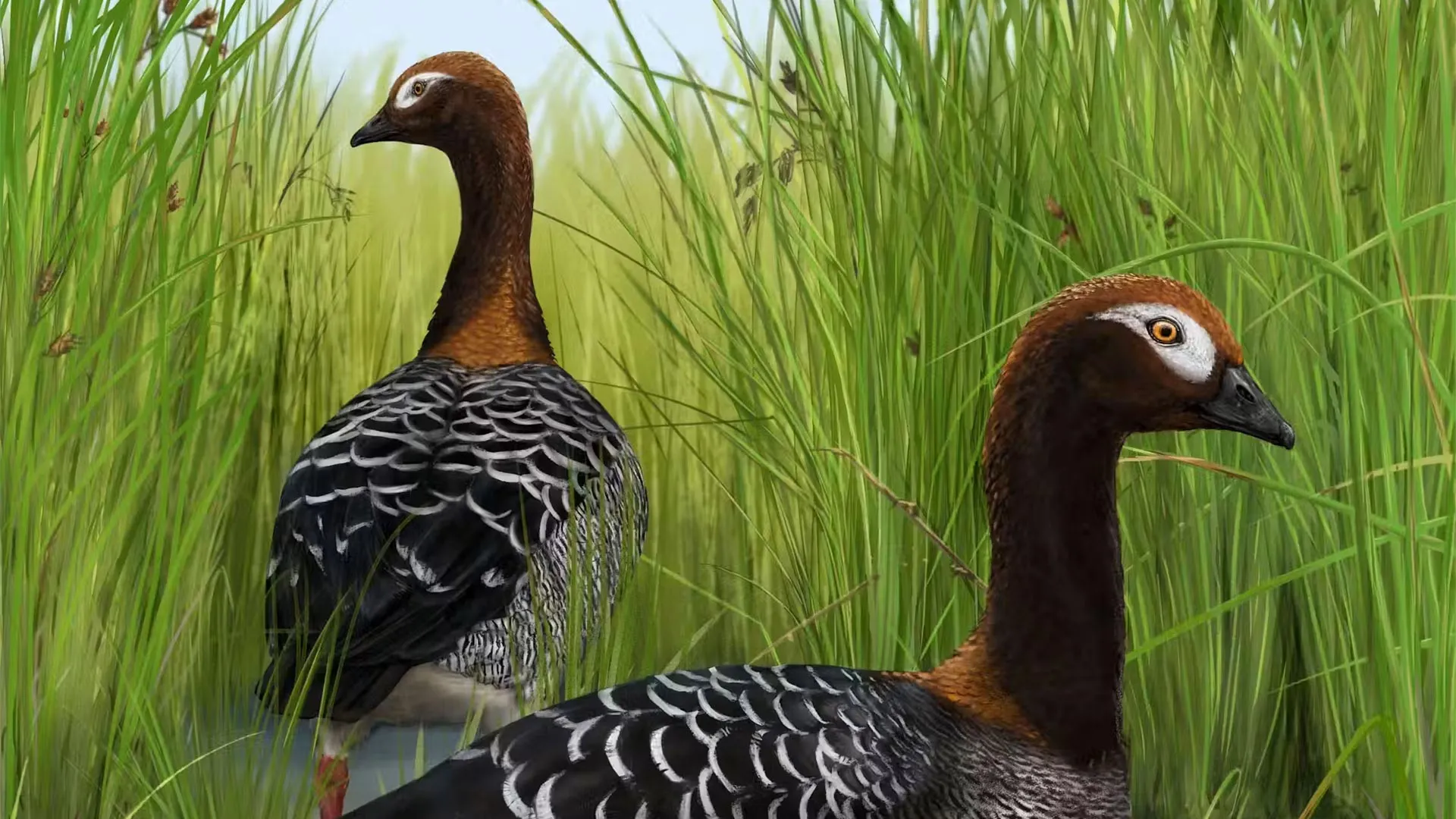
Deep within the ancient, sediment-rich remnants of a prehistoric lake in Central Otago, New Zealand, paleontologists have unearthed a remarkably preserved fossil that is challenging long-held assumptions about how the nation’s iconic birdlife evolved. The discovery, which introduces a previously unknown species of prehistoric waterfowl to the scientific record, provides critical new insights into the dynamic, wave-like colonization of the isolated landmass of Zealandia. Researchers from the University of Otago (Ōtākou Whakaihu Waka), the Museum of New Zealand Te Papa Tongarewa, and the University of Cambridge have determined that the fossilized remains belong to an ancient, small-sized goose that lived millions of years ago, completely altering the established timelines of avian migration and lineage in the Southern Hemisphere.
The findings, published in the peer-reviewed scientific journal Historical Biology, are the result of an exhaustive international research initiative focused on the internationally significant St Bathans fossil deposits. For decades, these deposits have served as an invaluable window into a prehistoric ecosystem that existed long before human settlement. By combining cutting-edge paleogenetics with meticulous morphological comparisons, the research team has pieced together a more intricate, layered narrative of how Aotearoa’s unique fauna came to be, proving that the biological history of the region is far more complex and fluid than previously understood.
Unearthing a Hidden Species in the St Bathans Deposits
The St Bathans fossil site in Central Otago is renowned among paleontologists for preserving a diverse array of Miocene-era animals and plants, offering a rare glimpse into an ecosystem that flourished roughly 16 to 19 million years ago. While waterfowl fossils are relatively abundant at the location, complete or identifiable goose remains have historically been sparse, leaving significant gaps in researchers’ understanding of early anatid evolution in the region.
To address this gap in the fossil record, an international team of scientists undertook a comprehensive re-examination of every single fossil bone from the St Bathans site that had ever been preliminarily classified as belonging to geese. The researchers conducted rigorous comparative analyses, juxtaposing these ancient fragments against other fossilized waterfowl recovered from the same geological strata. Furthermore, they cross-referenced the physical characteristics of the bones with an extensive, global repository of modern and extinct bird skeletons housed in international museum collections.
The painstaking investigation yielded a major breakthrough. The research team concluded that the analyzed bone assemblage contained an entirely undescribed species of waterfowl, roughly the size of a modern small goose. Formally designated as Meterchen luti, the newly discovered bird possesses a taxonomic name rooted in both classical etymology and whimsical scientific tradition. The genus name Meterchen is derived from ancient Greek meaning "mother goose," while the specific epithet luti comes from Latin, translating to "of the mud." This nomenclature pays homage to the nursery rhyme "Old Mother Goose" while aptly describing the manner in which the ancient creature’s remains were entombed and preserved within the muddy sediments of a prehistoric lakebed.
Associate Professor Nic Rawlence, Director of the Otago Palaeogenetics Laboratory and a co-author of the study, emphasized that Meterchen luti occupies a distinct evolutionary branch. Crucially, the St Bathans goose is not closely related to the recently extinct giant flightless New Zealand geese belonging to the genus Cnemiornis, nor does it share a direct lineage with their modern Australian counterpart, the Cape Barren goose. This clear taxonomic separation signaled to the researchers that they were dealing with an evolutionary chapter far more complicated than a simple, linear progression from ancient waterfowl to modern island giants.
Rethinking the Chronology of Zealandia’s Colonization
For many years, mainstream evolutionary theory in New Zealand biogeography adhered to a relatively straightforward model of avian arrival. An older, prevailing hypothesis argued that the St Bathans goose represented the direct evolutionary ancestors of the giant, flightless Cnemiornis geese. If correct, this theory implied that the lineage had maintained a continuous, uninterrupted history of at least 14 million years within the isolated continental fragments of Zealandia.
However, this long-held hypothesis increasingly clashed with emerging genetic datasets. Modern DNA and molecular clock analyses have strongly suggested that the ancestors of the giant Cnemiornis geese actually arrived in New Zealand from Australia much later, approximately seven million years ago. While proponents of the older morphological theory previously discarded these genetic contradictions, the new multidisciplinary study has definitively weighed in on the debate.
Alan Tennyson of the Museum of New Zealand Te Papa Tongarewa, who served as the lead author of the study, noted that the comprehensive reassessment strongly supports the later arrival theory. The new research paints a picture of multiple, successive waves of colonization over millions of years, rather than a single, ancient wave of settlers that gave rise to all subsequent forms.
According to Tennyson and his colleagues, while many bird species have indeed traversed the vast expanse of the ocean to reach New Zealand over deep time, the ancestors of several of the country’s most prominent large endemic birds arrived surprisingly recently. Recent arrivals—dating back a mere four to five million years—include iconic taxa such as the takahē, Forbes’ harrier, and the apex avian predator, the giant Haast’s eagle.
The integration of the Meterchen luti discovery into this broader timeline indicates that the St Bathans goose represents an earlier, independent colonization event. The ancestors of this ancient goose reached Zealandia more than 14 million years ago, establishing a localized lineage that ultimately flourished for a time before going completely extinct without leaving any modern descendants. This lineage extinction highlights the precarious and ever-shifting nature of island ecosystems, where ancient pioneers could successfully colonize a landmass yet still succumb to environmental, climatic, or ecological pressures over vast stretches of geological time.
The Power of Multidisciplinary Paleontology
The successful identification of Meterchen luti and the subsequent restructuring of New Zealand’s avian evolutionary tree underscore a broader methodological shift within modern paleontology. Scientists are no longer relying solely on traditional osteology—the study of bone structure and physical morphology—to reconstruct the history of life on Earth. Instead, contemporary research demands what Associate Professor Rawlence describes as using "all the tools in the toolbox."
By seamlessly integrating ancient DNA extraction, high-resolution CT scanning, stratigraphic analysis, and macroevolutionary modeling, researchers can interrogate the fossil record with unprecedented precision. This multidisciplinary approach allows science to track how the dynamic geological shifts, profound climatic oscillations, and eventual human-induced pressures upon Zealandia have collectively shaped the unique evolution of Aotearoa’s terrestrial fauna.
The methodological rigor applied to the St Bathans deposits has yielded particularly profound insights into the phenomenon of island gigantism and morphological acceleration. The giant flightless Cnemiornis geese serve as a textbook example of how rapidly island species can undergo dramatic physical transformation once isolated from mainland mammalian predators and pressures. Standing approximately one meter tall and tipping the scales at up to 18 kilograms, Cnemiornis represented the largest geese anywhere in the world.
Yet, as the new study highlights, this astonishing evolutionary transformation occurred over a relatively short evolutionary timeframe following a colonization event roughly seven million years ago. The coexistence—albeit at different points in geological history—of diverse waterfowl lineages like the ancient, modest-sized Meterchen luti and the later, colossal Cnemiornis demonstrates that Zealandia acted as a dynamic crucible of avian evolution, marked by repeated immigration, rapid adaptation, and, frequently, terminal extinction.
Broader Implications for Conservation and Biodiversity
Beyond academic debates regarding Miocene-era biogeography, the formal description of Meterchen luti carries significant weight for modern conservation science and ecological understanding. As conservationists grapple with the unprecedented biodiversity crisis facing contemporary ecosystems, studying the deep-time history of island biogeography provides essential baseline data regarding how species respond to isolation, environmental change, and habitat loss.
New Zealand’s avian fauna has long been recognized globally as a natural laboratory for studying evolution, largely due to the prolonged geographic isolation of the Zealandia continent following its separation from Gondwana. However, discoveries like the St Bathans goose continually refine our understanding of just how porous ocean barriers have been over geological epochs. The realization that New Zealand’s birdlife is the product of continuous, rolling waves of colonization—rather than an ancient, static ark of Gondwanan relics—fundamentally changes how scientists view the resilience and adaptability of migratory species.
Furthermore, documenting the rise and fall of lineages such as the St Bathans goose provides sobering context regarding the natural turnover of species. Ecosystems are inherently dynamic; lineages emerge, adapt, radiate, and vanish even in the absence of anthropogenic interference. However, understanding the natural vulnerabilities of specialized island forms—such as the rapid evolution of flightlessness in response to predator-free environments—offers critical lessons for safeguarding modern endemic species against introduced mammalian predators and rapidly changing global climates.
As international research teams continue to sieve through the remarkably rich sediments of the St Bathans fossil deposits, the prehistoric lakes of Central Otago are expected to yield further secrets. Each recovered bone fragment adds another critical data point to the complex matrix of Southern Hemisphere biodiversity. Through the combined power of ancient genetics, painstaking anatomical comparison, and collaborative global science, researchers are slowly resurrecting a lost world, ensuring that the forgotten inhabitants of ancient Aotearoa, from muddy lakebed geese to apex predators, are finally written back into the history of life on Earth.
