
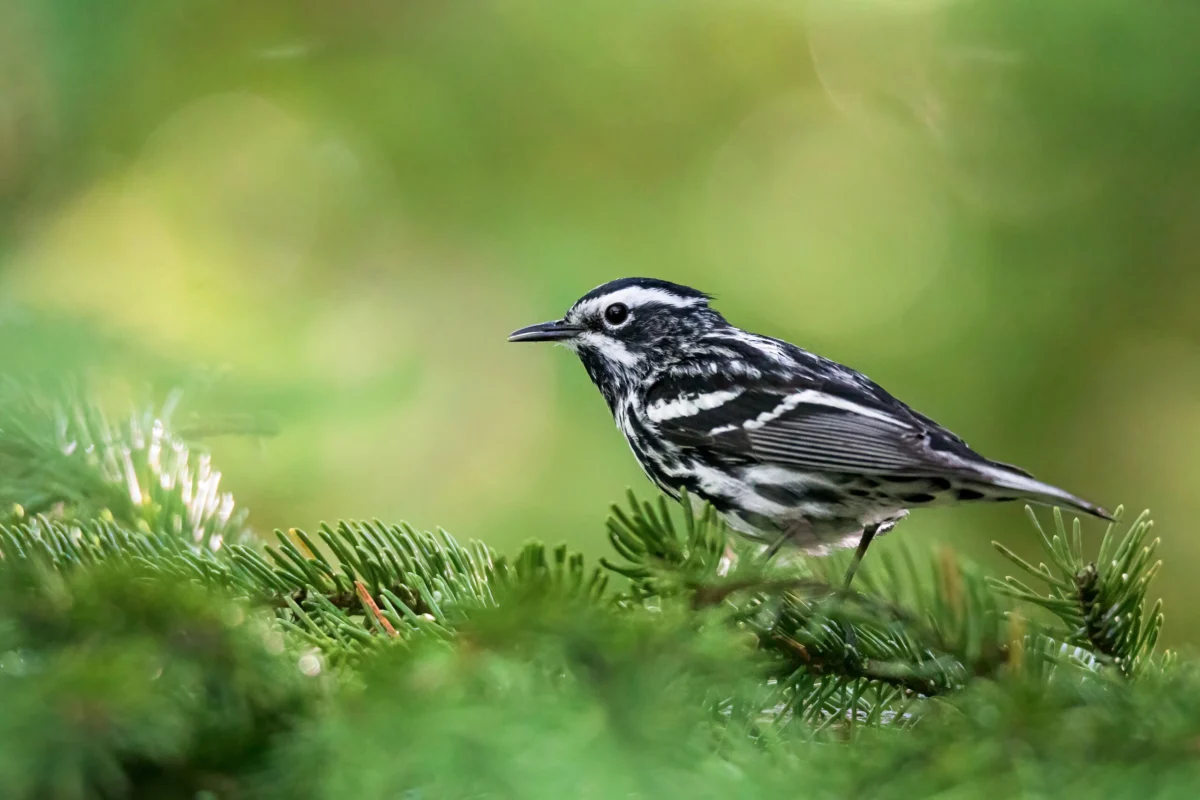
Across the diverse ecosystems of North America, from the arid landscapes of the Western mountain ranges to the bustling urban parks of the East Coast, one color palette remains a constant: the bold, high-contrast duo of black and white. While many birds are celebrated for their vibrant blues, reds, and yellows, the prevalence of black-and-white plumage is not merely an aesthetic coincidence. It is an evolutionary strategy, a survival mechanism, and a defining characteristic of some of the continent’s most successful avian species. Ornithologists and researchers note that this specific color combination is found in dozens of species, serving functions that range from structural integrity to complex behavioral signaling.
The evolutionary logic behind this monochromatic display is rooted in physics and biology. Black feathers, which are dense with melanin, are structurally more resistant to wear and tear than lighter-colored feathers. This durability is particularly advantageous for birds that forage by pecking at wood, such as woodpeckers, or those that spend significant time navigating abrasive environments. White feathers, conversely, offer distinct advantages in thermoregulation and camouflage, particularly in snowy or sun-drenched environments. When combined, these colors create "countershading," a classic biological adaptation where an animal is darker on top and lighter on the bottom. This strategy obscures the bird’s silhouette against both the sky and the ground, effectively baffling predators who struggle to perceive depth and form in the high-contrast pattern.
Chronology of Avian Adaptation and Migration
The presence of these birds in North American landscapes is tied to long-standing migratory cycles that have shifted alongside changing climate patterns. For neotropical migrants like the Black-and-white Warbler and the Bobolink, the return to breeding grounds in the spring marks a seasonal shift in the visibility of these species. Historical records suggest that these birds have followed established migratory corridors for millennia, moving from the boreal forests of Canada down through the Appalachians and into the Gulf Coast.
Recent data from the National Audubon Society and other biological surveys indicate that the timing of these arrivals is shifting. As global temperatures rise, the "phenological mismatch"—where birds arrive at their breeding grounds before their primary food sources are available—has become a growing concern for conservationists. Despite these challenges, the consistent visibility of non-migratory species, such as the Black-capped Chickadee and the White-breasted Nuthatch, provides a baseline for tracking regional avian health. These resident birds maintain their plumage year-round, serving as reliable sentinels for backyard ecosystem monitoring.
Categorizing Common Backyard Visitors
To the casual observer, distinguishing between similar-looking species can be a challenge. The following classification outlines the most common species encountered by homeowners and birding enthusiasts, emphasizing key diagnostic features.
The Black-capped Chickadee (Poecile atricapillus) serves as a quintessential example of backyard wildlife. Distinguished from its southern counterpart, the Carolina Chickadee, by wider white edges on its wing feathers and a more extensive white cheek patch, it remains a favorite at feeders. In contrast, the White-breasted Nuthatch (Sitta carolinensis) is often identified by its unique behavior; these birds are known for their habit of spiraling head-first down tree trunks, a trait that makes them easily recognizable even from a distance.
Woodpecker identification presents its own set of challenges, most notably between the Downy and the Hairy Woodpecker. While they appear virtually identical in their black-and-white markings, the size disparity is the most reliable metric for field identification. A common mnemonic among birders—that the Downy fits in a standard pint glass while the Hairy does not—continues to be a standard reference point for those seeking to differentiate between the two in the field.
Data on Species Distribution and Conservation
Ornithological data highlights that the distribution of black-and-white birds is not uniform. Large-scale avian surveys reveal that certain species, such as the Canada Goose, have adapted so successfully to human-altered landscapes that they now occupy nearly every urban and rural waterway in North America. Their iconic black neck and head, paired with white cheeks, are recognized globally. Conversely, species such as the Red-cockaded Woodpecker face significant conservation hurdles. Listed as a threatened species, its habitat requirements are highly specific to old-growth pine forests, illustrating how even successful plumage patterns cannot compensate for the rapid loss of critical nesting environments.
In the coastal regions, the diversity of black-and-white seabirds—ranging from the Atlantic Puffin to the Black Skimmer—demonstrates the effectiveness of countershading in aquatic environments. Researchers at marine biology institutes note that the contrast of these birds provides a distinct advantage when diving, as the pattern can mask the bird from both aerial predators looking down and marine life looking up at the surface.
Expert Analysis and Environmental Implications
Environmental scientists suggest that the prevalence of these birds is a testament to the versatility of their evolutionary design. Dr. Aris Thorne, a specialist in avian plumage, notes that "the persistence of black-and-white coloration across such diverse taxa—from raptors and corvids to waterfowl and songbirds—is evidence of a highly effective set of survival tools."
The implications for residential conservation are significant. By installing suet feeders, maintaining native plant gardens, and providing water sources, homeowners can directly support these populations. The broader impact of such localized efforts is substantial; when thousands of individual households create "micro-habitats," they provide critical stopover points for migratory species and stable resources for year-round residents. This collective action is essential for mitigating the loss of biodiversity caused by urbanization and agricultural expansion.
Future Outlook and Research Priorities
As tracking technology improves, the focus of ornithology is shifting toward understanding how these birds navigate increasingly fragmented habitats. The use of GPS-enabled banding and satellite tracking has allowed researchers to map the specific flight paths of the Common Loon and the various species of terns with unprecedented accuracy. These insights are leading to more informed policy decisions regarding protected flyways and coastal preservation zones.
For the public, the ability to identify these birds is more than a hobby; it is a gateway to ecological literacy. The Audubon bird guide app and similar digital resources have democratized access to identification tools, allowing citizens to participate in community science programs like the Great Backyard Bird Count. By reporting sightings of species like the Black-billed Magpie or the Rose-breasted Grosbeak, the public provides researchers with invaluable data points that inform long-term population trends.
The story of North America’s black-and-white birds is one of resilience and adaptation. From the smallest chickadee in a suburban garden to the vast, haunting presence of a loon on a northern lake, these species continue to thrive by utilizing a color scheme that has stood the test of evolutionary time. Understanding these birds requires more than just a quick glance; it requires an appreciation for the complex interplay between light, feather structure, and the environment. As our climate continues to shift, these monochromatic sentinels will remain at the forefront of our efforts to study, protect, and cherish the natural world.
Whether one is a professional ornithologist or a curious backyard observer, the study of these birds offers a profound look into the mechanics of survival. Through continued conservation efforts and a commitment to maintaining native habitats, the sight of a black-and-white flash in the trees or a striking silhouette against the tide will remain a staple of the North American landscape for generations to come.
