
What began as a routine shortcut to circumvent parking fees has culminated in a monumental ecological discovery. In the spring of 2022, Rachel Fordyce, a lab technician at Cornell University’s entomology department, was seeking a more efficient pedestrian route to her laboratory. By parking her vehicle at Ithaca’s East Hill Plaza and cutting through the hallowed grounds of the historic East Lawn Cemetery, she stumbled upon a phenomenon that would alter contemporary understandings of wild bee ecology. The air was alive with an unprecedented hum, and the ground itself seemed to move. Thousands of bees were swarming the landscape, an arresting sight that prompted Fordyce to capture a few specimens in a standard glass jar and deliver them to her supervisor, Professor Bryan Danforth.
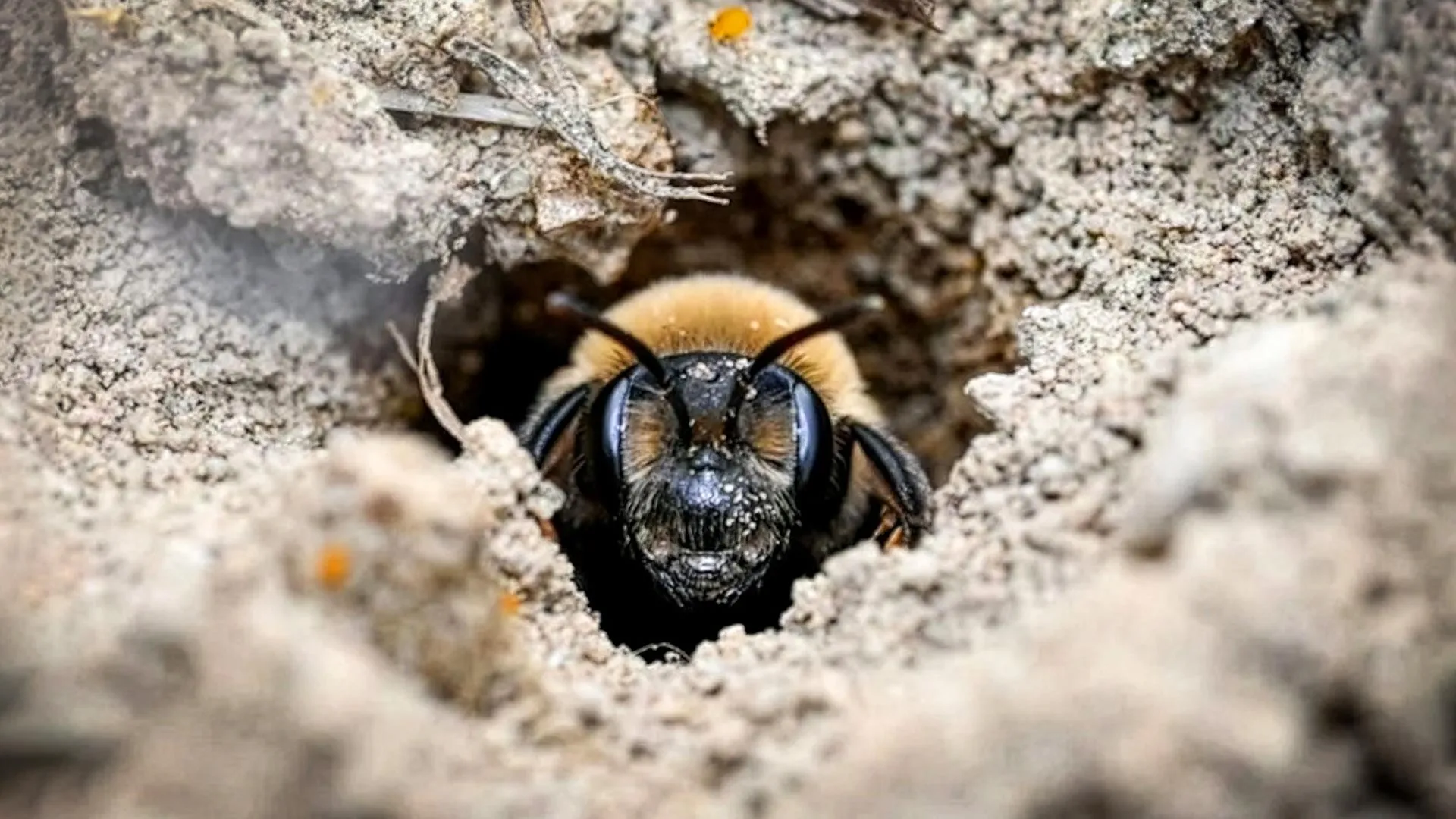
Upon closer inspection at Cornell’s College of Agriculture and Life Sciences, the insects were identified as Andrena regularis, commonly referred to as the regular mining bee. This solitary, wild subterranean species is known for its vital ecological role in pollinating both wild flora and critical agricultural crops. What initially appeared to be a localized natural curiosity soon unraveled into something much larger. Subsequent scientific investigations revealed that East Lawn Cemetery harbors one of the most expansive and ancient aggregations of ground-nesting bees ever recorded in scientific literature. Researchers estimate that a staggering 5.5 million individual bees are densely packed within a modest 1.5-acre sector of the cemetery grounds. To contextualize this massive concentration, the population density rivals more than 200 commercial honeybee hives and outnumbers the human population of Manhattan by more than threefold.
The findings, spearheaded by undergraduate researcher Steve Hoge ’24, were formally published on April 13 in the peer-reviewed scientific journal Apidologie. This groundbreaking discovery sheds light on a poorly understood sector of insect biology while underscoring the vital ecosystem services provided by solitary bees, particularly regarding New York’s signature agricultural commodities, such as apple production.
A Century-Long Sanctuary: The Historical Context of East Lawn Cemetery
Established in 1878, East Lawn Cemetery has served the Ithaca community for nearly a century and a half as a place of solemn remembrance. Yet, archival records indicate that the underground inhabitants of the A. regularis species have been utilizing these grounds for nearly as long. Historical documentation confirms that regular mining bees have occupied the cemetery since at least the early 1900s.
This longevity highlights a growing consensus among conservation biologists: older, well-established cemeteries frequently function as inadvertent ecological refuges. Free from the aggressive urban development, intensive pesticide applications, and heavy foot traffic that characterize modern municipal spaces, these pastoral landscapes offer a sanctuary for rare and sensitive species. Urban ecologists have long recognized that historic cemeteries often shelter uncommon botanical specimens, specialized insect populations, migrating avian species, and small mammals.
Keven Morse, the superintendent of East Lawn Cemetery, whose family has managed the nonprofit grounds for 46 years, notes that the land has long teemed with diverse wildlife. Throughout his decades of stewardship, Morse has observed white-tailed deer, Canada geese, red-tailed hawks, foxes, and coyotes navigating the grounds. However, it is the millions of subterranean bees that represent the property’s most remarkable biological asset. Despite the sheer density of the insects during the spring emergence, Morse reports that the bees are remarkably docile.
"And of course, bees," Morse remarked, noting that despite working intimately with the land for decades, he has never once been stung by the mining bees. His primary operational challenge is not safety, but landscape management during peak migration periods. "I just felt bad having to mow in certain areas. There’s probably three or four sections where they really migrate heavy, there’s a lot of them."
The cemetery’s unique environmental conditions provide an ideal habitat for the insects. The soil composition features high concentrations of sandy loam, which is favored by ground-nesting bees for excavation. Furthermore, the cemetery’s tranquil atmosphere, infrequent soil disruption, and absence of chemical pesticides create an optimal microclimate that allows the subterranean colonies to thrive undisturbed across generations.
Decoding the Life Cycle of Subterranean Pollinators
Despite the widespread cultural obsession with honeybees—an introduced species native to Europe—apiary specialists point out that honeybees represent only a fraction of global bee diversity. In reality, roughly 75 percent of all known bee species are solitary, ground-nesting insects akin to A. regularis.
"It’s the most common lifestyle for bees," Professor Danforth explained, emphasizing the historical oversight in academic literature regarding wild, non-social bees. When Steve Hoge initiated his deep-dive into the biology of A. regularis, he discovered a striking paucity of contemporary research. The most comprehensive academic reference available on the species dated back to 1978, presenting the Cornell research team with an exceptional opportunity to document the bee’s lifecycle and behavioral patterns with modern scientific rigor.
Unlike social insects that construct elaborate hives above ground, female regular mining bees operate as solitary architects. Each female excavates an individual burrow system underground, creating specialized brood chambers that she meticulously stocks with a nutritive paste of pollen and nectar. An egg is subsequently deposited within each chamber, where the resulting larva develops beneath the earth before eventually metamorphosing into an adult.
A distinct biological trait of A. regularis is its overwintering schedule. While the vast majority of insect species overwinter in immature life stages such as eggs, pupae, or larvae, regular mining bees overwinter as fully formed adults. This physiological adaptation explains their exceptionally early emergence in the spring. Timed precisely with the blooming of regional fruit trees, the bees break their subterranean dormancy as soon as ambient daytime temperatures consistently hover around 70 degrees Fahrenheit, typically in the month of April.
The geographical layout of the region further supports this massive population. Cornell Orchards, situated merely a third of a mile from East Lawn Cemetery, provides an abundant, reliable food source during the critical early spring foraging window. The close proximity of these extensive orchards supplies the millions of emerging bees with the necessary caloric intake immediately following their emergence from the soil.
Methodology: Quantifying a Subterranean Megapopulation
Calculating the precise population of a subterranean insect colony presents immense methodological challenges. To overcome this, the Cornell research team deployed an innovative monitoring framework centered on emergence traps. These devices consist of small, specialized mesh tents covering less than a single square meter of ground. As adult insects break through the soil surface, they are funneled upward into collection glass jars attached to the tents.
"You capture a whole community of animals coming out of the ground with this approach," Danforth noted.
Between March 30 and May 16, 2023, the team strategically deployed ten emergence traps across the cemetery grounds. Over this period, they harvested 3,251 individual insects representing 16 distinct species across the orders of bees, beetles, and flies. However, A. regularis overwhelmingly dominated the biological samples, confirming the site’s status as a monospecific megapopulation stronghold.
By extrapolating the capture rates from the traps across the cemetery’s estimated 6,000 square meters of suitable nesting habitat, researchers calculated a population range of 3 million to 8 million individuals, settling on a conservative average estimate of 5.5 million bees.
The traps also illuminated behavioral dynamics concerning sexual dimorphism and emergence sequencing. Male bees consistently emerged prior to females during early April warm spells. This protandry allows males to establish territories and await the emergence of the females, thereby maximizing reproductive success and genetic propagation.
Ecological Vulnerabilities: Parasites and Conservation Imperatives
While the East Lawn Cemetery population of A. regularis is currently thriving, the ecosystem is not without its vulnerabilities. The Cornell study documented significant instances of brood parasitism perpetrated by nomad, or "cuckoo," bees belonging to the species Nomada imbricata.
These parasitic insects utilize a stealth reproductive strategy. Instead of constructing their own nests and foraging for pollen, female nomad bees wait until an A. regularis female has laboriously provisioned an underground brood cell. The parasite then slips into the burrow, deposits its own egg alongside the host’s provisions, and retreats. Upon hatching, the nomad bee larva systematically eliminates the host bee larva and consumes the stored nectar and pollen intended for the mining bee’s offspring.
Beyond natural predation and parasitism, anthropogenic threats pose a severe risk to such concentrated aggregations. Because ground-nesting bees spend the vast majority of their lives hidden beneath the surface, their colonies are entirely vulnerable to landscape alterations, real estate development, and agricultural conversion.
Recognizing the fragility of these isolated strongholds, Professor Danforth and his research collaborators have initiated a global citizen science initiative. The program is designed to encourage everyday naturalists, landowners, and conservationists to identify, document, and report large ground-nesting bee aggregations encountered in their local communities.
"These populations are huge, and they need protection," Danforth concluded. "If we don’t preserve nest sites, and someone paves over them, we could lose in an instant 5.5 million bees that are important pollinators."
The broader implications of the Cornell study extend far beyond the borders of an upstate New York cemetery. By bringing scientific attention to the hidden world of solitary ground-nesting bees, the research highlights the critical necessity of integrating insect conservation into broader land-management strategies. As urban expansion continues to fragment natural habitats, unexpected refuges like East Lawn Cemetery demonstrate that biodiversity preservation can occur in the most overlooked corners of human civilization—provided those spaces are recognized, respected, and protected from destruction.
