
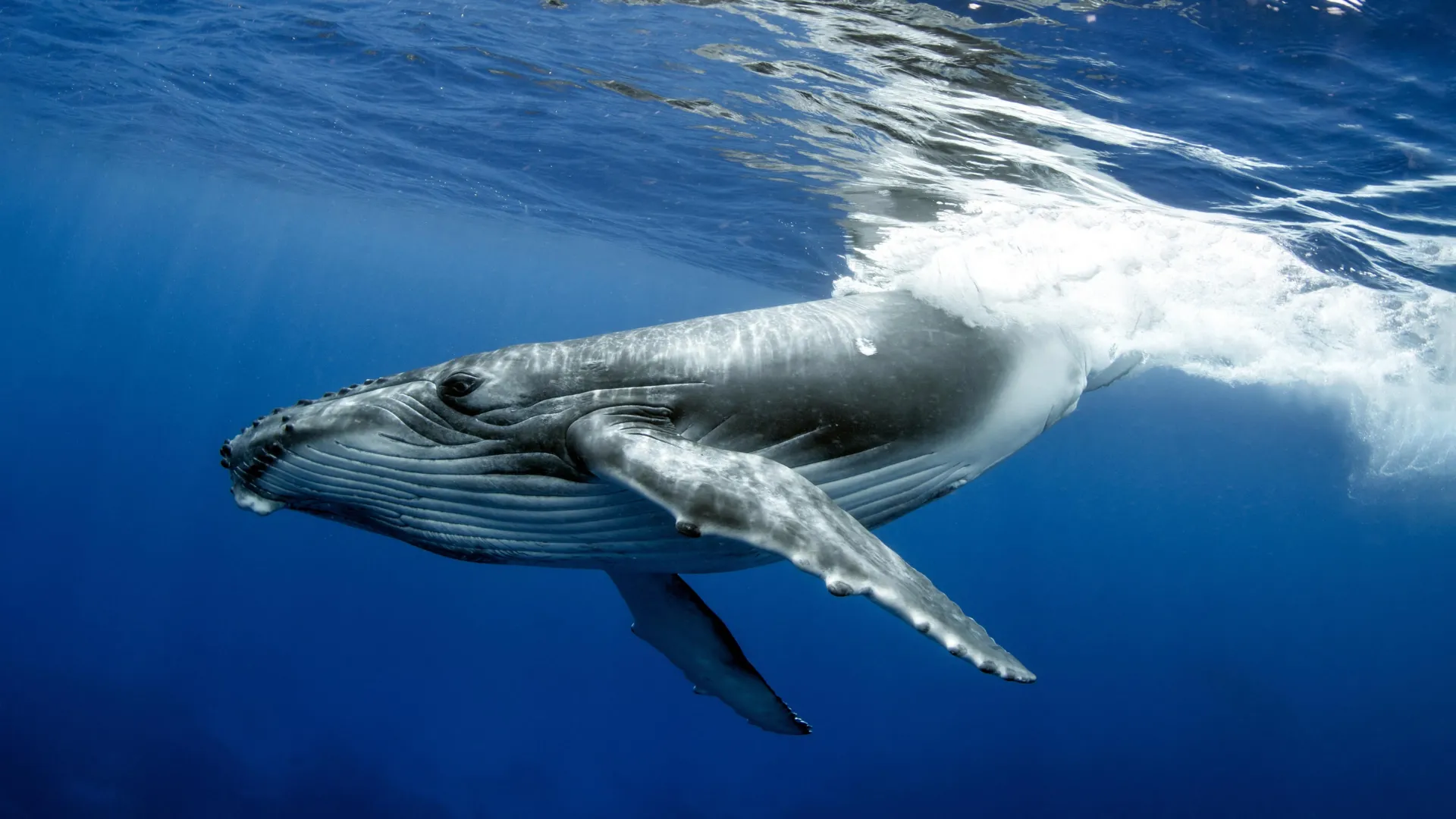
Marine scientists have confirmed a breathtaking milestone in marine biology, documenting for the very first time an extraordinary inter-oceanic migration by humpback whales. Researchers verified that individual humpback whales traversed more than 14,000 kilometers of open ocean between established breeding grounds in eastern Australia and Brazil. This monumental discovery shatters previous records for the longest documented movements of individual humpback whales anywhere on Earth, shedding new light on the vast navigational capabilities, behavioral adaptability, and genetic connectivity of these marine mammals.
The landmark finding was officially detailed in a study published in the peer-reviewed journal Royal Society Open Science, under the title First evidence of bidirectional exchange between distant humpback whale breeding populations in eastern Australia and Brazil. By analyzing decades of visual data, marine biologists have been able to bridge the massive spatial and temporal gaps separating two entirely distinct marine ecosystems, fundamentally altering our understanding of how global whale populations interact across planetary scales.
The Mechanics of Discovery: Fluke Photography and Global Collaboration
Unlocking a migration route spanning two distinct ocean basins required an unprecedented international effort involving marine research institutions, non-profit organizations, and a robust global network of citizen scientists. The cornerstone of the research relied on the visual identification of humpback whales through their unique ventral fluke patterns. Just as human fingerprints provide individual identification, the underside of a humpback whale’s tail features distinct pigmentation, scars, and serrated edges that remain unchanged throughout the animal’s life.
Researchers compiled a massive dataset comprising 19,283 high-quality fluke photographs collected between 1984 and 2025. This imagery originated from two primary regions: the eastern coast of Australia and various key breeding grounds across Latin America. Processing a dataset of this magnitude required a hybrid approach combining automated image recognition software with rigorous manual verification by experienced marine mammalogists.
A significant catalyst for this discovery was Happywhale, a global, crowdsourced whale-tracking platform that allows whale-watching operators, photographers, and researchers to upload images of whale flukes. When an image is uploaded, facial and pattern-recognition algorithms compare it against a global database, flagging potential matches that are subsequently authenticated by experts.
The study’s lead author, Dr. Cristina Castro of the Pacific Whale Foundation, emphasized the indispensable role played by public participation in modern marine science. Dr. Castro noted that every photograph captured by a tourist or amateur photographer contributes meaningfully to the broader corpus of whale biology, occasionally unlocking monumental behavioral insights that traditional, localized academic funding structures might otherwise miss.
A Chronology of Record-Breaking Journeys
The published research highlights two distinct, highly remarkable case studies of trans-oceanic movement, each revealing unique insights into the timing and scale of these marathon oceanic voyages.
The first documented journey centers on a whale initially photographed in the sheltered waters of Hervey Bay, Queensland, Australia, during the 2007 southern migration season. Researchers cataloged the animal again in the exact same location in 2013, reinforcing the understanding of site fidelity typical among humpback populations. However, the narrative shifted dramatically when the same fluke pattern was photographed near São Paulo, Brazil, in 2019.
Calculating the minimum straight-line distance between these two critical breeding habitats yielded an astonishing 14,200 kilometers—a distance roughly equivalent to traveling directly from Sydney to London. Because scientists only captured snapshots at the beginning and termination points of the journey, marine biologists stress that the actual distance swam by the animal was likely much greater, as whales rarely travel in straight lines across open ocean gyres.
Even more astounding is the second case study, which established a new absolute global record for humpback migration. Researchers first encountered this specific whale in 2003 at Brazil’s Abrolhos Bank, located off the coast of Bahia, which serves as the primary nursery ground for humpbacks in the South Atlantic. At the time of its initial sighting, the whale was documented swimming actively within a lively group of nine adult individuals.
Twenty-two years later, in September 2025, that exact same whale was spotted swimming alone in Hervey Bay, Australia. The verified distance between these two historic sightings measured an unprecedented 15,100 kilometers. This incredible span of time—two decades between initial cataloging and final re-identification—demonstrates the longevity of humpback whales and underscores the necessity of multi-decadal scientific monitoring programs.
Stephanie Stack, a PhD candidate at Griffith University and co-author of the study, marveled at the temporal and spatial span of the data. She pointed out that these individual whales were photographed decades apart, by entirely different observers, in opposing hemispheres separated by two massive ocean basins, yet contemporary data curation allows scientists to stitch their epic journeys together into a cohesive narrative.
Rarity and Context of Trans-Oceanic Crossings
Despite the monumental distances involved, the study emphasizes that these inter-oceanic migrations are exceptionally rare anomalies rather than commonplace behaviors. Spanning a database comprising over four decades of observations and nearly 20,000 individually identified humpback whales across eastern Australia and Latin America, researchers identified only two confirmed instances of individuals crossing between these specific breeding regions.
This accounts for a minuscule 0.01 percent of the total population represented in the comprehensive dataset. The vast majority of humpback whales remain strictly faithful to their traditional migratory corridors, traveling predictably between high-latitude feeding grounds in polar waters and low-latitude breeding zones near the equator.
The discovery, however, lends substantial credence to a long-debated scientific theory known as the Southern Ocean Exchange hypothesis. This hypothesis posits that humpback whales from geographically isolated breeding populations—such as those originating in Oceania, Australia, and South America—frequently mingle during the summer months in shared Antarctic feeding grounds. While foraging in these highly productive southern waters, individuals from different populations may intermingle socially. When the polar feeding season ends, an errant whale may mistakenly or deliberately align itself with a cohort heading toward an entirely different ocean basin, ultimately pioneering a novel migration route and establishing residency in a foreign breeding area.
Broader Ecological Implications and Genetic Significance
While occurrences of trans-oceanic migration are statistically rare, marine scientists argue that even occasional cross-basin movements carry disproportionately high ecological and evolutionary value for the long-term survival and resilience of global cetcean stocks.
One of the most immediate implications of these rare crossings is the enhancement of genetic diversity. Following historical commercial whaling operations that decimated global humpback populations during the 19th and 20th centuries, many surviving stocks experienced severe population bottlenecks, reducing their genetic variance. The natural migration of individuals across vast ocean barriers provides a mechanism for natural gene flow between isolated breeding stocks, bolstering genetic health, reducing the risks of inbreeding depression, and increasing overall population resilience against disease and environmental stressors.
Furthermore, these rare migrations serve as vectors for cultural transmission among marine mammals. Humpback whales are renowned for their complex, evolving vocalizations—commonly referred to as whale songs—which are sung by males on breeding grounds and undergo continuous cultural evolution. Songs often originate in one region and spread horizontally across ocean basins, jumping from population to population as migrating individuals introduce new musical motifs. The physical movement of whales across distant basins facilitates the rapid dissemination of these acoustic traditions, operating much like human cultural trends spreading globally.
Environmental Pressures and Future Outlook
As marine biologists analyze the implications of these findings, attention is increasingly turning toward how a rapidly changing global climate might influence whale behavior in the decades ahead. Researchers suggest that anthropogenic climate change could potentially drive an increase in the frequency of these extraordinary trans-oceanic crossings.
Rapid environmental shifts in the Southern Ocean, including the accelerated melting of Antarctic sea ice and subsequent alterations in the distribution, density, and phenology of Antarctic krill—the fundamental dietary staple for humpback whales—are actively transforming polar ecosystems. As traditional feeding grounds shift or experience ecological disruption, foraging whales may alter their historical movement patterns, increasing the likelihood of inter-population mixing in southern waters.
Furthermore, warming ocean temperatures and shifting oceanic currents could subtly modify navigational cues, prompting more wandering individuals to explore unfamiliar migratory corridors. While these long-distance travelers represent statistical outliers today, continued monitoring through multi-decadal research initiatives and platforms like Happywhale will be vital for tracking whether such behaviors become more prevalent in a shifting global climate.
The documentation of these epic oceanic journeys serves as a testament to the resilience and adaptability of humpback whales, while highlighting the profound insights that emerge when international scientific cooperation intersects with community-driven conservation science. As researchers continue to mine historical databases and deploy advanced tracking technologies, the mysterious migratory lives of the ocean’s gentle giants continue to unfold in unexpected ways.
