
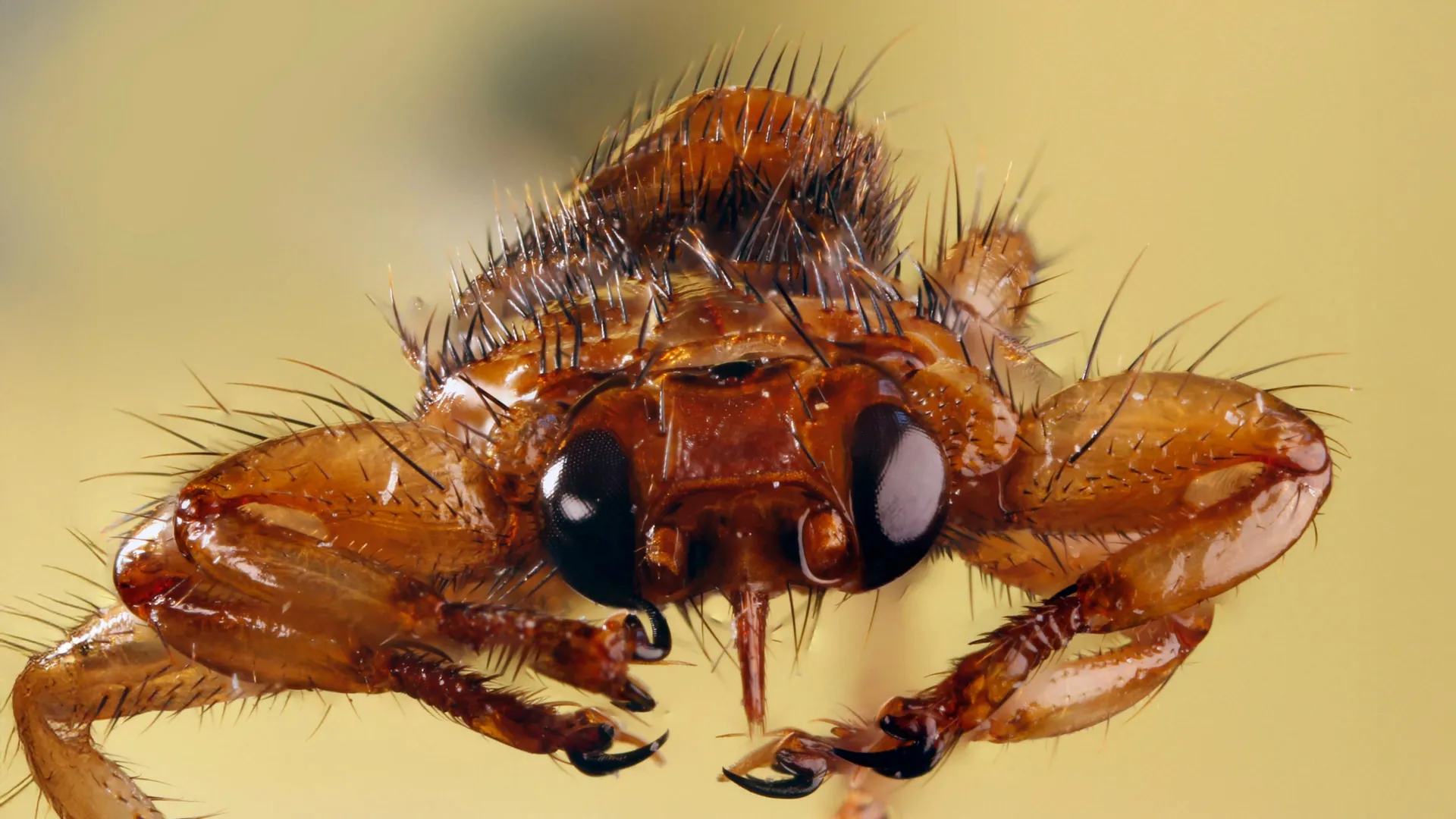
In the vast and complex theater of evolutionary biology, few transitions are as dramatic as the one experienced by the deer ked. A recent collaborative study conducted by researchers at Aberystwyth University in the United Kingdom and the University of Florence in Italy has shed light on a fascinating biological phenomenon: these peculiar, blood-feeding flies actively downscale their visual sensitivity after locating a host and abandoning flight forever.
Published in the esteemed Journal of Experimental Biology, the findings offer a rare glimpse into how parasitic organisms physiologically reorganize themselves when shifting from an active, free-roaming existence to a sedentary, permanent life nestled within the fur of a mammalian host. By examining the genetic mechanisms underpinning this transition, scientists have uncovered a sophisticated evolutionary strategy of energy conservation and resource reallocation.
The Dual Life Cycle of the Deer Ked
Deer keds—scientifically belonging to the family Lipoptena, most notably Lipoptena cervi—are specialized biting flies found widely distributed across temperate and boreal regions of Europe, Asia, and parts of the Americas, having also been introduced to other regions via imported wildlife and livestock. As immature adults, these insects possess fully functional wings and rely heavily on a combination of acute aerial agility and sharp vision to locate prospective hosts. While their primary targets are cervids such as red deer, roe deer, and fallow deer, they are opportunistic and will occasionally land on livestock, domestic dogs, and humans wandering through infested woodlands during peak seasons.
The life cycle of the deer ked is tightly intertwined with the biology of its forest-dwelling hosts. Pupae overwinter in the leaf litter, emerging as winged adults typically in the late summer and autumn. These young adults climb onto low-hanging vegetation, using their compound eyes to scan the horizon for the silhouette of a passing animal.
Once a deer ked successfully intercepts and lands upon a host, its life changes irrevocably. Within moments to hours of securing a foothold in the thick undercoat of the animal, the insect undergoes a startling physical transformation: it deliberately snaps off or sheds its wings, leaving behind small, distinctive basal stumps. From that moment onward, the insect abandons flight entirely. It spends the remainder of its days navigating a labyrinth of hair shafts, feeding exclusively on host blood, mating, and producing offspring in a profoundly restricted environment of perpetual twilight and warmth.
Investigating the Sensory Shift
To understand how these insects manage such a profound lifestyle pivot, the research team—led by Dr. Roger Santer of the Department of Life Sciences at Aberystwyth University—embarked on a detailed comparative analysis. The scientists sought to determine whether the loss of flight was mirrored by corresponding changes within the fly’s sensory nervous system, specifically its visual apparatus.
Vision is widely recognized by evolutionary biologists as one of the most energetically costly sensory modalities an animal can maintain. The neural processing power, metabolic upkeep, and cellular maintenance required to support high-performance compound eyes demand a substantial and continuous supply of metabolic energy. In environments where vision ceases to provide a distinct evolutionary advantage, natural selection often favors the reduction or complete loss of visual structures—a phenomenon famously observed in cave-dwelling organisms and deep-sea creatures.
To test this hypothesis in the context of parasitic adaptation, the research team gathered deer keds at two distinct life-stage milestones. The first group consisted of winged, pre-settled adults actively engaged in host-seeking behavior in the wild. The second group comprised wingless, post-settled adults harvested directly from host animals after they had fully transitioned to their permanent parasitic mode of existence.
Molecular Evidence: The Downregulation of Opsin Genes
Rather than merely observing anatomical changes, the researchers peered directly into the genetic blueprint of the insects. They focused their molecular analysis on a specific class of light-sensitive proteins known as opsins. Opsins are the fundamental molecular building blocks of photoreceptor cells in the compound eyes of insects, converting incoming photons of light into electrical neural signals that the brain interprets as sight.
By quantifying and comparing the levels of opsin gene expression between the flying and wingless cohorts, the research team obtained precise measurements of how the insects’ visual capabilities respond to their sudden environmental shift.
"We found that a flying deer ked’s visual system is much like that of a tsetse fly, which famously hunts out mammal hosts in Africa," explained Dr. Santer, discussing the comparative physiological baseline of the insects. Tsetse flies are renowned for their visual acuity and sophisticated hunting mechanisms, relying heavily on color contrast and motion detection to locate large mammalian targets across open landscapes.
However, the genetic profile of the deer ked shifted dramatically once the transition to parasitism was complete. "After a deer ked loses its wings and becomes an ectoparasite, activity of its opsin genes reduces to around half the previous level," Dr. Santer noted.
This fifty-percent reduction in opsin gene transcription provides quantitative proof that the insect actively dampens its visual sensitivity. Crucially, the researchers emphasize that the deer ked does not become entirely blind. Instead, the sensory system undergoes a calibrated downscaling. Because the fly no longer needs to navigate complex aerial environments, detect distant movement, or locate hosts from afar, it appears to dial down its visual input to a level sufficient only for local navigation within the dense, dark matrix of the host’s fur.
Energy Reallocation: Sacrificing Sight for Survival
The discovery raises a compelling biochemical question: Why would an organism actively suppress its own sensory capacity, even if it has limited use for it? The answer lies in the harsh energetic economics of survival.
In the wild, metabolic resources are finite. For a permanent parasite, every calorie diverted toward maintaining unused or underused sensory hardware is a calorie denied to more critical physiological functions. By cutting the metabolic costs of high-acuity vision in half, the deer ked frees up valuable biological energy.
Researchers hypothesize that this conserved energy is redirected toward metabolic processes vital to life as an obligate ectoparasite. These include intensive digestive processes required to process continuous blood meals, osmoregulation to handle the high-protein and high-iron fluid diet, and reproductive output to ensure the propagation of the species before the host’s grooming behavior or natural mortality brings the parasite’s life cycle to an end.
This metabolic trade-off highlights the ruthless efficiency of evolutionary pressures. Traits that confer fitness in one phase of an organism’s life history can become evolutionary liabilities in another, prompting rapid, targeted physiological downregulation.
Broader Implications and Future Control Strategies
While the study is fundamentally rooted in evolutionary physiology and neurobiology, the insights gained by the Aberystwyth and Florence research teams carry practical implications for pest management and veterinary science.
Biting flies belonging to the family Hippoboscidae—which includes deer keds, sheep keds, and related parasitic species—pose notable challenges to livestock health, wildlife management, and occasionally human recreation. Heavy infestations of deer keds can cause severe irritation, skin damage, hair loss, and secondary infections in deer and farmed cervids, leading to reduced overall animal welfare and economic loss in agricultural sectors focused on venison or fiber production.
According to the research group, achieving a comprehensive understanding of how biting flies utilize and subsequently modify their sensory systems across different life stages could pave the way for novel monitoring and control strategies. By pinpointing the specific sensory cues—whether visual, thermal, or chemical—that flying keds use to target hosts, scientists and agricultural engineers may be able to design more effective traps, repellents, or disruption technologies to intercept the insects before they successfully land and shed their wings.
Furthermore, the study adds a valuable case study to the broader scientific literature regarding phenotypic plasticity and sensory evolution in parasites. Parasitic organisms often undergo dramatic morphological and genetic regressions, shedding limbs, digestive tracts, or sensory organs over evolutionary timescales. The deer ked offers a uniquely accessible, real-time window into the early stages of this evolutionary trajectory, demonstrating how rapid gene expression changes can facilitate a lifestyle shift within a single generation.
As researchers continue to explore the genetic and neurobiological underpinnings of host-parasite interactions, the humble deer ked stands out as a prime example of nature’s capacity for radical functional remodeling—proving that sometimes, to successfully settle down in life, an organism must literally leave its past behind and dim the lights.
