
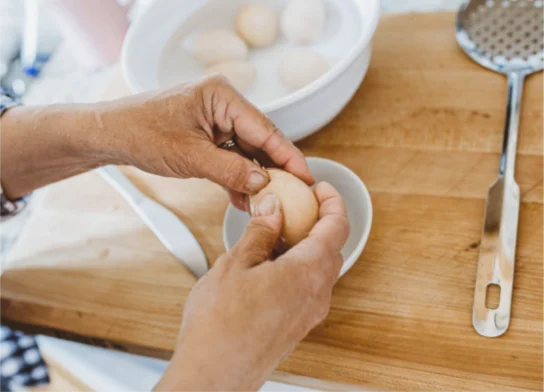
The challenge of peeling farm-fresh eggs has long been a point of contention among home cooks and culinary professionals alike. While conventional wisdom often suggests that older eggs are superior for hard-boiling due to their ease of peeling, a growing consensus among food scientists and agricultural experts points to steaming—rather than submerging eggs in boiling water—as the superior method for achieving pristine results. This technique, which relies on consistent thermal exposure, effectively addresses the structural challenges posed by the membrane of a fresh egg.

The Science of Shell Adhesion
The primary difficulty in peeling a fresh egg lies in the pH balance of the egg white. In newly laid eggs, the albumen has a lower pH, causing it to adhere tightly to the inner shell membrane. As an egg ages, it naturally absorbs carbon dioxide through its porous shell, causing the pH level to rise. This shift in alkalinity, combined with the gradual shrinkage of the egg contents as moisture evaporates over time, creates the natural separation that makes older eggs easier to peel.

However, waiting weeks for an egg to "age" often results in the development of a large air pocket at the rounded end of the egg, which can compromise the structural integrity and aesthetic appeal of the final product. Culinary research indicates that the key to peeling a fresh egg lies in the rapid denaturation of the egg white proteins. By using steam, the egg is subjected to a uniform, high-heat environment that causes the outer albumen to contract rapidly, pulling away from the shell membrane before the interior of the egg reaches the same internal temperature.

Chronology of Culinary Methodology
For decades, the standard approach to preparing hard-boiled eggs involved the "cold start" method, where eggs were placed in a pot of cold water and brought to a boil, or the "hot start" method, where eggs were dropped into already boiling water. Both methods have historically yielded inconsistent results. The cold start method risks overcooking the yolk while the water reaches a boil, while the hot start method often causes the shell to crack due to the thermal shock of hitting boiling water.

The adoption of the steaming method gained traction in professional kitchens during the early 2010s as chefs sought more precision in egg preparation. By placing eggs in a steamer basket suspended above boiling water, the cook ensures that the heat transfer is consistent and gentle. This process mitigates the risks associated with rapid temperature fluctuations, resulting in a consistent texture and an intact surface upon peeling.

Supporting Data and Comparative Analysis
Comparative tests conducted in controlled culinary environments demonstrate that steaming consistently produces a cleaner peel regardless of the egg’s freshness. When eggs are boiled, the water temperature fluctuates significantly when the cold eggs are introduced to the pot, leading to an uneven cooking process.

Data regarding the "gray-green ring"—a common aesthetic failure in hard-boiled eggs—further supports the steaming method. This discoloration is the result of a chemical reaction between the sulfur in the egg white and the iron in the yolk, forming ferrous sulfide. This reaction is accelerated by prolonged exposure to high temperatures. Because steaming cooks the egg more efficiently and requires less time to reach the desired internal doneness, it minimizes the formation of this compound. Observations confirm that eggs steamed for 10 to 12 minutes, followed by an immediate transition to an ice bath, consistently lack the green ring associated with over-boiling.

Implementation and Procedural Best Practices
To successfully execute the steaming method, the equipment required is minimal. A standard metal vegetable steamer, a bamboo steamer, or even a stainless-steel colander set over a deep pot of boiling water is sufficient. The procedure follows a strict protocol to ensure safety and quality:

- Preparation: Bring several inches of water to a rolling boil in a deep pot.
- Thermal Exposure: Place the eggs into the steamer basket in a single layer to ensure uniform heat distribution.
- Timed Cooking: Cover the pot tightly to trap the steam. A duration of 11 to 13 minutes is generally recommended for a hard-cooked yolk, depending on the desired level of firmness.
- The Ice Bath: This is the most critical step. Once the timer expires, the eggs must be removed immediately and submerged in a bowl of ice water. This "thermal shock" arrests the cooking process and causes the contents of the egg to contract further, facilitating the separation of the membrane from the shell.
Industry and Expert Perspectives
Food scientists emphasize that the "freshness" of an egg is a desirable trait for flavor and nutrient density, which is why techniques that preserve the egg’s integrity while allowing for easy peeling are highly valued. Experts at the culinary level note that while the "old egg" advice persists in home cooking lore, it is largely a workaround for improper heat management.

"The goal of any cooking process is to control the transformation of proteins," notes a senior researcher in poultry science. "Steaming provides a controlled environment where the exterior of the egg reaches the necessary temperature to solidify the white without requiring the entire egg to soak in water, which can lead to shell breakage and sulfur migration."

Broader Implications for Culinary Practices
The shift toward steaming has broader implications for food safety and waste reduction. For small-scale poultry keepers and commercial producers alike, the ability to process fresh eggs without sacrificing the quality of the final dish reduces the pressure to store eggs for extended periods. This contributes to better food turnover and ensures that consumers receive the freshest possible product.

Furthermore, as the industry moves toward more efficient, data-driven cooking techniques, the reliance on outdated "hacks"—such as adding vinegar or baking soda to the water—is being replaced by an understanding of basic thermodynamic principles. These additives, while popular on social media, have been shown in laboratory settings to have negligible effects on the actual permeability of the shell or the adhesion of the membrane.

Conclusion
The evidence indicates that the difficulty of peeling fresh eggs is not an inherent trait of the egg itself, but rather a byproduct of the traditional boiling method. By transitioning to a steam-based cooking protocol, home cooks can achieve the ideal balance of a tender white, a perfectly cooked yolk, and a shell that releases cleanly. As culinary education continues to prioritize the application of heat-transfer science, it is likely that steaming will become the standard procedure for hard-cooked egg preparation in professional and domestic kitchens globally. The transition to this method offers a reliable, repeatable, and effective solution to a long-standing domestic challenge, reinforcing the importance of technique over traditional superstition.
