
For more than three centuries, Sir Isaac Newton’s third law of motion has served as an unshakeable cornerstone of classical physics. The principle, most commonly summarized by the maxim that for every action there is an equal and opposite reaction, dictates the mechanics of nearly every observable physical interaction in the macroscopic world. When a runner presses their foot against the tarmac, the ground pushes back with an equivalent force; when a rocket ignites, escaping exhaust propels the vessel forward through an equal and opposite thrust. This bilateral balance of forces has long formed the bedrock upon which theoretical mechanics, aerospace engineering, and industrial physics are constructed.
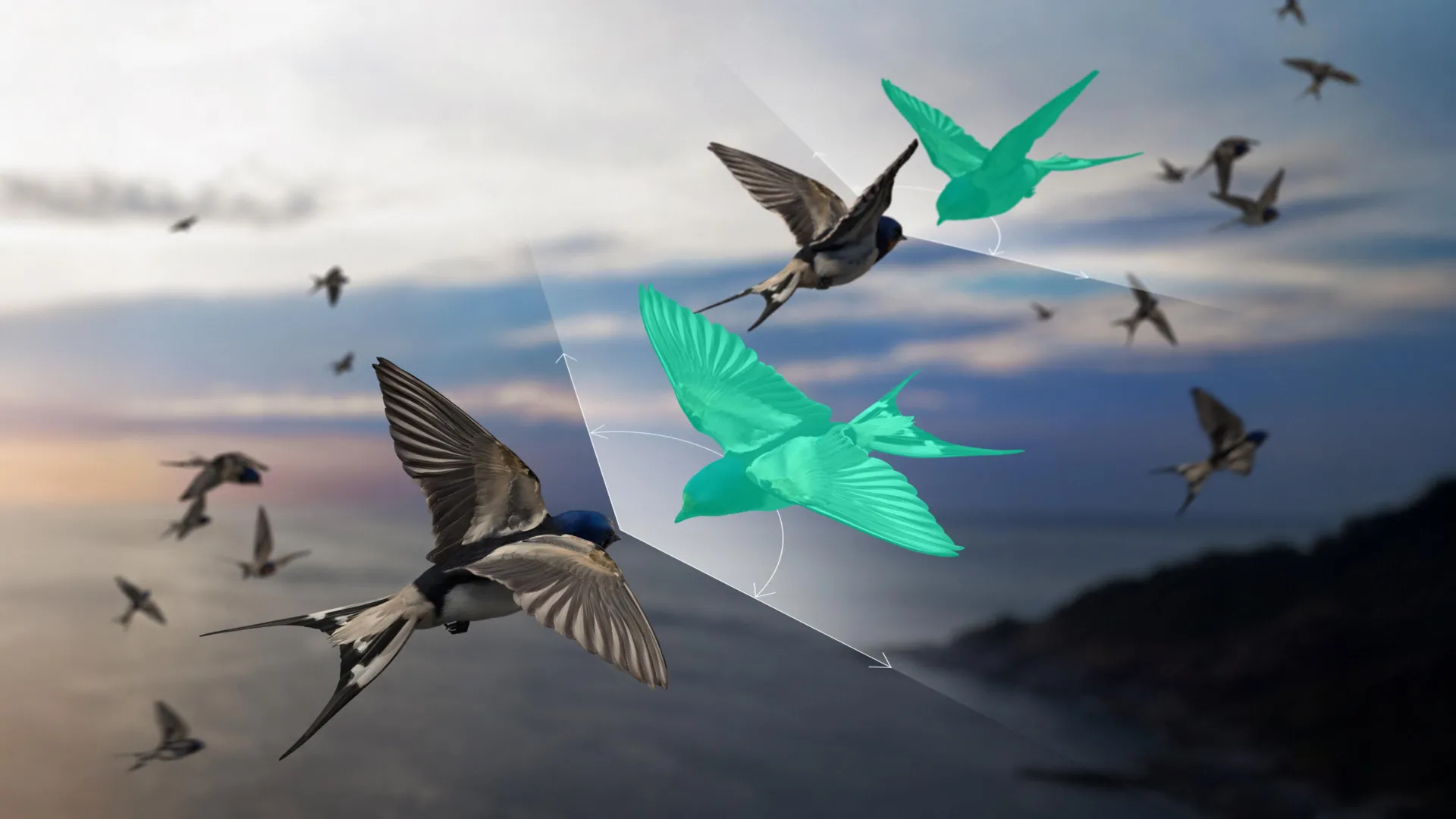
Yet, for decades, researchers studying the collective movement of living organisms and complex systems have been stymied by a glaring contradiction. When starlings gather in massive, undulating flocks to wheel across the twilight sky, they do not obey this reciprocal rule. Behavioral observations reveal that individual birds pay acute attention only to their immediate neighbors and the companions flying directly ahead of them. They do not adjust their flight paths in response to the birds trailing behind them. This localized, directional awareness creates a fundamental imbalance: the bird ahead influences the bird behind, but the bird behind exerts no reciprocal mechanical or visual influence on the bird leading it.
This phenomenon—where interactions operate strictly in a single direction—is not isolated to avian flocks. Across the natural world, biological systems routinely flout the action-reaction principle. Bacterial swarms writhing in Petri dishes, dense crowds of pedestrians navigating a bustling subway station, and even living cells migrating collectively within biological tissues all exhibit the exact same non-reciprocal dynamics. In each of these scenarios, individual components respond to only a fraction of their surrounding environment, rendering traditional, balanced models of physics inadequate.
The Persistence of Non-Reciprocal Systems in Physics
Historically, theoretical physics was constructed almost entirely around the assumption of reciprocity. Classical frameworks assume that if entity A exerts a force on entity B, entity B must exert an equal and opposite force back on entity A. While this assumption holds true for fundamental forces like gravity and electromagnetism in closed systems, it breaks down completely when applied to active matter—systems composed of energy-consuming units that generate their own motion.
Because traditional mathematical models were built exclusively for reciprocal interactions, scientists attempting to simulate bacterial colonies, crowd dynamics, or cellular migration have faced monumental hurdles. These simulations often required intensive computational power while yielding imprecise results, leaving a persistent blind spot in modern physics. Understanding these non-reciprocal systems is far from an academic exercise; accurate simulations are critical for predicting crowd behavior during emergency evacuations, optimizing urban pedestrian flow, and mapping how cancer cells metastasize and invade healthy tissue.
The Breakthrough in Dresden
To address this longstanding methodological impasse, an international team of researchers based in Dresden, Germany, embarked on a mission to rewrite the mathematical rules governing non-reciprocal systems. Working in collaboration with prominent theoretical physicist Roderich Moessner—a Principal Investigator of the Würzburg-Dresden Cluster of Excellence ct.qmat (Complexity, Topology and Dynamics in Quantum Matter) and director at the Max Planck Institute for the Physics of Complex Systems—the research group successfully devised a revolutionary framework. Their findings, which bridge a three-century-old gap in classical mechanics, were published in the prestigious journal Nature Physics.
Marín Bukov, a research group leader involved in the study, underscored the significance of the breakthrough. For generations, theoretical mechanics courses have relied heavily on the premise that all physical interactions are reciprocal. By establishing a valid mathematical pathway for non-reciprocal systems, the Dresden team has ensured that foundational physics principles can finally be applied to the complex, one-way behaviors observed in active matter.
The Mechanics of the Innovation: Enter the Fictitious Partner
The core achievement of the Dresden research team lies in their ingenious expansion of the traditional action-reaction framework. Rather than discarding classical mechanics entirely, the physicists sought a way to adapt existing, well-established simulation tools so they could accurately process non-reciprocal data.
In standard physics, researchers utilize mathematical variables that correspond to concrete, real-world properties—such as the exact position and velocity of a car in traffic, the location of an individual fish within a school, or the coordinates of a migrating bird. The breakthrough devised by Bukov, Moessner, and biophysicist Ricard Alert introduces a radical conceptual twist: the creation of fictitious, non-existent partners for every real component within a system.
According to Alert, the mathematical trick hinges on pairing every genuine actor with an artificial counterpart. The original, one-way non-reciprocal interactions between real entities are mathematically substituted with reciprocal interactions involving these newly minted auxiliary degrees of freedom.
To visualize this in a practical context, consider the aforementioned flock of birds. When researchers run simulations to replicate the fluid, synchronized movements of starlings, they bypass the traditional computational impossibility of one-way tracking by treating the system as if it were fully reciprocal. To accomplish this, they artificially project a fictitious bird directly in front of each real bird, oriented in precisely the opposite direction.
These imaginary partners do not correspond to any physical animal in the natural world. Instead, they serve as sophisticated mathematical scaffolding. By translating one-way interactions into a reciprocal format via these auxiliary variables, scientists can suddenly deploy decades of accumulated computational tools and algorithms designed for ordinary, balanced systems.
A Broader Horizon for Many-Body Physics and Quantum Matter
While the concept of utilizing auxiliary degrees of freedom is not entirely unprecedented within advanced physics, its successful application to macroscopic non-reciprocal systems represents a major paradigm shift. By grafting this methodology onto active matter research, the Dresden team has provided the scientific community with a powerful lens through which to examine complex systems with unprecedented accuracy.
Beyond immediate applications in biology and crowd dynamics, the implications of this research extend deeply into the realm of quantum physics. Roderich Moessner noted that the laboratories in Würzburg and Dresden frequently investigate quantum matter—systems where particles interact under extreme conditions to give rise to exotic macroscopic phenomena, such as high-temperature magnetism or lossless current transport.
The burning question now facing theoretical physicists is whether these newly understood exceptions to Newton’s third law might manifest at the quantum scale, potentially unlocking entirely novel forms of collective quantum behavior. Because humanity’s understanding of non-reciprocal quantum dynamics is still in its infancy, the discovery opens up a vast, largely unexplored frontier for experimental and theoretical investigation.
Implications for Future Research and Technology
The publication of the Dresden team’s findings in Nature Physics marks a critical turning point for multiple scientific disciplines. By solving the mathematical paradox of non-reciprocal interactions, the researchers have effectively provided a missing Rosetta Stone for active matter physics.
In the medical field, improved simulations of cellular migration could lead to better therapeutic strategies for stopping the spread of cancer. In robotics and artificial intelligence, engineers programming swarm intelligence—where hundreds of autonomous drones or micro-robots operate independently without global oversight—can utilize these refined models to enhance coordination and collision avoidance. Furthermore, urban planners modeling pedestrian traffic dynamics during large-scale public events will now have access to simulation tools that reflect the reality of human behavior rather than idealized, reciprocal physics.
As researchers begin to deploy this new theoretical framework across laboratories worldwide, the legacy of Newton’s third law remains intact for the closed, equilibrium systems it was originally designed to describe. However, thanks to the ingenuity of the Dresden physicists, science now possesses a rigorous, elegant method to account for the beautifully unbalanced, one-way interactions that define life and motion in the natural world.
