
The evolutionary history of powered flight has long presented paleontologists with a complex puzzle, marked by incremental discoveries regarding how dinosaurs transitioned into birds. Now, groundbreaking research into exceptionally preserved fossils from eastern China suggests that the timeline and trajectory of avian evolution were far more intricate than previously understood. By analyzing rare, color-preserved fossilized feathers, an international team of scientists has determined that certain feathered dinosaurs had already lost the capacity for flight millions of years before the catastrophic asteroid impact that wiped out the non-avian dinosaurs.
The study, published in the peer-reviewed journal Communications Biology by Nature Portfolio, was spearheaded by Dr. Yosef Kiat from the School of Zoology and the Steinhardt Museum of Natural History at Tel Aviv University. Collaborating with researchers from the United States and China, Dr. Kiat examined the physical characteristics and growth patterns of ancient plumage belonging to Anchiornis, a small, feathered dinosaur that roamed the Earth approximately 160 million years ago during the Late Jurassic period. The findings challenge the conventional academic consensus that once a lineage of dinosaurs developed feathers and rudimentary flight capabilities, those traits progressed in a linear, uninterrupted path toward modern avian flight. Instead, the data indicates that wing evolution was remarkably dynamic, characterized by evolutionary reversals where species could develop flight mechanics and subsequently abandon them.
A Window Into the Late Jurassic
To comprehend the significance of the new study, researchers must place the fossils within a vast evolutionary timeline. Dinosaurs diverged from other reptilian lineages approximately 240 million years ago. On a geological timescale, it was not long after this divergence that many species began developing proto-feathers—lightweight, keratin-based structures primarily utilized initially for thermoregulation, social signaling, and protection against the elements, rather than immediate aerodynamic propulsion.
By approximately 175 million years ago, a distinct group of theropod dinosaurs known as Pennaraptora emerged. This clade includes the direct ancestors of modern birds and represents the only dinosaur lineage to survive the Cretaceous-Paleogene extinction event 66 million years ago. Within the Pennaraptora lineage, feathers evolved sophisticated aerodynamic architectures capable of supporting gliding and powered flight. However, changing environmental pressures, shifts in ecological niches, and alterations in body mass frequently dictate evolutionary trade-offs. Just as modern flightless birds—such as ostriches, emus, and penguins—abandoned aerial mobility in favor of terrestrial or aquatic specialization, ancient dinosaurs may have experienced similar evolutionary pressures.
Until recently, confirming whether an extinct, feathered dinosaur was capable of flight relied primarily on biomechanical models of skeletal structures, wing-to-body mass ratios, and asymmetric vane shapes on fossilized quill impressions. While these osteological studies provided valuable insights, they often left room for scientific debate. The Tel Aviv University-led study introduces an entirely novel physiological metric for determining flight capability: the analysis of fossilized feather molting patterns.
Preserved Pigmentation and the Mechanics of Molting
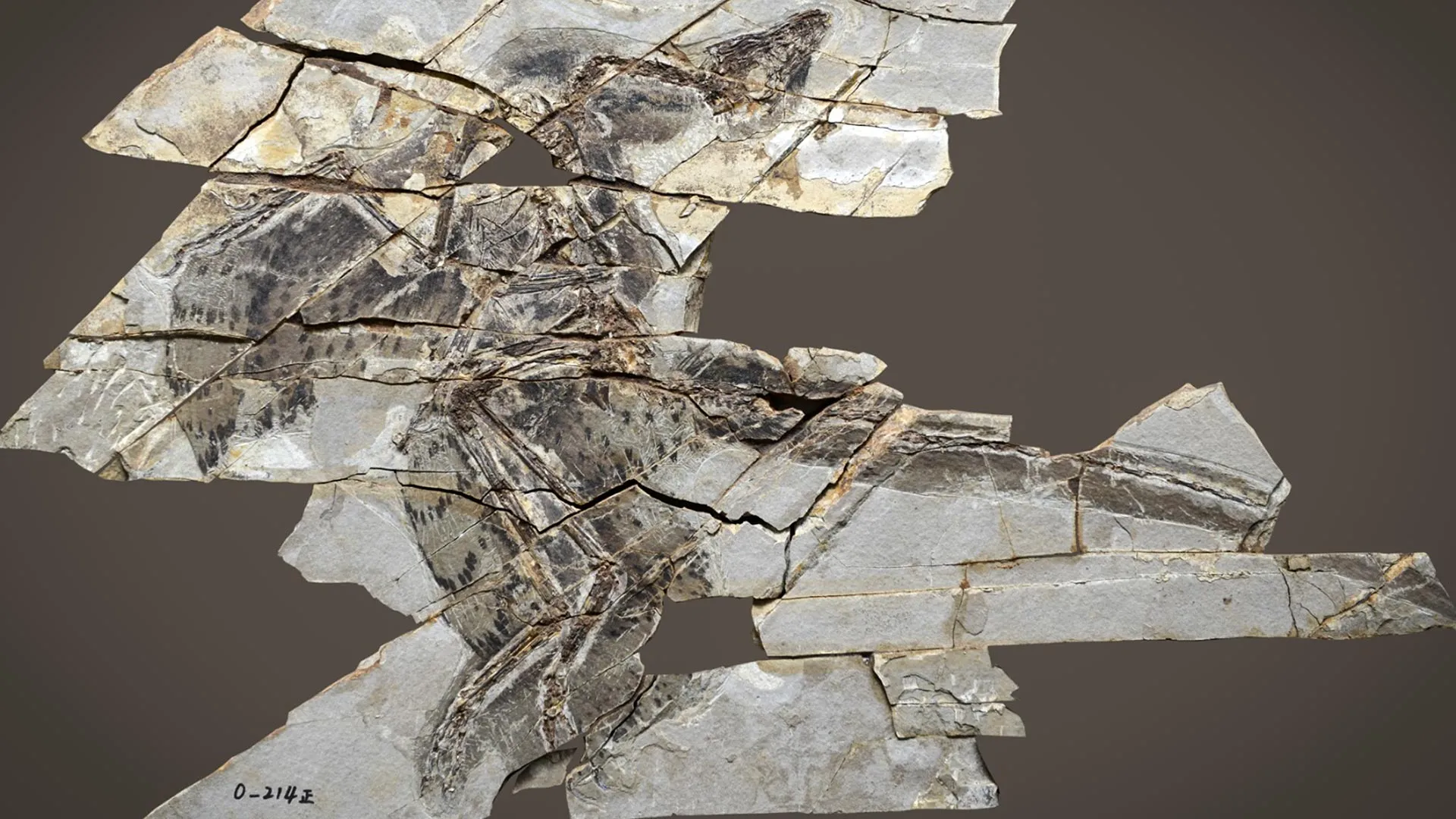
The breakthrough was made possible by the analysis of nine extraordinarily rare fossils of Anchiornis discovered in eastern China. Due to the unique fossilization environment of the region, these specimens preserved not only the delicate skeletal frames and carbonized outlines of feathers, but also the original melanin-based coloration patterns. Each analyzed specimen exhibited a consistent visual marker: wing feathers that were predominantly white, terminated by a distinct, dark black spot at the tip.
This preservation of pigmentation allowed Dr. Kiat, an ornithologist specializing in avian plumage, to study the microscopic growth and replacement cycles of feathers from 160 million years ago. In living birds, feathers develop over a period of two to three weeks, drawing nourishment from a dedicated blood supply. Once the feather reaches its terminal size, the blood vessels recede, leaving the structure as dead, keratinous material. Over time, physical wear and tear degrade the plumage, necessitating replacement through a biological process known as molting.
The mechanics of molting serve as a critical indicator of functional flight. Birds that depend on sustained flight for survival—such as raptors, swifts, and songbirds—require a precise, highly regulated molting strategy. Their wing feathers are shed and replaced in an orderly, symmetrical sequence, ensuring that the bird maintains adequate aerodynamic balance and lift throughout the process, enabling it to continue flying while its plumage regenerates. Conversely, flightless birds exhibit a random, irregular, and often simultaneous molting pattern, as the aerodynamic symmetry of their wings is no longer a matter of life and death.
By mapping the distribution of the black pigment spots across the fossilized Anchiornis wing feathers, the research team was able to trace both fully grown feathers and developing feathers that were still in the process of growing at the time of the animal’s death. The resulting distribution map revealed a disorganized, irregular growth and replacement pattern, directly contradicting the strict symmetry required for sustained aerial locomotion.
Implications for the Origins of Avian Evolution
The implications of the Anchiornis molting analysis extend far beyond a single species, offering a broader paradigm shift in how paleontologists interpret the fossil record. By combining morphological osteology with preserved microstructural and pigmentation data, scientists have unlocked a new methodological frontier.
"Feather molting seems like a small technical detail, but when examined in fossils, it can change everything we thought about the origins of flight," the research team noted in their official findings. "It highlights how complex and diverse wing evolution truly was."
The confirmation that Anchiornis was flightless despite possessing complex, well-developed feathers provides empirical support for the hypothesis of secondary flightlessness in dinosaurs. This phenomenon demonstrates that evolution is not a strictly progressive ladder, but rather a branching tree where traits can be gained, refined, lost, or repurposed depending on shifting ecological landscapes. For instance, as certain small theropods adapted to ground-dwelling predation, rapid running, or dense forest floors where vertical takeoffs were unnecessary, the metabolic and energetic costs of maintaining flight-optimized plumage may have outweighed the evolutionary benefits.
Scientific Community and Future Horizons
The publication of this study in Communications Biology has generated substantial discussion within the global paleontological and ornithological communities. Experts note that the integration of ornithological biology—specifically behavioral and physiological processes observed in extant birds—with deep-time paleontology bridges a critical disciplinary gap.
Independent researchers analyzing the methodology have praised the study for utilizing preserved soft-tissue pigmentation to infer functional behavior rather than relying solely on bone geometry. This technique opens the door for re-examining other exceptionally preserved feathered fossils housed in museums across China, Europe, and North America. Future research initiatives will likely target other members of the Pennaraptora clade to determine how widespread secondary flightlessness was during the Jurassic and Cretaceous periods.
As scientists continue to unearth and analyze rare specimens with intact soft tissues, our understanding of prehistoric ecosystems continues to evolve. The revelation that feathered dinosaurs may have experimented with flight, mastered it, and subsequently abandoned it paints a vivid picture of a dynamic, adaptable ancient world—one where the boundary between flighted and flightless was as fluid millions of years ago as it is among the diverse bird populations inhabiting the Earth today.
