
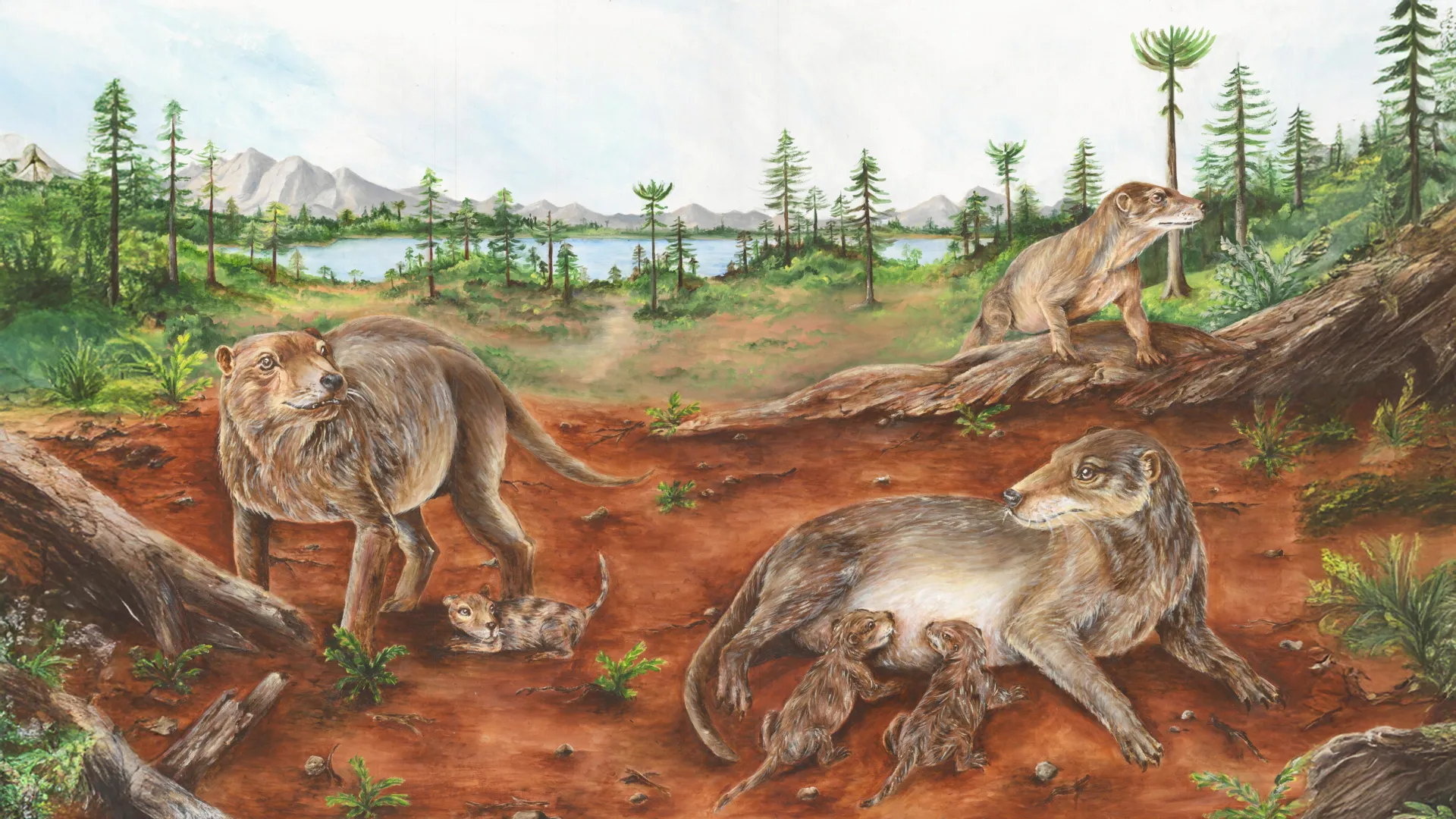
Paleontologists have uncovered compelling new evidence suggesting that the evolutionary timeline for live birth in the mammalian lineage stretches back much further than previously believed. A groundbreaking study published in the academic journal Frontiers in Mammal Science indicates that at least one species of ancient mammal ancestor, known as cynodonts, practiced viviparity—the biological process of giving birth to live young rather than laying eggs.
This discovery fundamentally challenges long-held scientific assumptions regarding the reproductive physiology of proto-mammals that roamed the Earth during the Triassic period. By analyzing the microscopic bone structure of a fossilized Chiniquodon theotonicus, researchers have pushed back the emergence of live birth in the mammalian lineage by an estimated 90 to 95 million years.
The Main Facts: Unlocking a Prehistoric Reproductive Mystery
The central finding of the study revolves around Chiniquodon theotonicus, a carnivorous cynodont that inhabited what is now northwestern Argentina approximately 236 million years ago. Cynodonts represent a critical transitional group in vertebrate evolution, sitting squarely on the evolutionary branch that eventually led to modern mammals, including humans.
For decades, the prevailing consensus among evolutionary biologists and paleontologists was that early cynodonts reproduced exclusively by laying eggs, much like modern-day reptiles and monotremes such as the platypus. Viviparity was generally categorized as a relatively recent evolutionary adaptation that developed much later with the advent of true mammals.
However, an international research team led by Dr. Leandro Gaetano, a paleontologist at the National Scientific and Technical Research Council (CONICET) in Argentina, utilized innovative histological methods to examine a fully grown C. theotonicus fossil. Their analysis revealed a distinct neonatal growth line—a microscopic ring within the bone matrix that forms in response to the physiological shock and rapid metabolic acceleration that occurs immediately after birth.
By calculating the estimated body mass of the newborn from this growth line and comparing it to the animal’s final adult weight, the researchers established a neonate-to-adult mass ratio that closely mirrors modern placental mammals, diverging sharply from the reproductive patterns of contemporary reptiles and birds.
Chronology of the Discovery: From Postgraduate Classroom to Global Scientific Breakthrough
The journey toward this paradigm-shifting discovery began modestly within the halls of an academic institution during a postgraduate paleontology course in Argentina. While examining thin sections of fossilized bone under high-powered microscopes, researchers noticed an anomalous structural feature within the skeletal architecture of the fully mature C. theotonicus specimen unearthed in northwestern Argentina.
Initial observations suggested that the ring-like mark did not conform to standard cyclical growth rings, which typically correspond to seasonal variations or annual hibernation patterns. Instead, consultations with experts in osteohistology and comparisons with living vertebrate species revealed a striking similarity to neonatal lines found in the bones and teeth of extant animals. These lines are triggered exclusively by the drastic physiological transition from an enclosed embryonic environment to independent postnatal existence.
Recognizing the profound implications of this microscopic marker, the research team initiated a rigorous comparative analysis phase. They gathered extensive morphological and physiological datasets from thousands of living vertebrate species, categorizing them by adult body mass, neonatal mass, and reproductive strategy.
Following months of computational modeling and biometric verification, the researchers formulated their conclusions, culminating in the formal publication of their study in Frontiers in Mammal Science. The peer-reviewed paper not only documents the physical evidence of viviparity in C. theotonicus but also establishes a reproducible methodological framework for identifying reproductive strategies in the deep fossil record—an area of paleontology that has historically been considered nearly impenetrable due to the fragile nature of soft tissues and embryonic remains.
Supporting Data: The Mathematics of Mammalian Reproduction
To substantiate their hypothesis, the research team conducted meticulous biometric comparisons focusing on body mass ratios. Because soft tissues, placentas, and embryos almost never fossilize, paleontologists must rely on indirect osteological proxies to infer reproductive biology.
The C. theotonicus specimen under investigation yielded specific metrics through its bone growth rings and outer cortical surfaces. Calculations derived from the fossilized remains indicate that the individual weighed approximately 1.7 kilograms at birth and grew to a final adult mass of roughly 12 kilograms. This establishes a neonatal-to-adult body mass ratio of approximately 14 percent.
To contextualize this figure, the researchers contrasted the cynodont data against extensive baseline datasets from three major vertebrate groups:
- Non-Avian Reptiles: Modern reptiles of comparable or slightly smaller adult sizes—such as large snakes, monitor lizards, and crocodilians weighing between 8 kilograms and 14.5 kilograms—produce hatchlings that are exceptionally small by comparison. Neonates in this group typically weigh between 9 grams and 53 grams, yielding a minuscule neonate-adult body mass ratio ranging from 0.1 percent to 0.6 percent.
- Birds: Avian species similarly produce proportionately lightweight offspring. Large birds such as cranes, pelicans, and vultures with adult masses between 8 kilograms and 21.5 kilograms yield hatchlings weighing from 110 grams to roughly 357 grams. This corresponds to a body mass ratio of approximately 1.3 percent to 4.5 percent.
- Placental Mammals: In stark contrast, modern placental mammals spanning a similar adult weight class (8 kilograms to 15 kilograms) regularly give birth to significantly heavier offspring. Neonates in this cohort range from 35.5 grams to 1.87 kilograms, with body mass ratios reaching as high as 18.77 percent.
For example, the bay duiker antelope—a small forest-dwelling mammal—produces offspring whose birth weight closely mirrors the estimated 1.7-kilogram birth weight calculated for the ancient C. theotonicus. By excluding egg-laying monotremes and marsupials (which typically give birth to extremely underdeveloped, embryonic young that mature in pouches), the researchers demonstrated that the cynodont’s biometric profile aligns exclusively with modern placental mammals.
Environmental Pressures and Evolutionary Drivers
The timing of this physiological adaptation aligns closely with the ecological dynamics of the Triassic period, a critical epoch in Earth’s history. Following the Permian-Triassic extinction event—the most catastrophic mass extinction in the planet’s history, which wiped out over 70 percent of terrestrial vertebrate species—surviving organisms faced intense ecological restructuring.
Senior study author Adriana Mancuso, a CONICET researcher specializing in terrestrial ecosystem evolution, emphasized the severe environmental pressures that characterized the era. Triassic landscapes were defined by fierce competition for diminishing resources, intense predatory competition, and a persistent global trend toward aridity and pronounced seasonality.
In such volatile environments, reproductive strategies play a decisive role in species survival. Egg-laying species (oviparity) expose vulnerable, immobile embryos to environmental extremes, temperature fluctuations, and nest predators for extended periods. Conversely, viviparity offers substantial evolutionary advantages. By retaining the developing embryo inside the maternal body, the mother provides a stable internal thermal environment, continuous nutrient delivery, and active protection against external predators and harsh climatic shifts.
The researchers posit that these intense ecological and climatic pressures during the Triassic may have acted as the primary evolutionary catalyst, favoring the retention of embryos and steering early mammalian ancestors away from traditional egg-laying mechanisms.
Official Responses and Expert Commentary
The publication of the study has drawn widespread interest and praise from the broader paleontological and evolutionary biology communities, sparking discussions regarding the reinterpretation of early synapsid physiology.
Lead author Dr. Leandro Gaetano highlighted the methodological breakthrough required to unlock this data. "If mammalian ancestors were egg-laying or viviparous has been considered an inscrutable mystery," Gaetano stated. "We came up with a somewhat ingenious set of methods to get at something very difficult to analyze in the fossil record. We show for the first time that live birth was present in at least one mammalian ancestor, Chiniquodon theotonicus, which lived approximately 236 million years ago. This implies that viviparity among early cynodonts originated in the mammalian lineage at least 95 to 90 million years earlier than previously thought."
Co-author María Miceli Baró, a graduate student at the University of Buenos Aires who contributed to the histological analysis, underscored the rarity of the findings. "In cynodonts, embryonic tissues were never observed before, let alone a neonatal line," Miceli Baró noted. "Through its analysis, we found that a trait that is generally linked to evolutionary success was present in animals long before true mammals originated."
Broader Impact and Scientific Implications
The identification of viviparity in Chiniquodon theotonicus carries profound implications for our understanding of mammalian evolution. For generations, textbook orthodoxy has taught that major physiological adaptations characteristic of modern mammals—such as lactation, specialized diphyodont dentition (two sets of teeth), fur, and endothermy (warm-bloodedness)—evolved alongside or shortly after the appearance of true mammals (Mammaliaformes) in the Jurassic period.
This new evidence suggests that the evolutionary timeline for these traits may be far more staggered and complex than previously understood. If a cynodont living 236 million years ago possessed the internal physiological machinery necessary to support prolonged intrauterine development and birth a neonate comprising 14 percent of its body mass, it raises critical questions about what other advanced maternal and metabolic traits may have been present in pre-mammalian synapsids.
Furthermore, researchers are careful to contextualize C. theotonicus not as an isolated biological anomaly, but potentially as an indicator of a broader phylogenetic shift. While additional fossil specimens and histological samples from related cynodont species will be required to confirm the hypothesis, the study opens the door to the possibility that the transition from egg-laying to live birth occurred much earlier in the broader synapsid tree.
"It is very well possible that Chiniquodon theotonicus does not represent an isolated case of viviparity among cynodonts," Dr. Gaetano concluded. "It could be evidence of the general switch from laying eggs to giving birth to live young early on in the mammalian lineage. But we need more evidence to test this hypothesis. Still, it looks like some cynodonts were in fact very similar to present-day mammals."
As paleontologists continue to re-examine existing museum collections and apply advanced imaging and histological techniques to long-stored fossils, the prehistoric world continues to reveal complex biological strategies that bridge the gap between ancient reptiles and the diverse mammalian fauna that dominate modern ecosystems today.
