
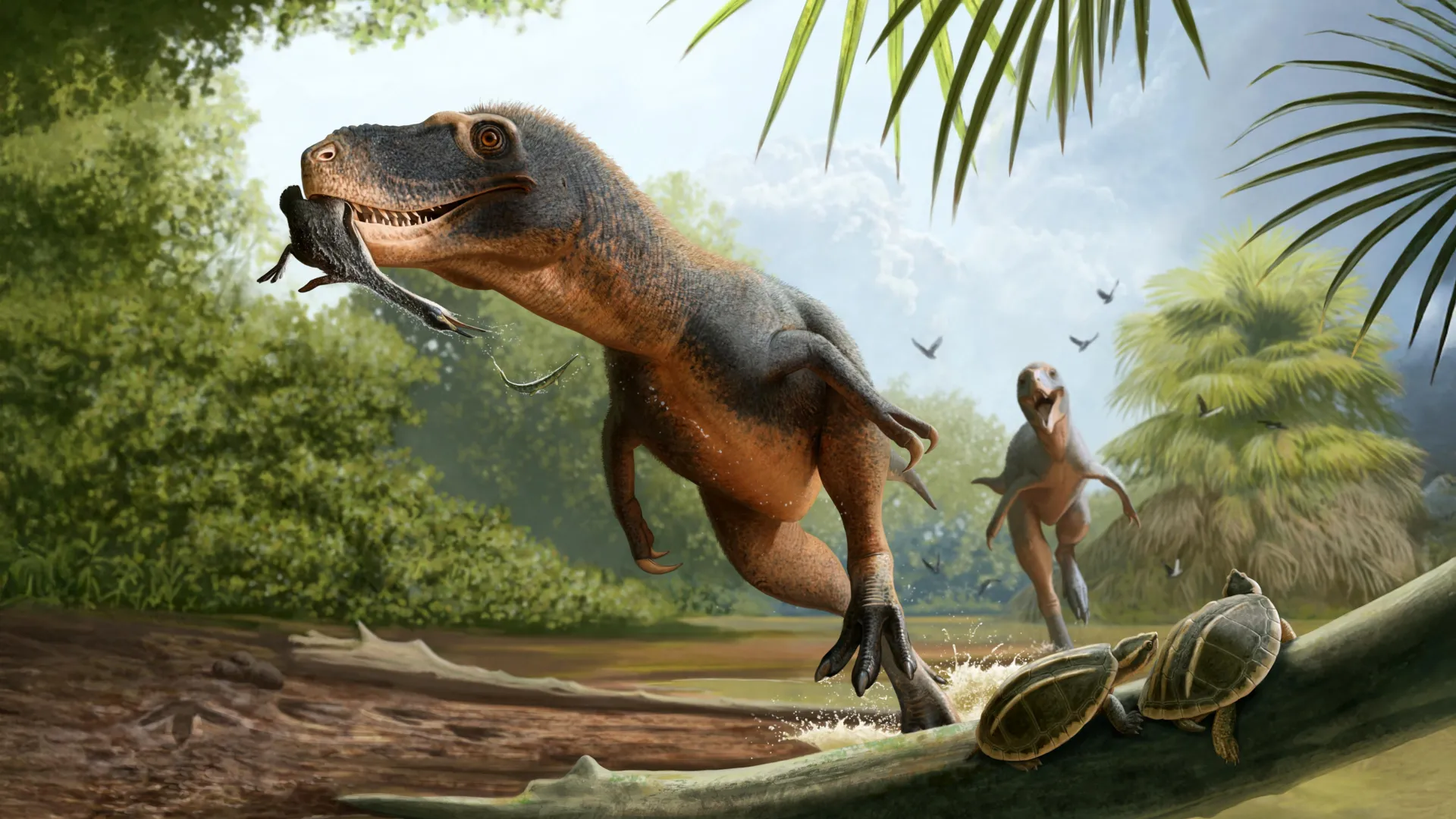
Approximately 66 million years ago, a formidable apex predator—likely a Tyrannosaurus rex or its controversial contemporary Nanotyrannus—consummated a final, fateful meal in the shadowy floodplains of what is now northeastern Montana. The prey was no standard herbivorous dinosaur, but rather a small, aquatic diving bird belonging to an extinct lineage known as hesperornithiforms. While the predator’s digestive acids dissolved much of the organic matter, they inexplicably left behind a pristine cryptographic record: a tiny, highly intricate fossil feather.
This remarkable specimen, entombed within a reddish-brown coprolite (fossilized feces), has now been brought to light by an international team of paleontologists. Published in the peer-reviewed journal Current Biology, the discovery is being hailed by researchers as perhaps the finest, most anatomically detailed feather specimen ever recovered from the Mesozoic Era. Beyond its extraordinary state of preservation, the microscopic architecture of this ancient feather is providing scientists with a vital new piece of the puzzle regarding one of Earth’s greatest biological mysteries: why birds emerged as the sole surviving lineage of the dinosaur family tree following the catastrophic mass extinction at the end of the Cretaceous Period.
A Detective Story Etched in Stone
The trajectory of this discovery reads like a classic scientific detective story, beginning humbly in the field and culminating in advanced laboratory imaging. In 2016, Dr. David DeMar, Jr., a research scientist and collections manager for the Hell Creek Project at the University of Washington’s Burke Museum, was conducting routine paleontological fieldwork in the Hell Creek Formation of Montana. While navigating a rocky outcrop to collect fossilized fish remains, a nondescript, golf-ball-sized nodule caught his eye.
"I was crawling up a rocky outcrop collecting fish fossils when I came across a dark, reddish-brown nodule about half the size of a golf ball," DeMar recounted. Upon picking up the specimen and scanning its surface with a hand lens, he spotted a tiny, fragile fossil feather protruding from the matrix. Given that feathers had evaded discovery in the Hell Creek Formation for more than 150 years of intensive prospecting, the find was unprecedented.
Recognizing the delicacy of the material, the research team opted for non-destructive analysis. They subjected the nodule to high-resolution micro-CT scanning at the University of Southern California’s medical campus. CT scanning allows researchers to digitally slice through solid objects via thousands of X-rays, rendering a precise three-dimensional interior map without damaging the fossil itself.
Co-author Nate Carroll, a paleontologist at the Carter County Museum in Ekalaka, Montana, noted the transformative nature of the scanning process. "Every hour processing the data revealed another feather, another scale, another bone—in stunning 3D," Carroll observed. The scans revealed a dense matrix containing not only multiple feathers, but also microscopic scales from a gar fish and distinct leg bones belonging to a hesperornithiform bird. Because the avian bones and feathers were co-mingled within the same coprolite deposit, scientists concluded they originated from a single unfortunate individual consumed by the large theropod.
Chronology of a Mass Extinction and Avian Origins
To understand the weight of this discovery, paleontologists look back through a deep evolutionary timeline spanning more than 150 million years:
- ~150 Million Years Ago: The earliest known bird, Archaeopteryx, emerges during the Late Jurassic Period, exhibiting a mosaic of avian and non-avian dinosaur characteristics.
- Cretaceous Period (~145 to 66 Million Years Ago): Birds diversify significantly, sharing ecological niches with a vast array of non-avian dinosaurs and primitive bird groups, such as the dominant enantiornithines and the specialized aquatic hesperornithiforms.
- 66 Million Years Ago: A colossal asteroid—roughly 6 miles wide—strikes the Yucatán Peninsula near Chicxulub, Mexico. The impact triggers a cataclysmic chain reaction, including massive earthquakes, global tsunamis, acid rain, and an "impact winter" caused by particulate matter choking out sunlight for years.
- Post-Cretaceous Era: Nearly all non-avian dinosaurs and the vast majority of avian lineages—including enantiornithines and hesperornithiforms—vanish entirely. Only a single group of modern-type birds, known scientifically as Neornithes, survives to populate the modern world.
Dr. Jingmai O’Connor, associate curator of fossil reptiles at the Field Museum in Chicago and lead author of the study, emphasized the rarity of studying feathers preserved via this biological pathway. "As far as I know, no one has ever thought to look for feathers or to study feathers in coprolites, so this project was really exciting," O’Connor stated.
Anatomical Insights into the Hesperornithiform
The newly analyzed feathers belong to the hesperornithiforms, a specialized clade of prehistoric aquatic birds. Morphologically, these creatures bore a striking ecological resemblance to modern loons or grebes. Most species within this lineage were flightless, instead relying on powerful, specialized lower limbs and feet to propel themselves through marine and freshwater environments in pursuit of fish.
When examining the ultrastructure of the preserved plumage, the researchers noted a fascinating evolutionary intermediate state. "Some of these diving birds’ feathers seem to have been modern-looking and waterproof, but they also had some smaller, fuzzy, primitive body feathers that we associate with dinosaurs and enantiornithines," O’Connor explained.
This dual nature places the hesperornithiform feather squarely between the primitive plumage of enantiornithine dinosaurs and the fully specialized contour feathers of modern Neornithes. While the feathers exhibited clear adaptations for an aquatic lifestyle—crucial for thermal regulation while diving in cold waters—they simultaneously retained archaic, down-like structural elements.
Challenging the Aquatic Survival Hypothesis
For decades, paleontologists have debated why Neornithes managed to endure the end-Cretaceous extinction while every other avian lineage perished. One of the most prominent prevailing theories posited that survival was primarily habitat-driven. According to this hypothesis, birds living in aquatic, marine, or shoreline environments were shielded from the immediate, scorching thermal pulse and widespread wildfires that devastated terrestrial ecosystems following the asteroid impact.
However, the discovery of a heavily specialized aquatic bird like the hesperornithiform inside a predator’s digestive tract complicates this narrative. Hesperornithiforms were fundamentally aquatic animals, yet their entire lineage was completely eradicated during the mass extinction event.
This paradox has forced researchers to look beyond mere geography and habitat preference. O’Connor and her colleagues argue that the physiological characteristics of the feathers themselves—and critically, the biological mechanisms governing how those feathers were replaced—may hold the definitive answer.
Feathers, Molting, and the Impact Winter
Following the Chicxulub impact, Earth was plunged into a prolonged period of darkness and severe global cooling known as an impact winter. During this time, maintaining core body temperature became an existential challenge for endothermic (warm-blooded) animals.
Modern birds (Neornithes) possess highly efficient plumaceous and vaned feathers that create optimal insulating air pockets. Furthermore, many modern birds have evolved sophisticated molting strategies that allow them to replace worn feathers gradually, ensuring continuous thermal protection.
In contrast, primitive birds and non-avian dinosaurs possessed less thermally efficient plumage. If hesperornithiforms and enantiornithines relied on primitive, less dense body feathers that trapped heat poorly, they would have been exceptionally vulnerable to the sudden temperature drops of the impact winter. Even if these aquatic birds successfully sheltered in water during the initial impact, they ultimately lacked the superior thermal insulation required to survive the multi-year darkness that followed.
Dr. Gregory Wilson Mantilla, professor at the University of Washington, curator of vertebrate paleontology at the Burke Museum, and a co-author of the study, highlighted the broad significance of the find. "We rarely find fossils of birds and even more rarely their feathers, giving us such important insight into the evolution of this key aspect of their biology," Wilson Mantilla noted. "On top of that, these bird feathers found within a large fossilized dinosaur dung give us an incredible window into predator-prey interactions 66 million years ago."
Broader Implications and Future Paleontological Research
The successful extraction and CT-scanning of delicate feather material from a fossilized coprolite marks a methodological breakthrough for paleontology. Traditionally, researchers relied on rare geological traps—such as amber deposits, where resin encapsulated ancient feathers in exquisite three-dimensional detail—to study soft-tissue morphology.
By demonstrating that fossilized feces can similarly preserve microscopic soft tissues in three dimensions, the study opens an entirely new frontier for exploration. Coprolites are relatively common in the fossil record and are frequently housed in museum archives worldwide, often overlooked as mere indicators of dietary habits rather than repositories of delicate biological history.
O’Connor expressed hope that this discovery will encourage a re-evaluation of existing museum collections. "Since no one has studied feathers in coprolites before, this opens up a whole new avenue for investigation," she remarked. "We only knew to look at this one because of how it happened to be split open, with the feather exposed—it was literally a lucky break. I hope more scientists start CT scanning coprolites and taking a closer look at them to see what might be inside."
As researchers apply advanced non-destructive imaging technologies to more coprolite specimens, the fossilized waste of prehistoric predators may yield further hidden details regarding ancient food webs, parasitic loads, and the delicate evolutionary stepping stones that allowed a single lineage of feathered dinosaurs to conquer the skies of the modern world.
