
For the vast majority of evolutionary history, the foundational strategy of reproduction across the animal kingdom was remarkably hands-off: organisms would produce and release offspring, leaving them entirely to fend for themselves against harsh environments and predators. Yet, at various points across evolutionary timelines, complex forms of parental and social care emerged, ranging from birds maintaining intricate nests and mammals providing nutrient-rich milk to social insects tending meticulously to developing larvae. For decades, evolutionary biologists and neuroscientists have sought to understand how such sophisticated nurturing behaviors could evolve from ancestors that exhibited little to no investment in their young. Now, a groundbreaking study published in the journal Nature sheds critical new light on this profound biological transition, suggesting that evolution did not construct entirely novel brain systems from scratch. Instead, it repurposed and adapted ancient neural pathways that originally regulated hunger and feeding, granting them a secondary, vital role in social caregiving.
The research, spearheaded by scientists at The Rockefeller University, utilized clonal raider ants as a model organism to decode the complex relationship between brain chemistry, age-dependent division of labor, and social care. By tracking hundreds of individual interactions within automated behavioral monitoring systems, the research team discovered that two specific neuromodulatory molecules—Neuropeptide F and Allatostatin A—act as chemical switches that push an ant’s behavior toward either nursing larvae or foraging for food. Crucially, these molecules are fundamentally intertwined with hunger signaling pathways, providing empirical evidence that parental care is deeply rooted in the ancient mechanics of finding and consuming nourishment.
Decoding the Evolutionary Machinery of Social Care
To understand how complex behaviors arise, scientists have long debated the mechanisms of evolutionary innovation. A leading hypothesis posits that nature rarely invents complex physiological and neurological systems from absolute scratch. Instead, parsimony dictates that evolution frequently co-opts and adapts biological infrastructure that already exists within an organism. Previous studies in mammals hinted at this possibility, suggesting that neuropeptides—small signaling molecules utilized by neurons to communicate across synapses—might have transitioned over evolutionary time from regulating basic metabolic needs, such as hunger, to encouraging protective and nurturing behaviors toward offspring.
However, establishing a definitive causal link has historically proved exceptionally challenging in neuroscience. Traditional model organisms like fruit flies (Drosophila melanogaster) and nematodes (Caenorhabditis elegans) do not exhibit parental care, limiting their utility for studying the evolution of nursing behaviors. Conversely, mice provide extensive parental care and share numerous conserved neuropeptide systems with humans, but the mammalian brain is immensely complex, containing roughly 100 million neurons and intricate neural networks that complicate fine-grained mapping.
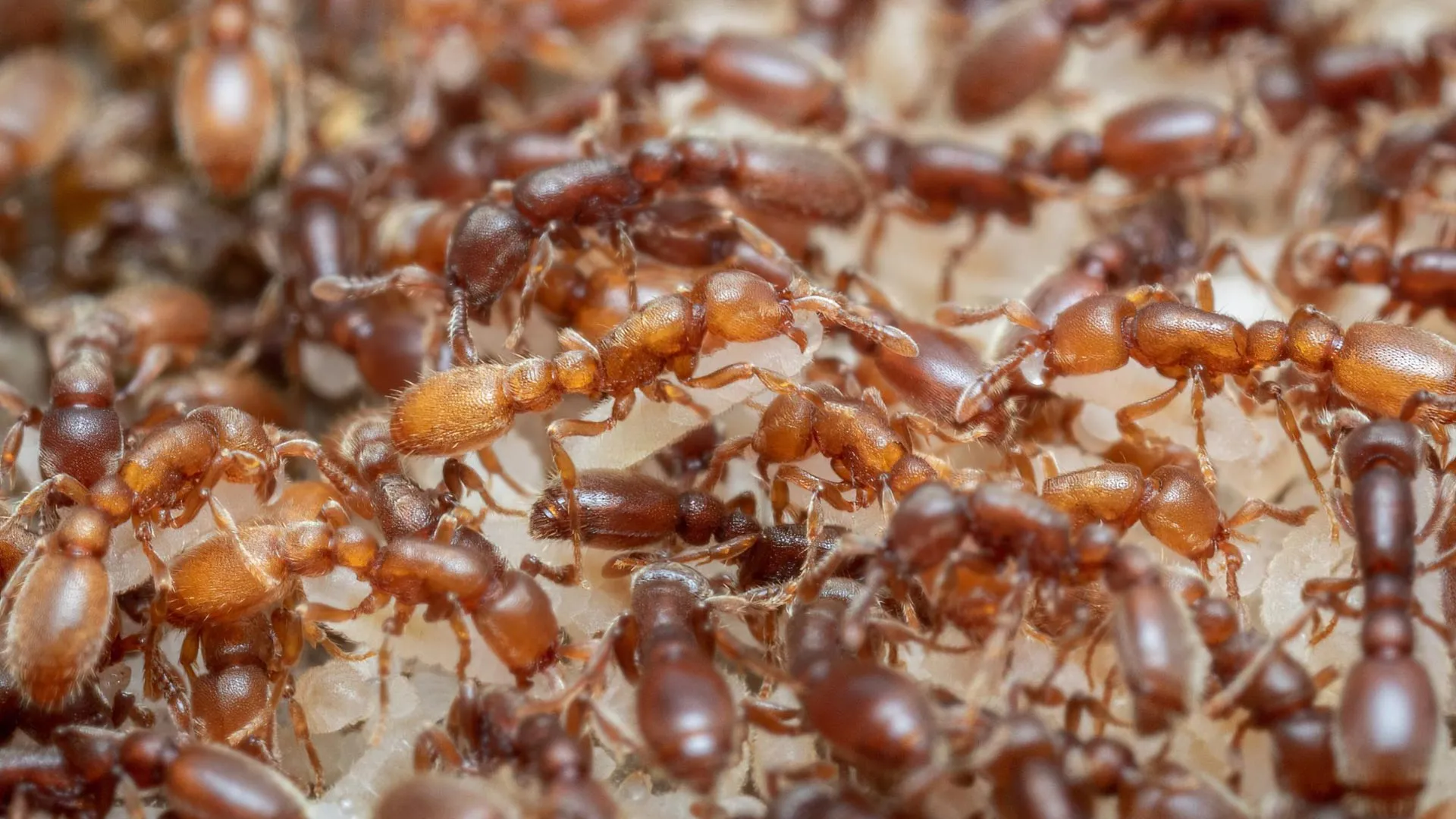
To bypass these experimental roadblocks, researchers turned to the clonal raider ant (Ocrogaster coeca). Possessing a brain containing only about 60,000 cells, these ants offer a streamlined yet socially sophisticated nervous system. Furthermore, ants and mammals share related brain signaling architectures that govern social behaviors and caregiving. Most importantly, ant colonies exhibit a rigid, age-based division of labor: younger ants remain inside the subterranean nest to nurse and tend to developing brood, while older ants transition out of the nest to hunt and forage for food. This predictable behavioral shift over an individual’s lifetime provides an ideal natural framework for studying how neuromodulators orchestrate changes in social roles as the brain ages.
Tracking Behavioral Transitions One Ant at a Time
To meticulously map the biochemical underpinnings of this age-based transition, the research team at Rockefeller University designed an innovative automated behavioral tracking system. Individual ants were paired with individual larvae, allowing high-throughput, precision monitoring of hundreds of caregiving interactions simultaneously.
Parallel to the behavioral tracking, the scientists undertook the massive task of mapping the ant’s neuropeptidome—the complete complement of neuropeptides produced within the insect’s central nervous system. Through rigorous biochemical analysis, the team successfully identified 70 distinct neuropeptides. Each of these candidate molecules was subsequently synthesized and individually tested to determine its specific capacity to alter or influence caregiving behaviors in the ants.
The investigation focused heavily on understanding where these promising chemical messengers were produced, how their concentration and distribution shifted over the natural lifespan of an ant, and how artificial manipulation of their activity levels impacted the insects’ daily routines. Additionally, the researchers conducted comparative assays between well-fed ants and those subjected to food deprivation. This experimental design was crucial for testing whether the chemical signals governing caregiving remained functionally tethered to the ancient metabolic circuits from which they presumably evolved.
The resulting data revealed that caregiving behavior in ants is inextricably linked to the neurobiology of hunger. Specifically, two primary signaling molecules were identified as opposing drivers of behavior, shifting an ant’s priorities based on its age and internal metabolic state: Neuropeptide F (NPF) and Allatostatin A (AstA).
The Dual-Molecule Switch: Neuropeptide F and Allatostatin A
The experimental findings demonstrated that NPF and AstA act as a functional biochemical toggle, directing whether an ant engages in nursing or foraging. NPF was shown to strongly encourage nurturing behavior, promoting active care and tending of larvae. In direct opposition, AstA stimulated migratory and exploratory behaviors, prompting the insects to abandon the brood chamber and depart the nest in search of sustenance.
This chemical dichotomy perfectly mirrored the natural physiological profile of the colony’s workforce. Young worker ants naturally exhibited high concentrations of NPF and low levels of AstA within critical processing centers of the brain. As the ants aged, this biochemical balance inverted; older workers displayed diminished NPF and elevated AstA levels, directly correlating with their physical transition from nest-bound nurses to external foragers.
When the researchers pharmacologically or genetically manipulated the activity of either molecule, the predictable progression of behavior was disrupted. Altering the signaling strength of NPF or AstA actively forced ants to shift their roles, proving that these neuropeptides are not merely passive correlates of age or status, but active causal agents that dictate whether an insect nurtures a larva or seeks out food.
Furthermore, these ancient neural circuits retained their sensitivity to nutritional status. When ants were starved, their endogenous levels of NPF spiked while AstA levels dropped, causing the hungry insects to paradoxically exhibit increased caregiving behaviors. Once the subjects were refed, the internal chemical balance inverted once more, rapidly subduing their nursing drive and reorienting their priorities toward foraging.
"We learned that parental behaviors build on the neural circuitry for feeding, and that makes some sense," notes Daniel Kronauer, head of the Laboratory of Social Evolution and Behavior at Rockefeller University. "Parental behavior is a lot about feeding—not just yourself, but your offspring."
Broader Implications and Shared Biological Blueprints
The implications of the study extend far beyond the social structure of ant colonies. By demonstrating that parental care evolved through the functional expansion of ancient feeding and metabolic circuits, the research provides a compelling conceptual framework for how complex behavioral repertoires emerge across diverse animal lineages. Rather than engineering entirely novel neurological hardware, evolution optimized pre-existing metabolic signaling pathways, driving animals to extend their innate drive for self-nourishment to include the sustenance and protection of their offspring.
This conservation of neurochemical machinery points toward a shared biological blueprint for parenting across widely separated branches of the animal tree of life. Because mammals utilize homologous neuropeptide systems—such as oxytocin, vasopressin, and related feeding-associated peptides—to regulate maternal and paternal care, the discovery suggests that evolutionary pathways leading to complex social behaviors are far more constrained and universal than previously assumed.
"It amazes me that similar parenting behaviors have evolved so many times in so many distinct animal lineages," remarks lead researcher Kay. "Our paper suggests that the evolutionary routes to these sorts of behaviors are far more constrained than we may have naively imagined. That’s very exciting, because it may eventually lead to a blueprint of how these complex social behaviors evolve."
Unlocking the Mysteries of Healthy Brain Aging
Beyond illuminating the evolutionary origins of parenting, the research highlights the exceptional value of clonal raider ants as a premier model for studying normal neurobiological aging. Contemporary biomedical research is overwhelmingly skewed toward investigating late-stage neurodegenerative pathologies, such as Alzheimer’s disease and other forms of dementia. Consequently, neuroscientists possess a profound knowledge gap regarding the subtle, progressive structural and chemical changes that occur within a healthy brain across a normal lifespan.
In clonal raider ant societies, the predictable, age-dependent transition from nursing to foraging provides a natural, highly organized system for observing how age-related shifts in brain chemistry systematically reshape behavior and cognitive priorities over time. Because these behavioral dynamics are fundamental to the survival and functional division of labor within the colony, they offer a unique window into healthy neural senescence.
The research team suspects that the neuromodulatory mechanisms driving age-dependent behavioral changes in ants are conserved across the animal kingdom, potentially operating similarly in complex mammals, including humans. By mapping how specific chemical messengers modulate behavioral proclivities over time, scientists hope to establish foundational baselines for understanding how healthy brains adapt, age, and maintain functional integrity.
"There’s a lot of research and funding invested in studying late-stage neurodegenerative diseases, but we actually know very little about how the brain changes throughout the normal healthspan of an individual," concludes Kronauer. "In ant colonies, these dynamics are central to the organization of the society. Our discovery provides a striking demonstration that neuromodulators can produce age-dependent changes in behavioral proclivities in ants, and I suspect that that’s the case in other animals as well, including in humans."
As researchers move forward, the primary objective will be mapping the precise neural circuits downstream of Neuropeptide F and Allatostatin A. By fully charting these pathways in ants and comparing them to corresponding mammalian networks, science moves one step closer to establishing a universal blueprint of social behavior, evolutionary adaptation, and lifelong brain health.
