
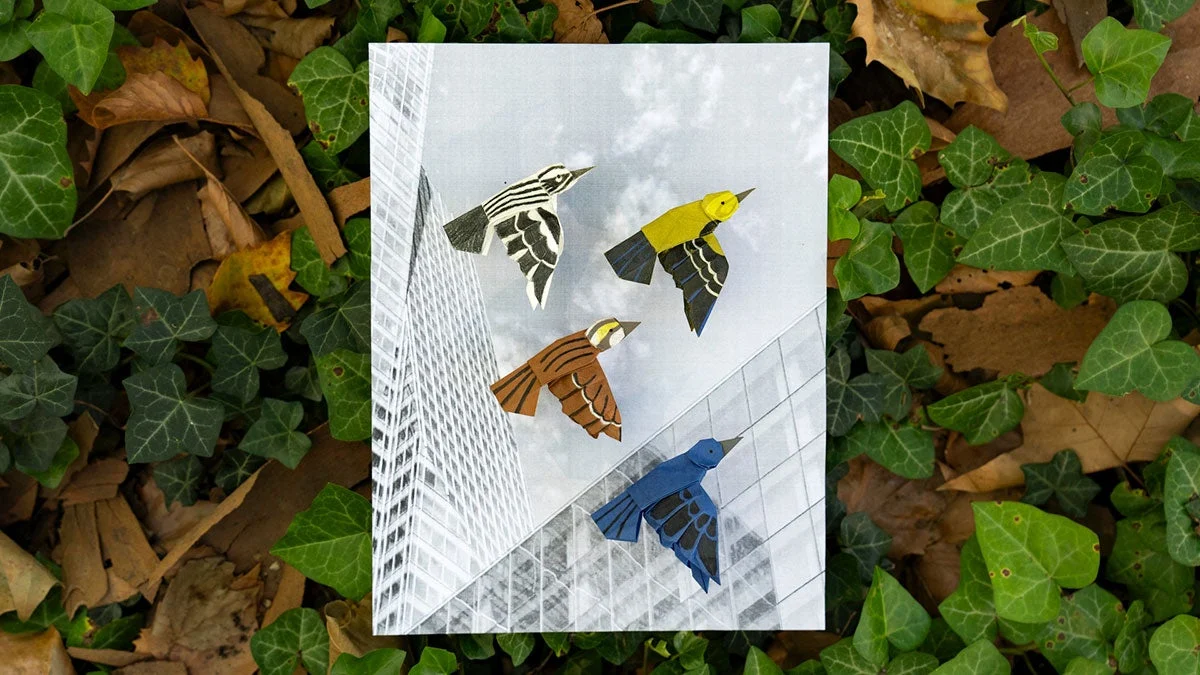
Miles Wu’s morning routine in New York City is starkly different from that of the average fourteen-year-old. While his peers may be sleeping in on a Sunday, Wu is navigating the glass-walled canyons of Manhattan, performing the solemn duty of a collision monitor for Project Safe Flight. His mission is to locate the victims of a silent, urban crisis: the hundreds of thousands of migratory birds that perish annually after colliding with the city’s reflective skyscrapers. Yet, Wu does more than just collect data; he transforms his grief into intricate, hand-folded origami, creating a bridge between the cold statistics of urban ecology and the fragile, ephemeral beauty of the avian world.
The catalyst for his current artistic project occurred this past May near Bryant Park. As he patrolled the perimeter of a glassy office tower, a sudden, sharp thud echoed against the pane. A brilliant Indigo Bunting, a species known for its deep, cerulean plumage, plummeted to the pavement. For Wu, the encounter was a jarring intersection of wonder and devastation. The bird’s vibrant color, even in death, served as a poignant reminder of the life lost to the city’s unyielding architecture. This moment became the genesis of his latest origami collection, a memorial that seeks to honor the lives of four specific victims: the Indigo Bunting, a Black-and-white Warbler, a Black-throated Green Warbler, and a White-throated Sparrow.
The Intersection of Birding and Origami
Wu’s journey into the intersection of art and conservation began long before he became a volunteer. An origami enthusiast for over seven years, he transitioned from folding simple geometric shapes to mastering complex biological forms. His transition into designing original patterns two years ago was fueled by his simultaneous growth as an amateur birder in Central Park. Birds, with their elaborate wing structures and delicate appendages, provided the perfect subject matter for his technical pursuits.
His design process is an exercise in both precision and empathy. Each of his avian models begins with a foundational "bird base," a traditional origami structure featuring five distinct flaps. From this starting point, Wu employs complex folding techniques to manipulate the paper into the unique contours of the species he aims to replicate. For his recent memorial piece, he opted for a heavier-weight paper, which allowed for more structural integrity when shaping the intricate feather patterns of the songbirds. By using colored pencils to apply the final details of their plumage, Wu brings a lifelike quality to his paper sculptures, ultimately mounting them against a photographic backdrop of the very buildings that claimed their lives.
The Silent Crisis of Migratory Collisions
The necessity for Wu’s work is grounded in a well-documented ecological crisis. New York City sits directly beneath the Atlantic Flyway, a primary migratory corridor for millions of birds moving between breeding grounds in the north and wintering habitats in the south. During these twice-yearly migrations, birds are frequently disoriented by the vast expanse of artificial light emitted by urban centers at night.
As dawn breaks, the danger shifts from light pollution to the reflective quality of modern glass architecture. Birds, unable to perceive glass as a solid barrier, often interpret the reflected sky or surrounding vegetation as a clear flight path. The consequences are fatal. According to data provided by the NYC Bird Alliance, the estimated death toll from window collisions in New York City ranges from 90,000 to 230,000 birds annually. Migratory species are particularly susceptible; these birds arrive in the city already physically depleted from long-distance flights, leaving them with reduced reaction times and lower energy reserves to navigate the complex, hostile terrain of the urban landscape.
A Volunteer’s Chronology of Care
For the past two years, Wu has been an active participant in Project Safe Flight, a program organized by the NYC Bird Alliance to monitor the impact of buildings on local and migratory bird populations. His routine is methodical: every Sunday during the peak of spring and fall migration, he arrives at his designated survey area before 7:00 a.m.
The protocol for volunteers is as rigorous as it is compassionate. If a bird is found alive, it is carefully collected and transported to the Wild Bird Fund, a dedicated wildlife rehabilitation center in the city. If the bird is found deceased, the remains are documented, collected, and eventually donated to the American Museum of Natural History’s ornithology collection. These specimens serve as invaluable data points for researchers studying everything from species distribution to the effects of climate change on migration patterns.
For Wu, this experience has provided a sobering education. He has encountered many species for the first time—what birders call "lifers"—only after they have collided with a building. It is a bittersweet irony that defines his early birding career: the realization that the most pristine specimens of rare migratory birds are often those that have met their end against a skyscraper’s window.
Data as a Catalyst for Policy Change
The significance of the work performed by volunteers like Wu extends far beyond the individual birds saved. The cumulative data collected by Project Safe Flight provides the empirical evidence necessary to lobby for legislative and structural changes. Advocacy groups have used these records to pressure building owners and city officials to adopt "bird-safe" building standards.
These standards include practical solutions such as implementing "Lights Out" initiatives, which reduce the amount of disorienting artificial light during peak migration periods, and the application of window film, fritting, or other patterns that break up the reflection of the glass, making it visible to avian eyes. Legislative efforts have seen successes in recent years, including local laws mandating bird-friendly materials for new construction and major renovations. However, the sheer volume of existing glass-facade buildings in the city means that the challenge remains a long-term, systemic issue.
The Role of Art in Conservation Advocacy
Miles Wu’s origami serves as a powerful supplement to traditional advocacy. While data sheets and policy briefs are essential for convincing lawmakers, art possesses the unique capacity to elicit an emotional response from the general public. By memorializing these birds, Wu transforms a "collision statistic" into an individual life.
"I thought this piece would be like a tribute to all the birds from Project Safe Flight," Wu notes. His work challenges observers to consider the birds not as casualties of urban development, but as fellow inhabitants of the city whose lives have intrinsic value. In a landscape often dominated by concrete and steel, his paper birds offer a quiet, artistic plea for a more harmonious coexistence.
The broader implications of his work suggest a growing trend among the next generation of conservationists: the marriage of scientific literacy with artistic expression. As the climate changes and urbanization continues to expand, the pressure on migratory species will only intensify. Projects like Wu’s, which combine rigorous field monitoring with public engagement, are vital for shifting the cultural perception of urban biodiversity.
As of the current season, the NYC Bird Alliance continues to emphasize that the solution to bird collisions is a shared responsibility. While the efforts of volunteers are heroic, the ultimate goal remains a city where the sky is not a death trap for the millions of wings that pass through it every year. Until that standard is met, teenagers like Miles Wu will continue their morning patrols, balancing the heartbreak of their discoveries with the meticulous, folding work of a memory-keeper, ensuring that every bird lost to a window leaves behind a story.
