
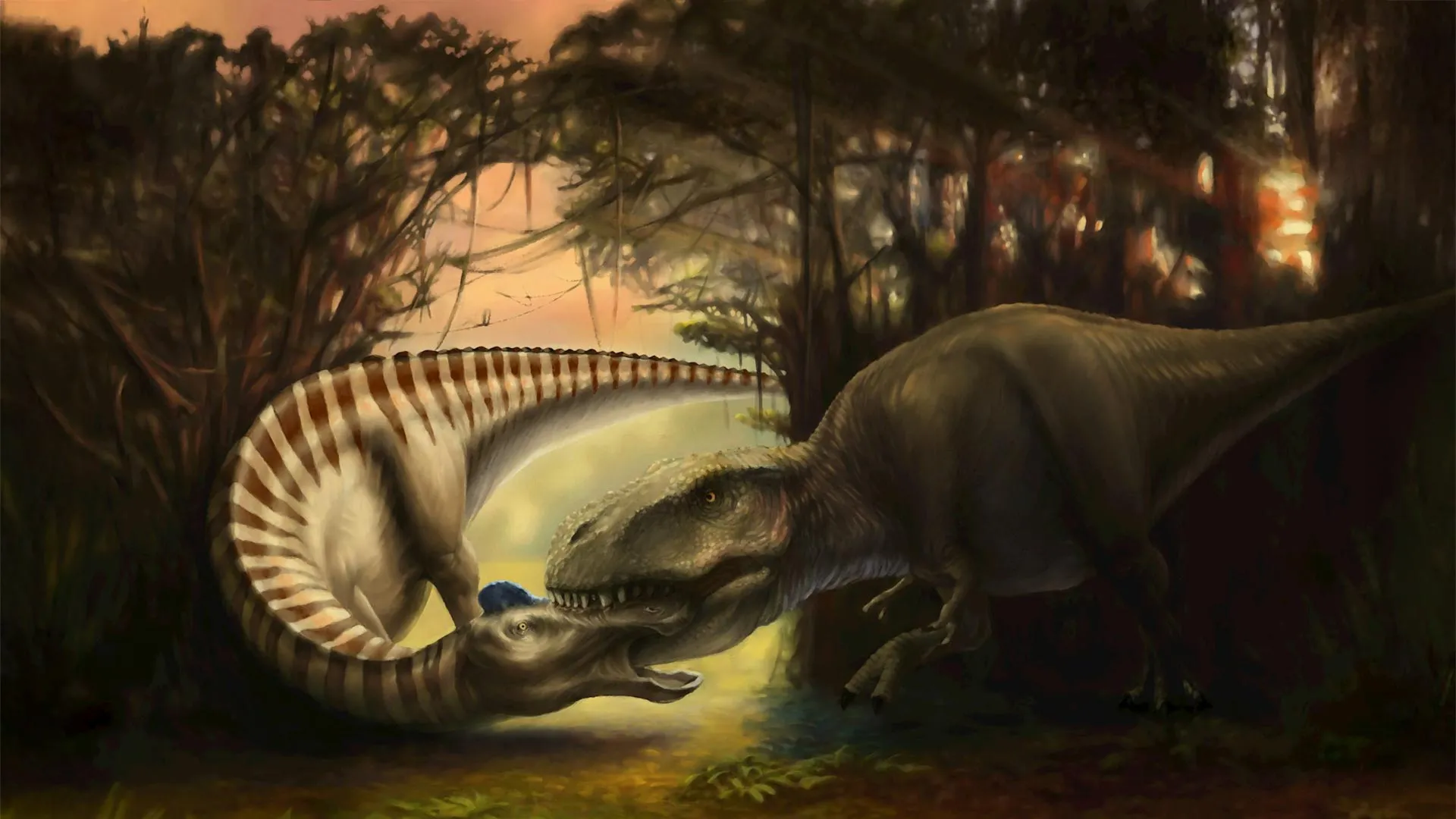
The harsh landscape of prehistoric North America approximately 66 million years ago was a theater of relentless survival, where apex predators and massive herbivores engaged in evolutionary arms races that have fascinated scientists for generations. Today, modern paleontological techniques are granting researchers unprecedented visibility into these ancient conflicts, thanks to an extraordinary specimen housed at the Museum of the Rockies in Bozeman, Montana. A newly published scientific study focuses on a remarkably preserved Edmontosaurus skull featuring a broken Tyrannosaurus tooth deeply embedded in its facial bones. This unique fossil provides a direct, physical archive of prehistoric predation, offering structural and behavioral insights that elevate our understanding of how the undisputed king of the Cretaceous hunted, fed, and interacted with its contemporaries.
The collaborative research effort, spearheaded by University of Alberta doctoral student Taia Wyenberg-Henzler alongside Dr. John Scannella, Curator of Paleontology at the Museum of the Rockies, bridges the gap between static fossil morphology and dynamic ancient behavior. Published in the peer-reviewed scientific journal PeerJ, the investigation treats the fossilized remains less like static museum exhibits and more like forensic evidence at a prehistoric crime scene. By combining traditional osteological analysis with advanced medical imaging technology, the research team has opened a fascinating window into the final moments of a duck-billed herbivore and the aggressive feeding strategies of the most famous carnivorous dinosaur in Earth’s history.
Chronology of a Discovery: From the Hell Creek Formation to the Museum Archives
The journey of this remarkable fossil began nearly two decades ago during a routine paleontological expedition in the rugged terrain of the Hell Creek Formation in eastern Montana. Spanning parts of Montana, North Dakota, South Dakota, and Wyoming, the Hell Creek Formation is globally renowned among geologists and paleontologists for preserving a rich assemblage of terrestrial fossils dating from the very end of the Cretaceous period, just prior to the catastrophic Cretaceous-Paleogene extinction event.
In 2005, field researchers operating on federally managed land under the jurisdiction of the Bureau of Land Management located a nearly complete skull belonging to an Edmontosaurus, a widespread and successful genus of duck-billed dinosaur. Recognizing the scientific value of the specimen, excavation teams carefully extracted the fossil from the sedimentary rock layers, ensuring the integrity of the bone matrix. The skull was subsequently transported to the Museum of the Rockies, an institution celebrated worldwide for housing one of the most extensive collections of dinosaur fossils in existence, particularly carnivorous theropods.
For years, the skull resided within the institution’s extensive collections before being selected for prominent public display in the museum’s Hall of Horns and Teeth. However, it was not merely the completeness of the skull that drew the attention of researchers; rather, it was a subtle, anomalous feature embedded directly within the facial architecture of the herbivore. A serrated fragment of a theropod tooth was discovered physically trapped inside the bone of the snout, having broken off during a violent impact millions of years ago. This chance preservation set the stage for the rigorous multi-year investigation that culminated in the recent PeerJ publication.
Anatomy of an Attack: Forensic Paleontology in the Cretaceous
While fossilized bones bearing tooth marks, gouges, and puncture wounds are relatively common occurrences in the fossil record of the Late Cretaceous, discovering an intact, broken tooth fragment deeply embedded within the skeletal structure of a prey animal is an exceedingly rare event. This distinction is crucial for paleoecologists attempting to reconstruct ancient food webs and predator-prey dynamics.
"Although bite marks on bones are relatively common, finding an embedded tooth is extremely rare," explained lead researcher Taia Wyenberg-Henzler during discussions surrounding the publication. "The great thing about an embedded tooth, particularly in a skull, is it gives you the identity of not only who was bitten but also who did the biting. This allowed us to paint a picture of what happened to this Edmontosaurus, kind of like Cretaceous crime scene investigators."
To definitively identify the perpetrator, the research team undertook a comprehensive comparative analysis. They cross-referenced the morphology, size, and serration patterns of the embedded tooth fragment against every known carnivorous dinosaur species inhabiting the Hell Creek ecosystem during the late Maastrichtian age. Through a process of elimination based on dental anatomy, the data pointed unequivocally to Tyrannosaurus, the apex carnivore of the region.
To peer beneath the surface without damaging the irreplaceable fossil, the team utilized high-resolution computed tomography (CT) scans. Conducted at Advanced Medical Imaging at Bozeman Health Deaconess Hospital, the scans provided internal, three-dimensional perspectives of the skull’s structural integrity and the exact trajectory of the tooth’s penetration. The imaging revealed how the immense mechanical forces exerted during the bite caused the tyrannosaur’s tooth to fracture and become permanently anchored within the facial bones of the Edmontosaurus.
Behavioral Implications: Active Predation Versus Scavenging Debates
The debate surrounding the hunting versus scavenging habits of Tyrannosaurus has persisted within the paleontological community for decades. While some historical hypotheses suggested that the massive theropod may have relied primarily on scavenging already-dead carcasses due to its immense size and potential turning radius, a growing body of consensus—bolstered by discoveries like the Hell Creek Edmontosaurus skull—points strongly toward active, predatory behavior.
Dr. John Scannella emphasized the behavioral significance captured by the fossil specimen. "A fossil like this is extra exciting because it captures a behavior: a tyrannosaur biting into this duckbill’s face," Scannella noted. Furthermore, the analysis of the bone surrounding the embedded fragment yielded vital chronological data regarding the timing of the injury relative to the animal’s death. Microscopic examination of the fossilized bone revealed a complete absence of healing or bone remodeling around the foreign object.
In vertebrate osteology, living bone responds to trauma and foreign bodies by initiating inflammatory and regenerative processes, resulting in bone growth around the site of injury if the organism survives for even a short duration. The total lack of healing indicators on the Edmontosaurus skull suggests two primary scenarios: either the herbivore was already deceased when the tyrannosaur scavenged the remains, or the force and placement of the bite were immediately fatal, terminating the animal’s life on the spot.
Wyenberg-Henzler points to the anatomical positioning of the tooth as a strong indicator of an active confrontation. "Looking at the way the tooth is embedded in the nose of the Edmontosaurus suggests that it met its attacker face-to-face, something that usually happens to an animal that was killed by a predator," she stated. The precise localization of the trauma to the snout, combined with the catastrophic structural failure of the tooth under immense bite force, paints a vivid picture of a violent, close-quarters interaction between two megafaunal titans.
Ecosystem Context of the Hell Creek Formation
To fully appreciate the significance of this fossil discovery, one must examine the broader ecological backdrop of the Hell Creek Formation during the late Cretaceous period, roughly 66 million years ago. This ancient ecosystem was characterized by broad, humid coastal floodplains, meandering river systems, and dense subtropical forests teeming with diverse plant and animal life.
In this dynamic environment, Tyrannosaurus rex reigned supreme as the apex predator, occasionally sharing its habitat with smaller carnivorous theropods such as Dakotaraptor or Acheroraptor, though none approached the sheer mass and ecological dominance of the tyrannosaur. Meanwhile, the herbivorous guild was heavily populated by massive ceratopsians like Triceratops horridus, armored ankylosaurs like Ankylosaurus magniventris, and abundant hadrosaurs, primarily represented by Edmontosaurus annectens.
Edmontosaurus was a highly successful, duck-billed herbivore capable of reaching lengths exceeding 12 meters and weighing several tons. Equipped with dental batteries containing hundreds of tightly packed teeth designed for grinding tough vegetation, Edmontosaurus lived in large social groups and formed a primary component of the available biomass for large predators. The ecological interaction between Tyrannosaurus and Edmontosaurus represents one of the classic predator-prey relationships in Earth’s history, comparable in scale to modern lions and zebras, albeit magnified to gargantuan proportions.
Scientific Methodology and Technological Advancements in Paleontology
The successful analysis of the Museum of the Rockies’ Edmontosaurus specimen highlights the rapidly evolving methodological toolkit available to contemporary paleontologists. Gone are the days when fossil study was limited to external visual inspection and manual preparation. Today, the integration of advanced medical diagnostics, digital photogrammetry, finite element analysis (FEA), and high-resolution computed tomography has transformed paleontology into a highly quantitative, multi-disciplinary science.
The collaboration between the Museum of the Rockies and medical professionals at Bozeman Health Deaconess Hospital exemplifies how cross-disciplinary partnerships enhance scientific inquiry. By leveraging clinical CT scanning equipment designed for human medicine, researchers can visualize internal microstructures, vascular canals, and fracture propagation paths hidden deep within fossilized stone. This non-invasive approach preserves the physical integrity of delicate museum specimens while extracting maximal data density.
Furthermore, comparative dental databases allow researchers to model bite mechanics and stress distributions with remarkable accuracy. Understanding the structural limits of tyrannosaur teeth—which were robust, D-shaped in cross-section, and designed to withstand crushing forces rather than merely slicing flesh—helps scientists reconstruct the biomechanical parameters of a bite capable of shattering bone and leaving fragments embedded in prey.
Broader Impact and Future Directions in Tyrannosaurid Research
The publication of this study in PeerJ contributes significantly to the ongoing refinement of our understanding of tyrannosaurid paleobiology. As more specimens with pathological trauma, healed bite marks, and embedded dental elements are discovered and analyzed, researchers can begin to map out behavioral patterns across geographic and temporal ranges within the Late Cretaceous.
While individual fossils capture isolated moments in deep time, accumulating these data points allows paleontologists to test hypotheses regarding hunting strategies, prey selection preferences, social interactions, and intraspecific combat among tyrannosaurs themselves. Future research initiatives at institutions like the Museum of the Rockies and the University of Alberta will likely continue to apply advanced imaging techniques to existing museum collections, re-examining historical finds with modern technological lenses.
Ultimately, the embedded tooth within the Edmontosaurus skull serves as a poignant reminder of the dynamic, unforgiving nature of the prehistoric world. Sixty-six million years after the dust settled on the Age of Dinosaurs, these silent archives continue to speak, offering humanity a clearer, more vivid window into the complex evolutionary dramas that played out across the ancient landscapes of Montana long before the dawn of human history.
