
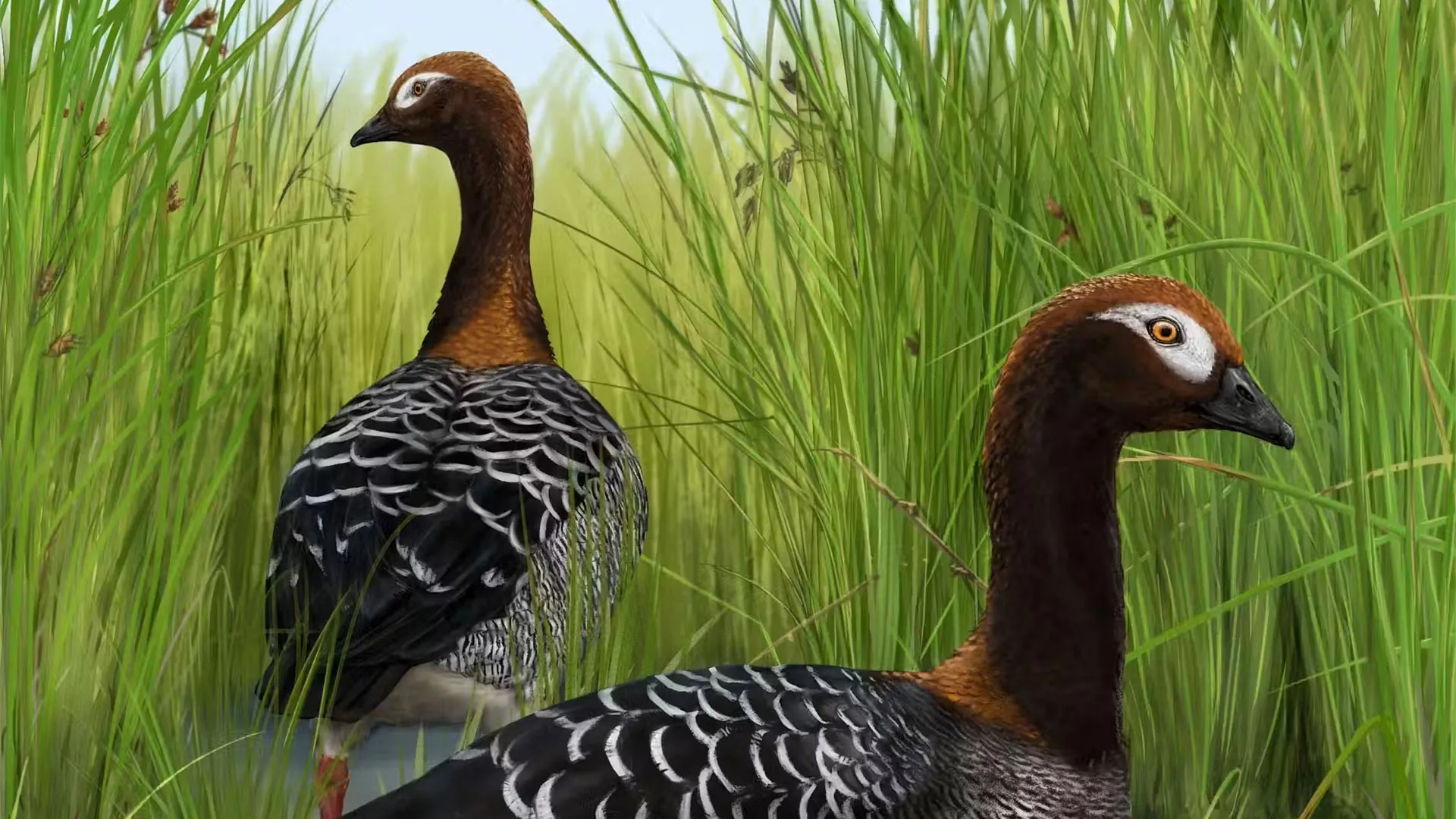
A rare fossilized goose unearthed from the remains of an ancient Miocene lake in Central Otago is fundamentally transforming scientific understanding of how New Zealand’s unique and fragile avian ecosystems evolved over millions of years. Researchers from the University of Otago, operating under its Māori name Ōtākou Whakaihu Waka, announced the discovery of an entirely new, undescribed species of waterfowl that challenges long-held orthodoxies regarding the arrival and diversification of birds in Aotearoa. The finding forms the core of a groundbreaking international study published in the peer-reviewed journal Historical Biology, shedding new light on a prehistoric landscape that continues to yield extraordinary secrets.
The collaborative research effort was spearheaded by an interdisciplinary team of scientists hailing from the University of Otago, the Museum of New Zealand Te Papa Tongarewa, and the University of Cambridge in the United Kingdom. By meticulously re-evaluating fossil material recovered from the globally renowned St Bathans fossil deposits—a treasure trove of early Miocene fauna preserved in the ancient Manuherikia basin—the team has managed to resolve a long-standing debate concerning the evolutionary lineage of New Zealand waterfowl. The implications of this research extend far beyond a single extinct bird, offering a more nuanced, dynamic perspective on the biogeography of Zealandia, the largely submerged continent that broke away from Gondwana roughly 80 million years ago.
Unearthing a Hidden Species in the St Bathans Deposits
The St Bathans fossil deposits are celebrated among paleontologists for providing a rare window into life in New Zealand approximately 16 to 19 million years ago, long before human settlement and the introduction of mammalian predators transformed the archipelago. While the site has yielded an abundance of fossilized waterfowl bones over decades of painstaking excavation, remains explicitly attributable to geese have historically been scarce, recovered only in fragmented and isolated pieces.
Associate Professor Nic Rawlence, Director of the Otago Palaeogenetics Laboratory and co-author of the new study, noted that this relative scarcity prompted the research team to take a fresh look at the archives. To solve lingering mysteries regarding the relationship between ancient and modern waterfowl, the scientists undertook a comprehensive, systematic re-examination of every single fossil bone from St Bathans that had ever been tentatively categorized as belonging to geese.
This meticulous review involved direct morphological comparisons between the fossil fragments and an extensive, global reference collection of modern and extinct bird skeletons housed in institutional archives. Through careful anatomical analysis, the team determined that a specific subset of these bones did not match any known taxon. Instead, they belonged to a previously undescribed species roughly the size of a small, modern goose.
The newly classified bird has been officially named Meterchen luti. The moniker is a playful yet scientifically grounded nod to both its origins and the circumstances of its discovery. The generic name Meterchen is derived from ancient Greek, translating to "mother goose" and honoring the famous nursery rhyme character Old Mother Goose, metaphorically evoking the image of an ancient goose emerging directly from the primordial mud. The specific epithet luti is Latin for "of the mud," paying homage to the damp, silty fossil beds of the ancient Lake Manuherikia where the bones lay entombed for nearly 20 million years.
Crucially, morphological and phylogenetic analyses revealed that Meterchen luti occupies a distinct branch on the avian family tree. Dr. Rawlence emphasized that the St Bathans goose is not closely related to the recently extinct giant, flightless New Zealand geese belonging to the genus Cnemiornis, nor is it an evolutionary sister to their modern Australian counterpart, the Cape Barren goose (Cereopsis novaehollandiae). This distinction is vital, as it dismantles previous assumptions about evolutionary continuity within the region’s waterfowl populations.
Rethinking the Chronology of Avian Colonization
For decades, paleontologists and evolutionary biologists debated the timeline of how New Zealand’s iconic bird species populated the isolated landmass. The dominant, long-standing hypothesis posited that many of the country’s lineages had deep roots stretching back unbroken to the breakup of Gondwana, or that ancient island-dwellers like the St Bathans goose served as the direct, uninterrupted ancestors of later endemic megafauna, such as the giant flightless Cnemiornis geese. Under this older theoretical framework, it was assumed that the lineage leading to the giant geese had maintained a continuous presence in Zealandia for at least 14 million years.
However, this traditional view increasingly clashed with mounting molecular evidence. Recent genetic studies analyzing ancient DNA extracted from subfossil remains have consistently pointed to a much more dynamic, wave-like pattern of colonization. These genetic clocks suggest that the ancestors of many of New Zealand’s most prominent birds—including the takahē, Forbes’ harrier, and the gargantuan Haast’s eagle—did not evolve in situ from ancient Gondwanan stock over tens of millions of years. Instead, they arrived via trans-oceanic dispersal surprisingly recently, in geological terms, dating back only four to five million years.
Alan Tennyson of Te Papa, lead author of the new study, explained how the discovery of Meterchen luti helps bridge the gap between morphological paleontology and modern genetics.
"An earlier theory argued that the St Bathans goose represented the direct ancestors of giant flightless Cnemiornis geese, implying this lineage had a very long history of at least 14 million years in Zealandia," Tennyson said. "However, this conflicts with genetic evidence suggesting the ancestors of Cnemiornis arrived from Australia only about seven million years ago, which proponents of the earlier theory discarded. Our rigorous reassessment supports the later arrival theory."
By integrating fossil morphology with state-of-the-art genetic modeling, the research team demonstrated that the lineage represented by Meterchen luti did indeed arrive in Zealandia more than 14 million years ago, establishing an early chapter in the island’s ecological story. However, unlike the uninterrupted lineage once imagined by classical paleontologists, this ancient group eventually went extinct without leaving any surviving descendants in the modern fauna. The ecological niches they once occupied were subsequently repopulated millions of years later by entirely separate waves of avian colonizers crossing the Tasman Sea from Australia.
The Power of Paleogenomics and the St Bathans Archive
The breakthrough published in Historical Biology underscores a broader methodological revolution currently sweeping through the biological sciences. By combining classical fossil analysis with cutting-edge paleogenomics, modern researchers are no longer forced to rely solely on fragmented bones or incomplete stratigraphical records to reconstruct prehistoric ecosystems.
"Using all the tools in the toolbox, including DNA and fossils, we can reconstruct how the dynamic geological, climatic, and human history of Zealandia has shaped the evolution of Aotearoa fauna in ever more detail," Dr. Rawlence stated.
The St Bathans fossil deposits serve as the premier crucible for this multidisciplinary approach. Formed during the early Miocene epoch, the deposits capture a subtropical New Zealand that bore little resemblance to the alpine and temperate landscapes of today. Lake Manuherikia was a sprawling, shallow body of water surrounded by lush forests and wetlands teeming with archaic life. In addition to waterfowl, the site has previously yielded fossils of early bats, terrestrial crocodiles, land-dwelling mammals, primitive moa ancestors, and a vast array of unique shorebirds and parrots.
The preservation conditions at St Bathans—characterized by fine-grained lacustrine sediments that protected fragile skeletal elements from total destruction—have allowed scientists to piece together a remarkably vivid picture of this lost world. Yet, as the re-examination of the goose fossils demonstrates, even well-studied collections continue to hold unrecognized species hidden in plain sight, waiting for advances in analytical techniques and renewed scholarly focus.
Rapid Island Evolution and Modern Conservation Implications
Beyond clarifying prehistoric migration routes, the study of New Zealand’s ancient geese provides profound insights into the mechanics of evolutionary biology, particularly the phenomenon of island gigantism and rapid morphological adaptation.
Following the arrival of the ancestors of the Cnemiornis geese from Australia roughly seven million years ago, these birds underwent a dramatic transformation in response to the predator-free, resource-rich environment of Zealandia. Within a relatively brief geological timeframe, they lost the ability to fly and expanded significantly in body size. Standing approximately one meter tall and tipping the scales at up to 18 kilograms, Cnemiornis species eventually evolved to become the largest geese anywhere in the world.
Dr. Rawlence highlighted these giant flightless birds as a textbook illustration of how quickly island species can morphologically diverge from their continental relatives when subjected to novel ecological pressures. This capacity for rapid evolution, while a testament to the adaptability of nature, also highlights the extreme vulnerability of island ecosystems. When apex avifauna evolve in the complete absence of terrestrial mammalian predators—such as the native rats, cats, and dogs introduced by humans centuries later—they lose innate behavioral defenses against predation. Consequently, both the ancient lineages that died out naturally due to climatic shifts and the more recent megafauna decimated following human arrival underscore the precarious nature of island biodiversity.
As researchers continue to analyze materials from St Bathans and other fossil localities across the country, the emerging narrative of New Zealand’s wildlife is one of perpetual flux rather than static isolation. The arrival, diversification, and eventual extinction or transformation of species like Meterchen luti reveal an evolutionary theater far more complex and dynamic than early naturalists could have ever imagined. By peeling back the layers of ancient mud in Central Otago, modern science is not only honoring the ghosts of Aotearoa’s deep past but also gaining crucial context for the preservation of its surviving natural heritage.
