
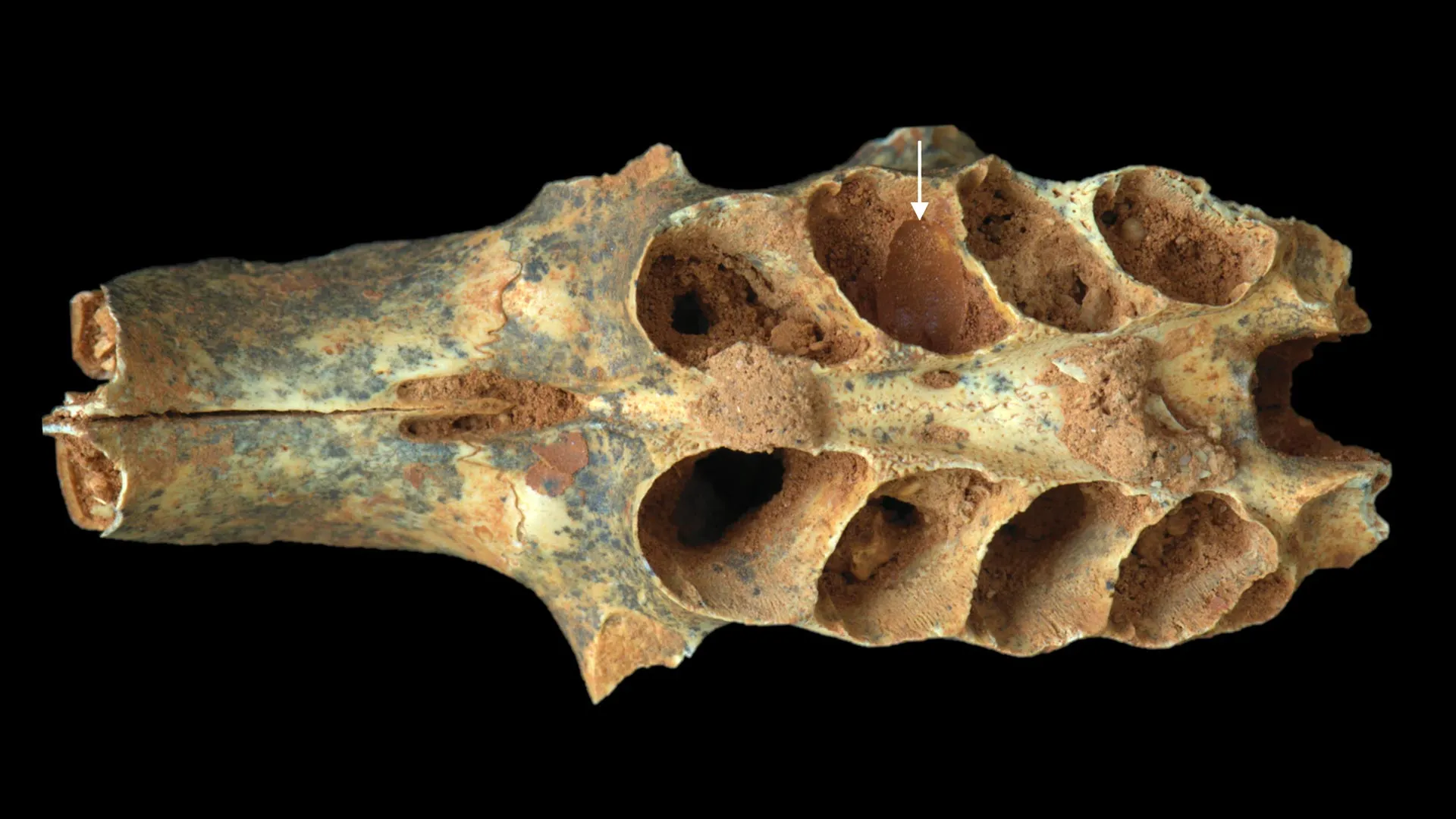
Deep within a limestone cave on the Caribbean island of Hispaniola, a remarkable prehistoric ecosystem has come to light, offering scientists an unprecedented glimpse into the complex interactions of ancient fauna. Around 20,000 years ago, generations of owls utilized a subterranean cavity as a roosting site, continually regurgitating indigestible pellets containing the skeletal remains of their prey. Millennia later, these accumulated bones became an unexpected and vital resource for an entirely different class of organisms. According to a groundbreaking study published in the journal Royal Society Open Science, ancient solitary bees repurposed the empty tooth sockets of these fossilized vertebrate jaws as subterranean nurseries for their offspring.
This extraordinary discovery marks the first documented evidence in the paleontological record of insects utilizing animal skeletal structures as a nesting substrate. The findings shed light on the adaptive behaviors of prehistoric invertebrates, the micro-ecological pressures of island environments during the Pleistocene epoch, and the intricate web of interactions that bind vertebrate and invertebrate species within a shared paleoenvironment.
A Subterranean Tapestry: Unearthing the Hispaniola Cave Deposit
The island of Hispaniola, which is politically divided between Haiti and the Dominican Republic, is characterized by extensive karst topography. The region’s soluble limestone bedrock has been eroded over millennia by acidic groundwater, creating a dense network of caves, sinkholes, and subterranean passages. According to local geological surveys, certain zones feature distinct sinkholes occurring at intervals as frequent as every one hundred meters.
The specific cave investigated in this study had previously been identified by Juan Almonte Milan, curator of paleobiology at the Museo Nacional de Historia Natural in the Dominican Republic, as an exceptionally rich repository of fossils. The site’s scientific potential was fully realized when Lazaro Viñola López, then a doctoral researcher at the University of Florida and the Florida Museum of Natural History, mounted an expedition to explore the deposit. Viñola López, currently a postdoctoral researcher at the Field Museum in Chicago, led the field investigations that uncovered the unique fossil amalgamation.
Accessing the fossil-bearing strata required specialized speleological techniques. Researchers anchored ropes to the surface and rappelled through a vertical drop, entering an underground environment populated by arachnids, including resident tarantulas. Navigating a ten-meter horizontal tunnel brought the team to the fossil-rich chambers.
Stratigraphic analysis revealed that the cave preserved multiple distinct fossil layers, separated cleanly by carbonate flowstone deposits that accumulated during ancient periods of heightened regional rainfall. The recovered fossil assemblage is exceptionally diverse, encompassing the remains of more than fifty species. While the vast majority of the specimens consist of small rodents, the deposit also preserves the bones of extinct sloths, various birds, reptiles, and amphibians. Furthermore, the presence of turtle and crocodile remains suggests that some larger fauna occasionally tumbled into the vertical opening, unable to escape the subterranean trap.
The Avian Architects: Owls as Ecosystem Engineers
The primary accumulators of this massive bone bed were birds of prey. Over hundreds or potentially thousands of years, generations of owls used the cave as a permanent roost. As is typical of raptor biology, these birds ingested small mammals and other prey whole, subsequently regurgitating compacted pellets of fur, feathers, and bones.
This continuous biological deposition created a dense matrix of microvertebrate remains across the cave floor. Over millennia, the bones became fossilized through mineral replacement and sediment compaction, creating a detailed archive of the island’s historical biodiversity. It was within this dense accumulation of mammalian jawbones that Viñola López made his serendipitous observation.
While meticulously cleaning and cataloging rodent mandibles under laboratory magnification, the researcher noticed unusual sedimentary infills within the empty tooth sockets. Unlike the chaotic, jagged matrix of fine-grained mud and sand that typically infiltrates fossil cavities through natural water seepage, these deposits possessed a distinctly smooth, concave interior morphology.
"It was a smooth surface, and almost concave. That’s not how sediment normally fills in, and I kept seeing it in multiple specimens," Viñola López noted. "It reminded me of the wasp nest."
The structural morphology instantly triggered a comparison with an earlier formative experience. During his undergraduate studies in Montana, Viñola López had participated in a fossil excavation where a colleague demonstrated the morphology of fossilized wasp cocoons—small, mud-constructed chambers where developing insect larvae metamorphose into adults. The microscopic architecture of the infills in the Hispaniola jaws bore a striking resemblance to these trace fossils.
Micro-Architecture and Paleontological Identification
To confirm the biological origin of the structures without destroying the rare fossil specimens, the research team employed high-resolution X-ray computed tomography (CT scanning). This non-invasive imaging technique generated detailed, three-dimensional digital models of the material compacted inside the tiny tooth sockets, measuring significantly smaller than the eraser on the end of a pencil.
The resulting scans provided definitive evidence matching the architectural hallmarks of mud nests constructed by modern solitary bees. Crucially, the internal chambers preserved microscopic grains of ancient pollen. This botanical evidence confirmed that the female bees had provisioned the tiny cavities with protein-rich floral resources intended to nourish their emerging larvae.
The construction methodology involved an intricate behavioral adaptation: the bees likely gathered local clay and soil particles, mixed them with specialized oral secretions to create a durable mortar, and shaped the slurry inside the bone cavities. Beyond simply serving as a container, the hollow jaws of larger vertebrate prey offered structural protection, shielding the fragile brood chambers from external environmental hazards and potential invertebrate predators, such as parasitic wasps.
Taxonomic Classification and the Mystery of the Builders
Because the warm, humid climatic conditions of Caribbean caves accelerate the decomposition of chitin and soft tissues, no fossilized adult bees were recovered from the matrix. Consequently, scientists cannot definitively link the trace fossils to a precise species currently recognized in modern taxonomy.
Despite the absence of skeletal remains of the insects themselves, the distinct architectural signatures of the trace fossils warranted formal scientific classification. The research team designated the structures as a new ichnospecies: Osnidum almontei. This binomial nomenclature honors Juan Almonte Milan, whose decades of foundational paleontological work in the Dominican Republic brought the cave system to academic prominence.
The absence of preserved bees leaves open two primary hypotheses regarding their taxonomic identity. It remains entirely plausible that the nests were built by an extant species of solitary bee whose ecological habits—specifically regarding nesting substrates—remain undocumented by modern science. Alternatively, given that a significant proportion of the vertebrate fauna preserved alongside the nests is now extinct, the architect bees may represent an extinct lineage that vanished following late-Quaternary environmental shifts.
Ecological Drivers Behind a Bizarre Behavior
The discovery of Osnidum almontei highlights the extraordinary behavioral plasticity of insects under ecological duress. Entomologists note that while social insects like honey bees and paper wasps construct elaborate, free-standing communal hives, the vast majority of bee species worldwide are solitary. These non-social insects typically excavate underground burrows, bore into decaying timber, or occupy naturally occurring fissures in rocks and vegetation. Certain African and European species are known to utilize empty terrestrial snail shells as portable or stationary nurseries.
The adoption of mammalian tooth sockets on Hispaniola was likely driven by severe environmental constraints. Geological surveys of the cave’s surrounding terrain indicate a predominance of exposed limestone karst with minimal soil accumulation. This scarcity of deep, unconsolidated earth would have severely limited the availability of traditional ground-burrowing sites for solitary bees.
Simultaneously, the continuous avian activity in the cave provided an abundant, pre-fabricated supply of stable, micro-cavities. The tooth sockets of rodent mandibles offered uniform dimensions, structural rigidity, and a degree of thermal insulation that favored the successful maturation of insect larvae.
Implications for Paleoentomology and Future Research
This finding carries significant methodological implications for the broader discipline of paleontology. Researchers emphasize that vertebrate paleontologists frequently focus exclusively on macro-remains—bones, teeth, and skulls of large animals—often cleaning away or discarding fine sediments that adhere to specimens.
Without prior exposure to insect trace fossils, preparation techniques might have inadvertently destroyed the delicate mud nests as mere "dirt" infills. The study underscores the necessity of interdisciplinary vigilance, urging paleontologists to scrutinize micro-features on fossil surfaces for evidence of invertebrate activity.
Furthermore, the identification of Osnidum almontei demonstrates how trace fossils can reconstruct ancient ecological webs that leave no direct macro-fossil record. By coupling high-resolution imaging technologies with traditional osteological analysis, scientists can extract detailed behavioral data from seemingly mundane geological contexts.
As research continues across the cave systems of the Greater Antilles, scientists hope to locate additional trace fossils that might yield preserved organic remnants or DNA. Until then, the tiny, bone-bound nurseries of Hispaniola stand as a testament to the resourcefulness of prehistoric life, illustrating how the discarded waste of an apex predator became the cradle for the next generation of the island’s insect population.
