
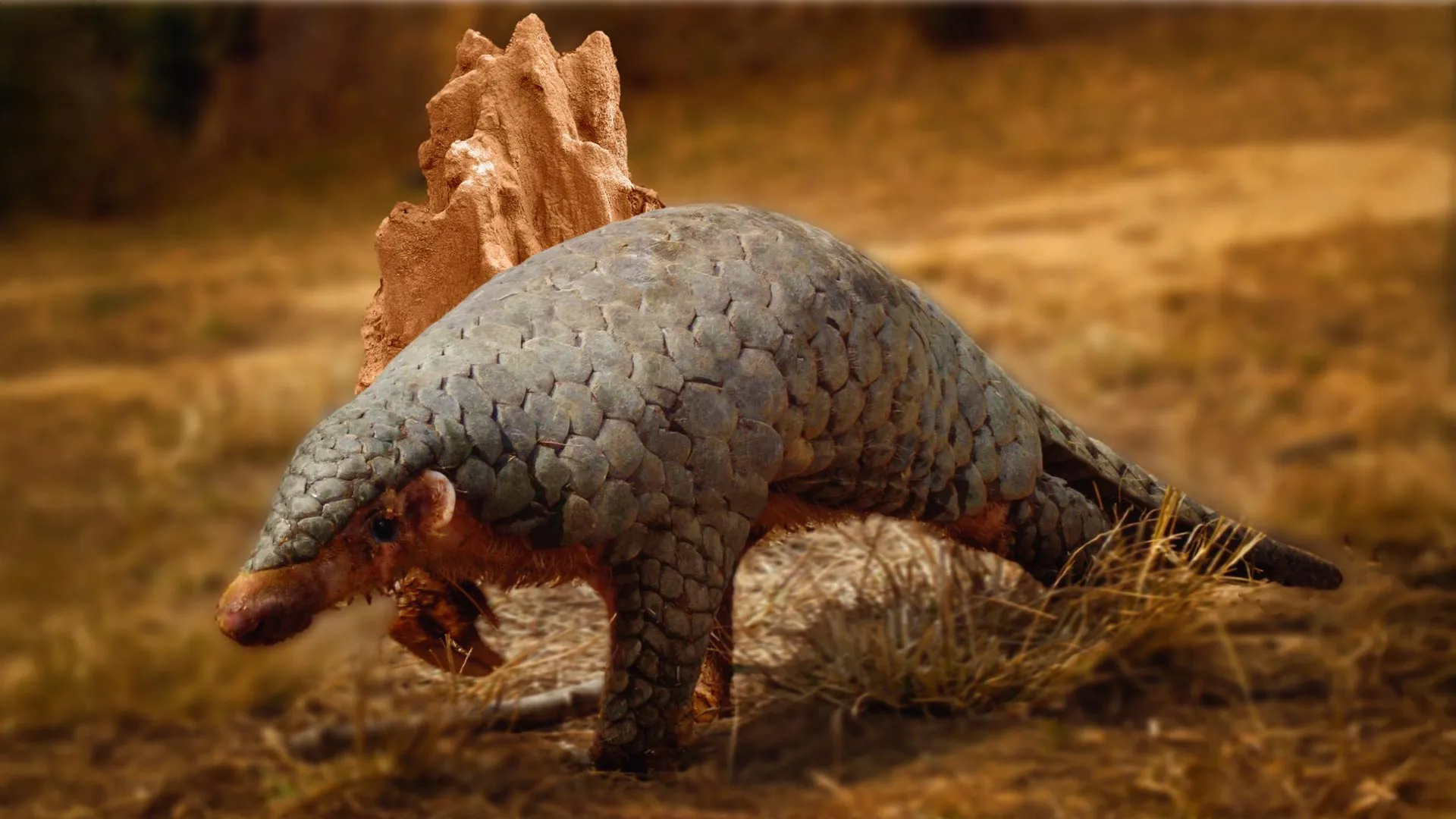
The pangolin, an evolutionary marvel often resembling a pinecone-clad dinosaur, occupies a precarious and tragic distinction in the modern natural world. Found exclusively across the tropical and subtropical regions of Africa and Asia, these solitary, nocturnal mammals are armed with powerful curved claws designed for tearing open termite mounds and long, muscular tails. Yet, their most defining physical characteristic—overlapping keratin scales that armor their bodies—has also made them the prime target of illegal wildlife trafficking. Widely considered the most heavily poached and trafficked mammals on Earth, pangolins face imminent threats of extinction due to a relentless global black market driven largely by the demand for their scales in traditional medicine.
Now, an international team of scientists has confirmed that a previously unrecognized Asian pangolin species, scientifically designated as Manis aurita, is quietly surviving in the rugged terrain of Nepal and Northern India. Published in the peer-reviewed journal Communications Biology, the groundbreaking study not only untangles a long-standing taxonomic confusion regarding the region’s mountain-dwelling fauna but also provides crucial geographic and genetic mapping. By clarifying species boundaries, this discovery equips wildlife authorities, international conservationists, and forensic scientists with an advanced, science-based toolkit to track illegal wildlife supply chains, pinpoint poaching hotspots, and radically improve targeted rescue and reintroduction operations.
Untangling the Complex Pangolin Family Tree
The formal identification of the Himalayan pangolin as a distinct, valid species is the culmination of a decade-long scientific pursuit, though the initial threads of this taxonomic riddle began to unravel systematically in recent years. In 2025, a separate research collective determined that animals historically lumped together under the broad classification of Chinese pangolins actually comprised two distinct biological lineages. While one population was confirmed to reside primarily within China proper, the second distinct lineage inhabited the high-altitude Himalayan foothills stretching across Nepal, India, Bhutan, and Myanmar. Initially, this mountain-dwelling population was formally described and named Manis indoburmanica, commonly referred to as the Indo-Burmese pangolin.
However, the rigid protocols governing international zoological nomenclature dictate the principle of priority: when a single biological species has received multiple scientific names over the decades, the earliest validly published name takes precedence. While the 2025 designation of M. indoburmanica brought renewed attention to the unique ecology of the Himalayan animals, it inadvertently triggered a race among taxonomists to comb through historical archives to determine if an older, forgotten name already applied to the lineage.
Parallel to those developments, a dedicated research team led by scientists from the Field Museum, Guangzhou University, the Guangdong Academy of Forestry, and Nepal Engineering College had been deep into a ten-year investigation examining the evolutionary history of pangolins globally. Utilizing a rigorous combined methodology that paired modern mitochondrial and nuclear DNA sequencing with detailed morphological analyses of skeletal structures, the team sought to accurately define the true extent of pangolin biodiversity.
During their archival investigations, the researchers stumbled upon historical records documenting Manis aurita, a pangolin species originally described by naturalists in 1836. Over the intervening decades and centuries, as taxonomic practices shifted and specimen comparisons grew scarce, M. aurita had been systematically stripped of its species status and relegated to a mere subspecies of the broader Chinese pangolin group. This administrative demotion effectively concealed its true evolutionary uniqueness from modern conservationists.
"This left us with a core taxonomic riddle: what is the relationship between indoburmanica and aurita? Are they the same species or different species?" explained Dr. Kai He, a co-corresponding author of the study and a researcher at the South China Biodiversity Research Center at Guangzhou University. The resolution of this evolutionary puzzle required reaching far back into the annals of natural history, ultimately leading the researchers to the archives of the Natural History Museum in London.
The 1836 DNA Breakthrough
The definitive turning point in the study occurred when curators and geneticists at the London museum successfully extracted and sequenced DNA directly from the historical type specimen of the Nepalese subspecies aurita. Dating back to 1836, the fragile museum specimen was nearly 190 years old, presenting significant technical hurdles for modern genetic extraction techniques. Nevertheless, the successful sequencing of the historic genetic material provided an unmistakable match to modern Himalayan pangolin tissue samples collected in the field.
The genetic data proved conclusively that the animals temporarily designated in 2025 as Manis indoburmanica were, in fact, identical members of the ancient species first cataloged by naturalists in the early 19th century under the name Manis aurita. Consequently, under the established rules of biological nomenclature, Manis aurita was reinstated as the correct, valid scientific name for the Himalayan pangolin.
"This taxonomic clarification provides a crucial scientific basis for combating illegal poaching and lays the groundwork for protecting this cryptic endangered species," noted Dr. Yan Hua, a co-corresponding author of the study from the Guangdong Academy of Forestry.
Morphologically, the newly validated Manis aurita can be distinguished from its lowland Chinese counterpart through several subtle yet distinct anatomical variations. According to Dr. Anderson Feijó, the Negaunee Assistant Curator of Mammals at the Field Museum and a co-corresponding author of the study, the Himalayan pangolin possesses a noticeably larger body, a significantly longer tail, and smaller external ears than the Chinese pangolin. In a historical nod to these physical traits, the specific epithet aurita directly references the animal’s distinctive anatomical ear structure. Furthermore, extensive field surveys and geographical data indicate that the two species do not share overlapping territorial ranges, existing instead in distinct ecological niches separated by topography and climate.
A Powerful New Weapon Against Global Wildlife Trafficking
For conservationists on the front lines of the global fight against wildlife crime, the formal validation of Manis aurita is far more than an academic exercise in taxonomy. It represents a vital operational tool. Pangolins are hunted relentlessly to supply international black markets, driven largely by the persistent demand for their keratin scales within traditional medicine systems, where buyers falsely believe the scales possess medicinal or aphrodisiac properties.
Law enforcement agencies and wildlife customs officials tasked with interdicting this illegal trade frequently face a major evidentiary challenge: smugglers rarely transport live, intact animals across international borders. Instead, enforcement operations typically uncover massive sacks of dried, stripped scales. Without whole specimens or intact anatomical features, identifying the exact species—and more importantly, the precise geographic origin of the poached animals—has historically been an arduous, often impossible task.
The DNA methodologies validated and utilized in this new research fundamentally change that dynamic. By establishing clear genetic baselines for distinct species like Manis aurita, conservation scientists and forensic geneticists can now analyze confiscated shipments of pangolin scales, accurately identify the species involved, and trace the material back to its specific native range. This capability allows law enforcement agencies to work backward from illicit retail markets to pinpoint active poaching hotspots and dismantle organized trafficking syndicates operating within specific geopolitical borders.
Moreover, the precise delineation of species boundaries and geographic habitats has profound implications for captive breeding and wild reintroduction programs. Historically, conservationists attempting to rehabilitate and release rescued pangolins ran the risk of accidentally introducing individuals into inappropriate ecosystems due to a lack of taxonomic clarity.
"Before, you might have introduced Chinese pangolins into Nepal, because you didn’t know the difference," explained Dr. Feijó. "By defining the differences between the species and the limits of where each species is found, we can make better conservation decisions." Ensuring that the correct indigenous species is released into its native habitat is paramount for maintaining the genetic integrity of dwindling wild populations and maximizing the survival rates of reintroduced animals.
The Indispensable Value of Natural History Collections
The success of the multi-year study underscores the irreplaceable scientific and conservation value housed within the archives of natural history museums worldwide. Because pangolins are exceptionally elusive, nocturnal, and heavily depleted across their natural ranges, obtaining fresh biological samples directly from the wild is extraordinarily difficult and time-consuming.
By utilizing preserved historical specimens gathered over a century and a half ago, the research team gained access to genetic material representing diverse geographical populations that are now extremely rare or locally extirpated in the wild. This broad chronological and spatial sampling enabled the scientists to construct a robust, comprehensive evolutionary tree that would have been impossible to assemble using contemporary field samples alone.
"Using museum collections allows us to have access to more individuals across the species’ range," Dr. Feijó emphasized. "If you only rely on fresh material, since the animals are so rare to find in the wild, this greatly limits the information that you can gather. We used collections to have a more complete sampling of the species. It’s a big advantage to have this resource available as a repository of material that we can look back and keep learning from."
Echoing this sentiment, Narayan Koju, a researcher at Nepal Engineering College at Pokhara University and the study’s first author, highlighted the collaborative, multinational nature of the achievement. "This finding marks the culmination of more than five years of research that began in Nepal, where we first documented evidence suggesting that Himalayan pangolins represented a distinct evolutionary lineage," Koju stated. "The confirmation of Manis aurita as a valid species demonstrates the importance of long-term research, international collaboration, and museum collections. Most importantly, it provides a strong scientific basis for conservation planning, wildlife forensics, and efforts to protect one of the world’s most trafficked mammals from extinction."
As illegal wildlife trade continues to push numerous mammalian lineages toward the brink of collapse, the rediscovery and formal validation of Manis aurita serves as a powerful reminder of how modern molecular techniques, combined with historical archives, can illuminate hidden biodiversity. Armed with this new taxonomic clarity, global conservationists and international law enforcement agencies are now significantly better equipped to protect these vulnerable, armored mammals before they vanish from the Himalayan foothills entirely.
The international study was conducted through a collaborative effort involving researchers from an extensive coalition of institutions, including Guangzhou University, Nepal Engineering College, Pokhara University, the Chinese Academy of Sciences, the University of Washington, the Smithsonian National Museum of Natural History, the University of Sevilla, the Guangdong Academy of Forestry, Tribhuvan University, Aspect Ecology Oxfordshire, the Chinese Wildlife Forensic Science Service, the Chengdu University of Traditional Chinese Medicine, and the Field Museum.
