
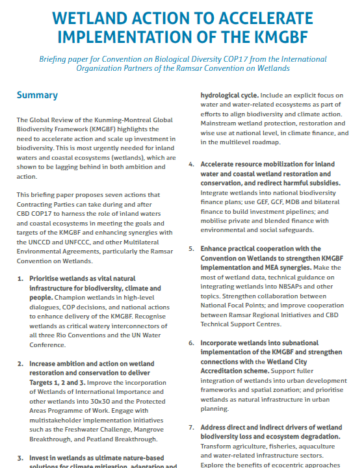
The international community is facing a critical juncture in the global fight to halt and reverse biodiversity loss, with new findings revealing that inland waters and coastal ecosystems are severely lagging behind in policy ambition and on-the-ground implementation. Released ahead of the upcoming seventeenth meeting of the Conference of the Parties to the Convention on Biological Diversity (CBD COP17), a comprehensive new briefing paper compiled by the six International Organization Partners (IOPs) of the Ramsar Convention on Wetlands—namely BirdLife International, the International Water Management Institute (IWMI), the International Union for Conservation of Nature (IUCN), Wetlands International, the World Wide Fund for Nature (WWF), and the Wildfowl & Wetlands Trust (WWT)—sounds the alarm on the state of the world’s most threatened ecosystems.
According to the Global Review of the Kunming-Montreal Global Biodiversity Framework (KMGBF), current international efforts are failing to meet the pace and scale required to safeguard aquatic environments. While terrestrial and marine frameworks have seen marginal improvements in target-setting, rivers, lakes, peatlands, mangroves, and estuaries remain acutely neglected in national biodiversity strategies. To bridge this dangerous gap, the coalition of environmental organizations has outlined a targeted, seven-point action plan for Contracting Parties. This blueprint is designed not only to accelerate KMGBF implementation during and after CBD COP17 but also to forge vital policy synergies with the United Nations Convention to Combat Desertification (UNCCD) and the UN Framework Convention on Climate Change (UNFCCC), ensuring a unified global response to the triple planetary crisis of climate change, biodiversity loss, and land degradation.
The Background of the Kunming-Montreal Global Biodiversity Framework
The Kunming-Montreal Global Biodiversity Framework, adopted in December 2022 at CBD COP15 in Montreal, Canada, established a historic set of global targets to be achieved by 2030. Often dubbed the "Paris Agreement for nature," the framework includes 23 concrete targets aimed at halting habitat destruction, restoring 30% of degraded ecosystems, reducing the introduction of invasive species, and mobilizing at least $200 billion annually for biodiversity conservation.
However, the path from global agreement to domestic execution has been fraught with challenges. Under the KMGBF, nations were required to update and submit their National Biodiversity Strategies and Action Plans (NBSAPs) ahead of CBD COP16. As global environmental reviews began taking stock of these submissions, a worrying trend emerged: while countries made substantial commitments regarding terrestrial forestry and marine protected areas, inland waters—which cover a mere fraction of the Earth’s surface but support an astonishing 10% of all known species—were largely sidelined.
Wetlands are disappearing three times faster than forests. From the shrinking of major inland river basins to the relentless conversion of coastal mangroves for aquaculture and urban expansion, the degradation of these ecosystems carries catastrophic implications for both wildlife and humanity. Freshwater fish populations, for instance, have suffered a staggering 83% decline since 1970, driven by overexploitation, pollution, fragmentation of rivers by dams, and climate-induced droughts.
The Seven-Point Action Plan for CBD COP17
To course-correct before the 2030 deadlines, the Ramsar Convention’s six International Organization Partners have formulated a pragmatic roadmap. Designed for adoption and integration by Contracting Parties attending CBD COP17, the framework emphasizes that protecting wetlands is not an isolated conservation objective, but a foundational prerequisite for achieving broader global sustainability goals.
The proposed interventions focus on bridging policy silos. Historically, biodiversity conservation, climate change mitigation, and water security have been treated as distinct governance sectors, frequently resulting in conflicting national policies. For example, agricultural subsidies have often inadvertently encouraged the drainage of carbon-rich peatlands or the over-extraction of river basins. The briefing paper stresses that CBD COP17 must serve as a platform to break down these institutional barriers.

Key elements of the proposed strategy include embedding wetland restoration directly into updated NBSAPs, establishing robust quantitative indicators to track the ecological health of inland waters, and scaling up climate finance toward nature-based solutions that prioritize water systems. Furthermore, the partners call for the strict enforcement of transboundary water management agreements, recognizing that rivers and subterranean aquifers frequently cross national borders and require cooperative, multilateral stewardship to prevent systemic collapse.
Integrating the Rio Conventions: Biodiversity, Climate, and Land
One of the core arguments advanced by BirdLife International, IWMI, IUCN, Wetlands International, WWF, and WWT is the necessity of institutional synergy. The three Rio Conventions—the CBD, the UNFCCC, and the UNCCD—were established following the 1992 Earth Summit in Rio de Janeiro to address interconnected environmental crises. In practice, however, they have frequently operated in administrative isolation.
Inland waters and coastal ecosystems represent the ultimate nexus of these three conventions. Peatlands, floodplains, and salt marshes are among the most potent carbon sinks on the planet. When intact, they sequester vast quantities of atmospheric carbon; when drained or degraded, they release centuries of stored greenhouse gases back into the atmosphere, directly undermining UNFCCC mitigation targets.
Similarly, the loss of wetlands exacerbates land degradation and desertification, directly clashing with the objectives of the UNCCD. Healthy wetlands act as natural buffers against extreme weather events, mitigating the impacts of severe floods and stabilizing soil against erosion during prolonged droughts. By aligning national reporting and implementation frameworks across the three conventions, governments can optimize resource allocation, reduce administrative burdens, and maximize the ecological return on investment.

Timeline and Chronological Context
The release of the briefing paper marks a critical milestone in the international environmental diplomatic calendar:
- December 2022: CBD COP15 concludes with the landmark adoption of the Kunming-Montreal Global Biodiversity Framework.
- Late 2024 (CBD COP16): Countries submit their revised NBSAPs, revealing a distinct deficit in freshwater and wetland integration.
- September 25, 2026: The six Ramsar IOPs release their joint briefing paper ahead of CBD COP17, providing an independent assessment of implementation gaps and proposing corrective actions.
- Upcoming CBD COP17: Delegates gather to negotiate enhanced accountability mechanisms, financing structures, and cross-convention alignment.
- 2030: The ultimate deadline for achieving the targets set out in the KMGBF.
Expert Analysis and Institutional Reactions
Environmental policy analysts have widely welcomed the initiative, noting that the international community has historically suffered from "blue blindness"—the tendency to overlook aquatic biodiversity in favor of charismatic terrestrial landscapes like tropical rainforests or savannahs.
Representatives from the scientific and conservation communities have emphasized that investing in wetlands yields exceptionally high cost-benefit ratios. Restoring a degraded river floodplain or re-wetting a drained peatland not only restores biodiversity and sequesters carbon, but also improves water quality, enhances regional food security through sustainable fisheries, and provides natural flood risk reduction for downstream urban populations.
Despite these clear economic and ecological benefits, domestic financing remains a major stumbling block. While global financial pledges have increased, a significant portion of international climate and biodiversity finance continues to bypass aquatic ecosystems. The briefing paper urges international financial institutions, multilateral development banks, and private sector investors to overhaul their screening criteria, ensuring that no investments are funneled into projects that degrade critical freshwater or coastal habitats.
Broader Implications for Global Sustainability
As the international community prepares for CBD COP17, the stakes could not be higher. The credibility of the Kunming-Montreal Global Biodiversity Framework rests entirely on the willingness of governments to address glaring implementation deficits before the 2030 horizon.
If policymakers fail to incorporate the recommendations put forward by the Ramsar International Organization Partners, the world risks missing its overarching biodiversity targets while allowing vital life-support systems to unravel. Conversely, prioritizing inland waters and coastal ecosystems offers a multi-solve opportunity: a single, concerted effort to restore wetlands can simultaneously advance biodiversity protection, stabilize the global climate, and secure water resources for billions of people worldwide. The roadmap is established; the responsibility now lies with Contracting Parties to translate these science-based recommendations into binding national policies and urgent, measurable action.
