
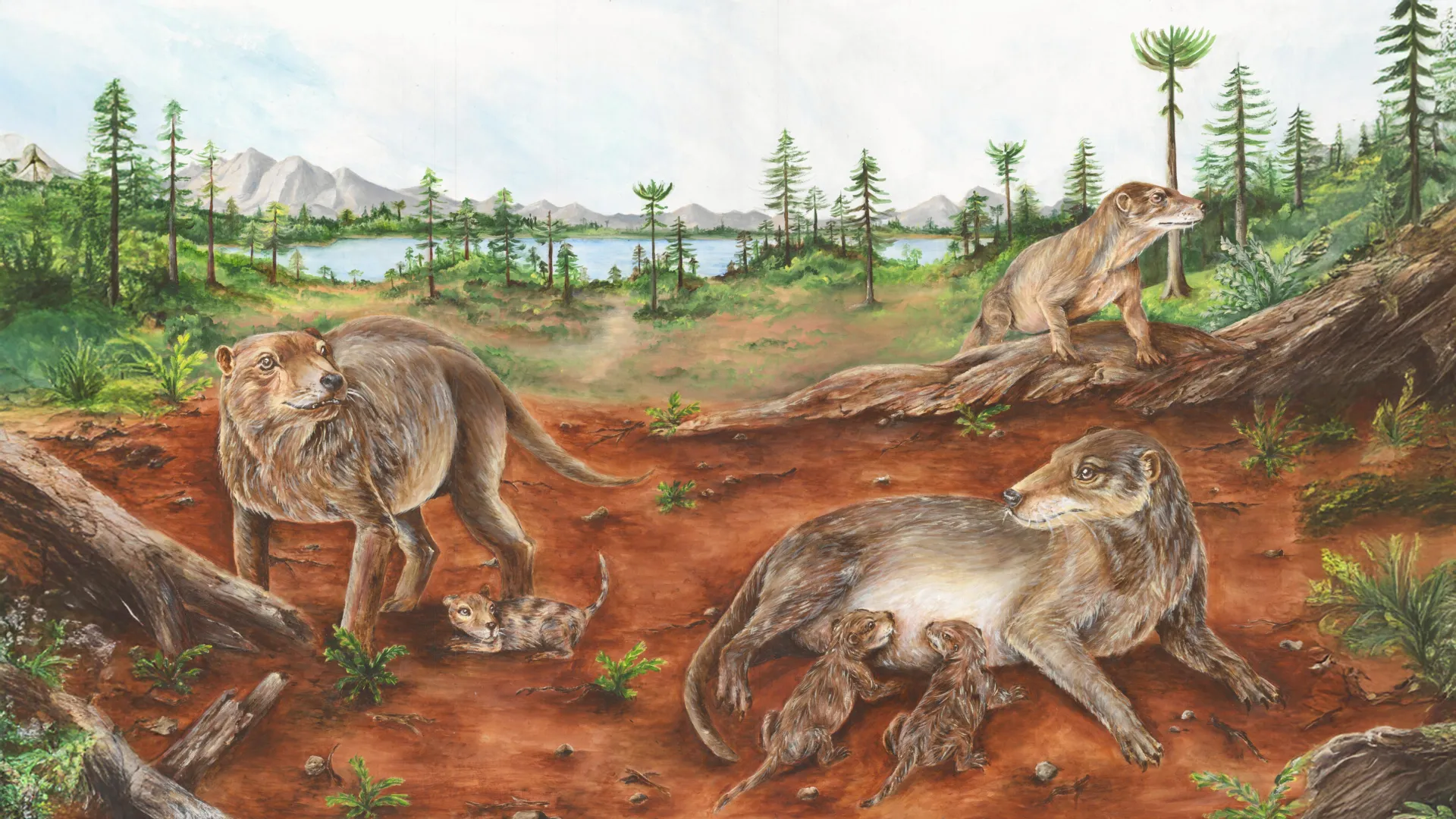
The evolutionary timeline of mammalian reproduction has been dramatically upended by a groundbreaking paleontological discovery in northwestern Argentina. According to a new study published in the peer-reviewed journal Frontiers in Mammal Science, researchers have uncovered the first compelling microscopic evidence that certain cynodonts—the ancient precursors to modern mammals—may have bypassed egg-laying entirely in favor of giving birth to live young. This revelation pushes the suspected origins of viviparity in the mammalian lineage back by an astounding 95 to 90 million years, fundamentally altering how scientists understand the biological and reproductive strategies of prehistoric fauna that roamed the Earth during the Triassic period.
At the center of this paradigm shift is Chiniquodon theotonicus, a carnivorous cynodont that inhabited South America approximately 236 million years ago. Lead author Dr. Leandro Gaetano, a prominent paleontologist at the National Scientific and Technical Research Council (CONICET) in Argentina, noted that documenting live birth in C. theotonicus bridges a critical evolutionary gap. For generations, the exact reproductive mechanics of early mammalian ancestors remained an inscrutable mystery in the fossil record, largely because soft tissues, embryonic remains, and reproductive organs rarely fossilize under normal geological conditions. By pioneering a novel analytical framework centered on bone histology and comparative body-mass scaling, the international research team has managed to peer directly into the maternity wards of the deep past.
The Evolution and Ecological Pressures of the Triassic Period
To understand the magnitude of this discovery, scientists must look back to the Triassic period, a dynamic and hazardous chapter in Earth’s history. The Triassic immediately followed the Permian-Triassic extinction event—often referred to as the "Great Dying"—which wiped out an estimated 70 percent of terrestrial vertebrate species and over 95 percent of marine species. Ecosystems during the early-to-mid Triassic were engaged in a massive, chaotic process of structural recovery and biological restructuring.
Senior study author Adriana Mancuso, a CONICET researcher specializing in the evolution of terrestrial ecosystems, explained that this era was defined by intense competition for scarce resources and relentless predatory pressures. Furthermore, the global climate was trending toward widespread aridity, accompanied by strong, punishing seasonal variations. In such a volatile environment, reproductive strategies were under immense evolutionary scrutiny.
Under harsh climatic conditions and high predation rates, eggs left in primitive nests face extreme vulnerability to environmental desiccation, temperature fluctuations, and opportunistic predators. Viviparity—retaining the developing embryo inside the mother’s body—offers profound physiological and environmental protections. In utero development shields the fragile embryo from external climatic extremes and grants the mother mobility, allowing her to flee danger or forage for food without abandoning her brood. The researchers theorize that the adaptive pressures of the Triassic may have acted as a primary catalyst for the evolutionary transition away from egg-laying, selecting for traits that maximized neonatal survival in hostile landscapes.
Cracking the Code: The Discovery of the Neonatal Growth Ring
For decades, paleobiologists assumed that unraveling the reproductive history of extinct non-mammals was nearly impossible due to the sheer scarcity of direct fossil evidence. However, the breakthrough in the Chiniquodon theotonicus study began serendipitously during an advanced postgraduate training course. Researchers were examining thin sections of a fully grown C. theotonicus fossil under high-powered microscopes when they noticed an unusual, distinct growth mark embedded deep within the bone’s microstructural matrix.
Drawing from comparative biology and veterinary pathology, the team identified the feature as a neonatal line. In extant mammals, reptiles, and birds, a neonatal line forms as a distinct histological ring in bones or teeth in response to the massive, sudden acceleration of metabolic and skeletal growth that occurs immediately after birth or hatching. This physiological shock leaves a permanent, chemical signature in the mineralized tissue of the skeleton.
To rigorously test whether this microscopic ring truly represented a birth mark rather than an ordinary seasonal growth pause, the research team devised an intricate biometric methodology. They utilized precise measurements from the fossilized skeletal elements to reconstruct the animal’s weight at two pivotal moments in its life: at the time of birth, as indicated by the neonatal ring, and at the time of death, as reflected by the outer dimensions of the fully matured bone.
Comparative Scaling: A Mammalian Blueprint
Once the neonatal and adult body masses were calculated, the team embarked on a massive comparative analysis. They cross-referenced their estimations for Chiniquodon theotonicus with comprehensive biological databases encompassing several thousand species of living mammals, non-avian reptiles, and birds.
The mathematical results were both striking and unambiguous. According to the study’s calculations, the individual C. theotonicus specimen weighed approximately 1.7 kilograms at birth and reached an adult body mass of roughly 12 kilograms before its death. This establishes a neonate-to-adult body mass ratio of approximately 14 percent.
When placed in comparative context, this ratio firmly separates C. theotonicus from modern non-mammalian amniotes. For instance, living reptiles of comparable adult sizes—such as large snakes, crocodilians, and turtles weighing between 8 and 14.5 kilograms—produce hatchlings that are drastically smaller, typically ranging from a mere 9 to 53 grams. This yields exceptionally low neonate-to-adult mass ratios of roughly 0.1 to 0.6 percent.
Avian species display a similarly conservative investment in hatchling size. Birds weighing between 8 and 21.5 kilograms generally produce hatchlings scaling from 110 to 357 grams, resulting in mass ratios between 1.3 and 4.5 percent.
In sharp contrast, modern placental mammals of equivalent adult sizes (8 to 15 kilograms) exhibit significantly heavier newborns, with weights spanning from 35.5 grams to an impressive 1.87 kilograms. Their neonate-to-adult mass ratios can soar as high as 18.77 percent. As a practical modern analog, the bay duiker antelope—a medium-sized forest-dwelling mammal—delivers single offspring that closely match the estimated birth weight of the ancient cynodont. By deliberately excluding non-placental mammals, such as monotremes (which lay eggs) and marsupials (which give birth to underdeveloped young that mature in pouches), the researchers highlighted how closely the ancient cynodont aligned with modern placental reproductive strategies.
"We were amazed to find that C. theotonicus grouped with extant placental mammals, being clearly distinct from other amniotes like reptiles or birds," Dr. Gaetano emphasized.
Unprecedented Insights from the Fossil Record
The implications of the study extend far beyond a single species, shedding light on a critical transitional phase in vertebrate evolution. Co-author María Miceli Baro, a graduate student at the University of Buenos Aires, underscored the rarity of the find. "In cynodonts, embryonic tissues were never observed before, let alone a neonatal line," she stated. "Through its analysis, we found that a trait that is generally linked to evolutionary success was present in animals long before true mammals originated."
Historically, the emergence of live birth within the mammalian lineage was viewed by evolutionary biologists as a relatively recent adaptation, developing long after the first true mammals (mammaliaforms) diverged from their cynodont ancestors. By demonstrating that Chiniquodon theotonicus practiced viviparity 236 million years ago, the research team forces a significant reassessment of the mammalian family tree.
It raises the compelling possibility that other complex physiological and metabolic traits—traditionally assumed to have evolved much later in tandem with true hair, lactation, and endothermy (warm-bloodedness)—may have roots stretching deep into the Triassic period.
Broader Implications and Future Research Directions
While the discovery provides a robust window into the biology of Chiniquodon theotonicus, the scientific community is already turning its attention to the broader questions raised by the study. Paleontologists must now determine whether viviparity was an isolated evolutionary experiment restricted to the chiniquodontid lineage or part of a broader, systemic transition away from oviparity across the entire cynodont clade.
Dr. Gaetano remains cautious yet optimistic about future discoveries. "It is very well possible that C. theotonicus does not represent an isolated case of viviparity among cynodonts," he concluded. "It could be evidence of the general switch from laying eggs to giving birth to live young early on in the mammalian lineage. But we need more evidence to test this hypothesis. Still, it looks like some cynodonts were in fact very similar to present-day mammals."
As researchers return to museum collections and field sites in South America and beyond to re-examine cynodont fossils through the lens of bone histology, the ancient history of mammalian reproduction continues to be rewritten. This study demonstrates that the biological innovations defining modern mammals—including the intimate maternal investment of live birth—were quietly shaping the animal kingdom millions of years before the first true mammal drew its initial breath.
