
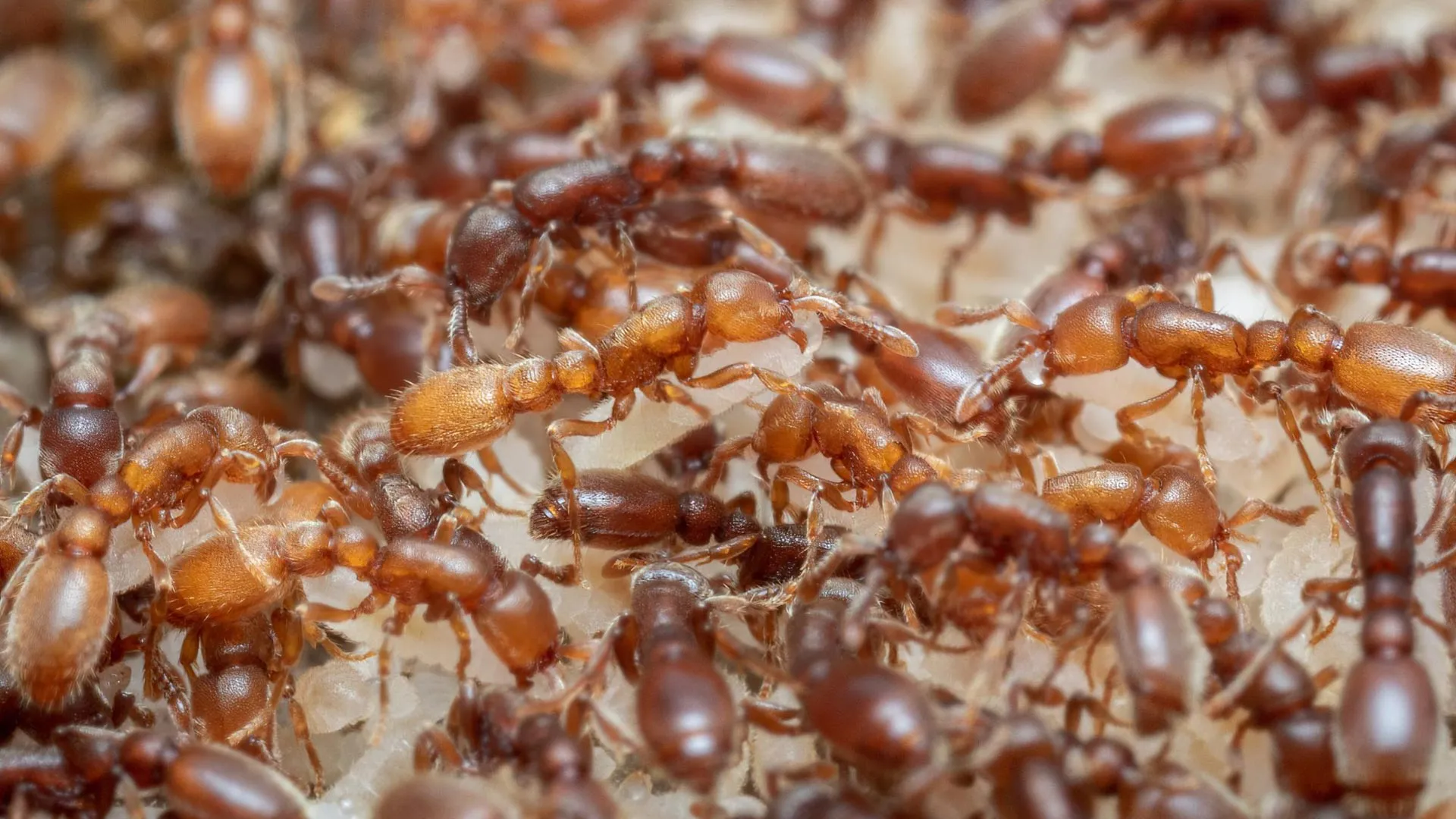
For millions of years across evolutionary history, the dominant reproductive strategy for countless animal species was remarkably hands-off: organisms would produce offspring and leave them to fend for themselves in a hostile world. Yet, at various points across the biological spectrum, complex forms of parental care eventually emerged, ranging from mammalian lactation and avian nest protection to the intricate larval tending observed in social insects. A landmark study published in the journal Nature has now illuminated a compelling explanation for this evolutionary leap, suggesting that nature did not invent entirely new neural systems from scratch to facilitate parenting. Instead, evolution appears to have recycled and repurposed ancient neural pathways that originally governed hunger and feeding, granting them a secondary, revolutionary role in social caregiving.
The research, spearheaded by scientists at The Rockefeller University, centers on the clonal raider ant (Oerapheidole and specifically Cerapachys biroi, commonly known as clonal raider ants), a species uniquely suited for decoding the complex mechanics of aging and social behavior. By observing these insects, researchers uncovered a profound evolutionary economy: the biochemical signals that compel an animal to seek out and consume food are closely mirrored by the signals that drive it to nurture its young. This discovery bridges a long-standing gap in behavioral neuroscience, offering a unified model that may ultimately shed light on the neurochemical blueprints of mammals, including humans.
Unraveling the Biological Economy of Evolution
The question of how complex caregiving behaviors evolved from ancestral lineages that offered little to no protection or nourishment to their offspring has long vexed evolutionary biologists. While scientists have widely theorized that evolution heavily relies on the repurposing of existing biological machinery—a concept often referred to by evolutionary biologists as molecular tinkering—proving this mechanism in a laboratory setting has historically proven exceedingly difficult.
In mammalian research, earlier studies hinted that neuropeptides, which are small protein-like molecules utilized by neurons to communicate across the brain, might bridge the gap between metabolic regulation and maternal behavior. Mammals, however, present a formidable obstacle to neuroscientists due to the immense complexity of their central nervous systems. A typical mouse brain, for instance, contains roughly 100 million cells, making the precise mapping of individual neural circuits handling caregiving an extraordinarily intricate and protracted endeavor.
Conversely, widely utilized invertebrate model organisms such as fruit flies (Drosophila melanogaster) and roundworms (Caenorhabditis elegans) possess simpler nervous systems but lack true parental care behaviors altogether. This left a critical void in behavioral research—a need for an organism that combines the experimental tractability of an insect with advanced social behaviors and structured caregiving. Clonal raider ants filled this exact niche. With an ant brain containing only about 60,000 cells, researchers gained the unprecedented ability to map underlying neural circuits at a much faster pace and with granular detail, bridging the divide between simple invertebrate genetics and complex mammalian social interactions.
Chronology and Experimental Methodology: Tracking the Ant Brain
The research team, led by Daniel Kronauer, head of the Laboratory of Social Evolution and Behavior at Rockefeller University, embarked on a meticulous multi-step investigation to decode the neurochemical architecture of the clonal raider ant. The methodology combined cutting-edge automated behavioral monitoring with exhaustive biochemical cataloging.
In the initial phases of the project, researchers engineered an automated behavioral tracking system designed to house individual ants alongside individual larvae. This high-resolution setup allowed the scientific team to continuously monitor and record hundreds of nuanced caregiving interactions without human observation bias. Following this behavioral baseline, the team identified and synthesized the complete set of chemical messengers present in the ant brain—a comprehensive catalogue known as the neuropeptidome.
"We annotated the neuropeptidome of this ant, the complete set of neuropeptides," explained lead researcher and co-author Sean R. Brady (referencing the collaborative lab efforts). "There were 70 that we could identify. It took a lot of hard work, but now we have a set of molecules that we can investigate in numerous ways."
With this library of 70 distinct neuropeptides synthesized, the researchers systematically tested each molecule to observe whether it triggered, inhibited, or otherwise altered the caregiving behaviors of the ants. Furthermore, the team accounted for the strict division of labor naturally found within ant colonies, which is heavily dictated by age. Younger ants characteristically remain within the confines of the nest, dedicating their time and energy to nursing and tending to vulnerable larvae. As these ants age, a natural behavioral shift occurs: they transition from indoor nurses to outdoor foragers, leaving the nest to hunt and gather food for the colony.
To determine how brain chemistry orchestrates this life stage transition, the researchers mapped where the most promising neuropeptides were produced, tracked how their concentrations fluctuated across the ant’s lifetime, and experimentally manipulated their activity levels. Finally, the team conducted comparative trials by analyzing ants that had been well-fed versus those that had been subjected to food deprivation, directly testing whether the neural signals governing caregiving remained tethered to ancient feeding circuits.
Two Molecules, Two Directions: The Chemical Drivers of Behavior
The biochemical analysis yielded striking results, demonstrating that insect caregiving is intimately and structurally intertwined with the neural networks governing hunger and satiation. Specifically, the researchers isolated two pivotal signaling molecules—Neuropeptide F (NPF) and Allatostatin A (AstA)—that act as chemical push-and-pull factors, driving the ant’s behavior in opposite directions based on age and internal physiological states.
Neuropeptide F (NPF) was found to strongly encourage caregiving behavior, motivating the ants to tend, groom, and feed the larvae. In direct contrast, Allatostatin A (AstA) acted as an inhibitor of caregiving, driving the insects to abandon the brood area, leave the nest, and embark on foraging expeditions.
The concentrations of these two competing molecules shifted predictably over the lifespan of the ant. Younger ants naturally exhibited significantly higher levels of NPF and markedly lower levels of AstA in critical regions of the brain, perfectly matching their role as nest-bound nurses. Older ants displayed the exact inverse neurochemical profile: elevated AstA and diminished NPF, aligning precisely with their physiological transition into outdoor foragers.
When the researchers experimentally altered the activity of either molecule using pharmacological interventions, the ants’ behaviors changed accordingly. This causal link proved that NPF and AstA were not merely passively correlated with the life stages of the ants, but actively dictated whether an individual insect nurtured the brood or sought out provisions.
The Hunger-Nurture Connection
Perhaps the most revealing discovery of the study was the manner in which these exact same neuropeptides responded dynamically to metabolic need. When the research team starved the ants, the insects’ internal chemistry shifted dramatically: NPF levels spiked, while AstA levels plummeted. Consequently, food-deprived ants began to behave much like dedicated caregivers, demonstrating an increased propensity to tend to larvae even though they themselves were hungry.
Conversely, once the starved ants were fed, the neurochemical balance reversed itself almost immediately. As satiation set in, the ants lost interest in the brood, and their behavioral drive shifted toward foraging. This metabolic plasticity provides a concrete window into how complex social behaviors likely sprouted from solitary survival mechanisms.
"We learned that parental behaviors build on the neural circuitry for feeding, and that makes some sense," noted Kronauer. "Parental behavior is a lot about feeding—not just yourself, but your offspring."
This conceptual breakthrough suggests that the evolutionary origin of parental care relies on an expansion of the self-preservation drive. Rather than inventing an entirely novel psychological motivation to protect and nourish others, evolution appears to have co-opted existing neural wiring designed to detect hunger and secure sustenance, redirecting those powerful internal motivators toward the offspring.
Implications for Mammalian Biology and Evolutionary Conservation
While the study was conducted exclusively on clonal raider ants, the implications extend far beyond the realm of social insects. Mammals—including rodents and humans—utilize closely related neuropeptidergic signaling systems to regulate maternal behavior, bonding, and appetite. The discovery of overlapping neuromodulatory mechanisms suggests that the basic biological strategy for parenting may be deeply conserved across vastly disparate branches of the animal kingdom.
"It amazes me that similar parenting behaviors have evolved so many times in so many distinct animal lineages," remarked co-researcher Dr. Kay (referencing the collaborative breadth of the project). "Our paper suggests that the evolutionary routes to these sorts of behaviors are far more constrained than we may have naively imagined. That’s very exciting, because it may eventually lead to a blueprint of how these complex social behaviors evolve."
By continuing to map the precise neural circuits activated by NPF, AstA, and related peptides, scientists hope to construct a comprehensive cross-species comparative model. This blueprint could ultimately illuminate how chemical signals in the brain are translated into complex social attachments across mammals.
Unlocking the Secrets of Healthy Brain Aging
Beyond illuminating the evolutionary origins of parenting, the clonal raider ant model presents an exceptional opportunity for neuroscientists studying the aging process. Traditional neuroscience research on aging has overwhelmingly focused on late-stage, severe neurodegenerative conditions such as Alzheimer’s disease and various forms of dementia. Consequently, contemporary science possesses a vast blind spot regarding the gradual, non-pathological shifts that occur within a healthy brain over a normal lifespan.
Because the age-related behavioral transition from nursing to foraging is essential to the survival and organization of an ant colony, these insects provide a natural, highly predictable system for examining how baseline brain chemistry reshapes behavioral tendencies over time. The researchers suspect that similar neuromodulatory mechanisms are at play during normal aging in other animals, including humans.
"There’s a lot of research and funding invested in studying late-stage neurodegenerative diseases, but we actually know very little about how the brain changes throughout the normal healthspan of an individual," Kronauer emphasized. "In ant colonies, these dynamics are central to the organization of the society. Our discovery provides a striking demonstration that neuromodulators can produce age-dependent changes in behavioral proclivities in ants, and I suspect that that’s the case in other animals as well, including in humans."
As researchers expand upon these findings, the clonal raider ant may well transform from a localized curiosity of behavioral ecology into a cornerstone model for understanding both the evolutionary roots of empathy and caregiving, and the delicate neurochemical choreography of a healthy, aging mind.
