
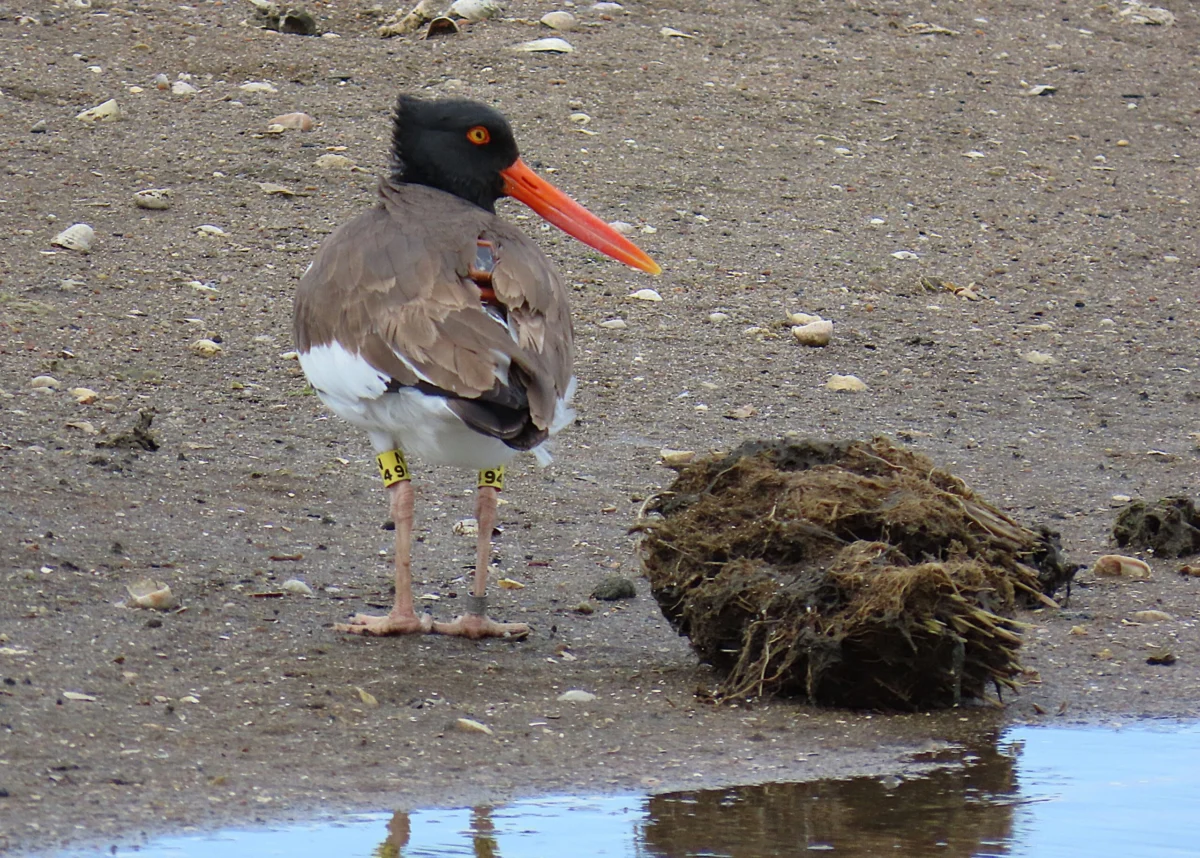
The survival of the American Oystercatcher, a charismatic shorebird recognized by its striking black-and-white plumage and brilliant orange-red bill, has long been a subject of intense scientific inquiry. For researchers monitoring the population along the Atlantic Flyway, the disappearance of a tagged bird often signifies a loss of data—or worse, the loss of the bird itself. However, the recent saga of N94, an American Oystercatcher fitted with a solar-powered GPS/GSM transmitter, has provided biologists with a rare and detailed window into the resilience of this species. After vanishing from satellite tracking maps for three months, the bird’s sudden reappearance in Virginia, followed by a successful return to Connecticut to raise a new brood, offers a compelling case study in the efficacy of modern avian tracking technology.
The Technological Breakthrough in Avian Monitoring
The "backpack" worn by N94 is a sophisticated piece of equipment: a solar-powered GPS/GSM transmitter. Applied by trained field biologists under strict ethical guidelines, these devices are revolutionizing ornithology. Unlike traditional metal leg bands, which require a researcher to physically capture the bird to identify it, GPS/GSM transmitters provide near-real-time data on a bird’s location, altitude, and activity patterns.
The integration of GSM cellular technology allows these devices to "ping" cellular towers whenever the bird is within range, transmitting coordinates directly to researchers. This data is critical for identifying essential stopover sites, wintering grounds, and breeding habitats. For the American Oystercatcher, which relies heavily on coastal ecosystems that are increasingly fragmented by human development and climate change, this granular level of data is the difference between general observation and precise conservation action.
A Chronology of a Disappearing Act
The story of N94 began in Connecticut, where she was one of five individuals selected for the pilot tracking program. Her movements in the 2025 season were marked by stability; she nested successfully at Sandy Point in West Haven, a vital coastal stretch. As the summer waned, she followed the natural instinct of her species, gathering at Milford Point—a critical staging area—to prepare for her southbound journey.
Her migration path was clear until she reached the marshes north of Atlantic City, New Jersey. At that juncture, the satellite signal ceased. For three months, the absence of data created a period of uncertainty for the research team. In wildlife biology, a "no-signal" period can be caused by technical failure, the death of the subject, or simply the bird entering a "dead zone" where cellular coverage is unavailable.
The silence was finally broken when N94’s transmitter pinged from a location in Virginia. The data confirmed she had survived the winter months in a region she likely found optimal for foraging, even if the tracking network was unable to capture her exact path during the transit. By the start of the 2026 nesting season, N94 had completed her northbound migration, returning to the exact nesting site at Sandy Point. There, she reunited with her mate, N95, to begin the cycle anew.
The Dynamics of Parenting and Vigilance
The 2026 nesting season proved to be a success, with the pair managing to fledge two chicks. The success of this brood was not merely a matter of chance; it was a result of intense parental investment. Field staff member Becca Mulligan, who conducted the direct observation of the pair, noted that N94 and N95 displayed a higher level of vigilance than other pairs in the vicinity.
"They seemed to be the most vigilant pair at Sandy Point," Mulligan reported. "They would initiate defensive behaviors, moving their chicks into the dense vegetation long before any humans or potential threats reached the immediate vicinity of the nest."
This behavior is a survival mechanism. American Oystercatchers are highly sensitive to disturbances. When a beachgoer or a loose dog approaches a nesting site, the adults often cease feeding and begin scanning for threats. This "vigilance behavior" is energy-intensive; constant disruptions can prevent the birds from foraging adequately or, in worse cases, cause them to abandon the nest entirely. Mulligan’s observation that the chicks continued to pester N95 even after fledging highlights the complexities of family dynamics in shorebirds, providing a human-interest element to the scientific data.
Comparative Data: The Breeding vs. Non-Breeding Strategy
The research project also provided a unique opportunity to compare the behaviors of breeding birds like N94 with non-breeding individuals like N93. While N94 remained tethered to her nesting territory, N93 demonstrated significantly different movement patterns.
Data shows that non-breeding birds, which are not tied to the obligations of nest defense or chick-rearing, utilize a much larger geographical range. N93’s map shows an expansive footprint, likely exploring various feeding grounds without the energetic costs of defending a territory. This comparison is vital for conservationists; it proves that the habitat requirements for a population are not monolithic. Protecting only the nesting sites would leave non-breeding individuals vulnerable during their broader foraging cycles. N93’s history—having spent the previous non-breeding season on the west coast of Florida—suggests a high degree of site fidelity, a trait that warrants further investigation to determine if the bird will return to that same wintering ground.
Implications for Coastal Conservation
The implications of the data gathered from N94 and her peers are far-reaching. By mapping these movements, researchers can better coordinate with stakeholders along the Atlantic Flyway. This includes local municipal governments, private property owners, and state wildlife agencies.
For instance, if the data reveals that a specific stretch of salt marsh in New Jersey is a "high-traffic" stopover site, conservation groups can prioritize that land for protection or restrict public access during critical migration windows. The data also underscores the necessity of maintaining high-quality "staging areas." These are the refueling stations of the avian world; if these sites are degraded by pollution, sea-level rise, or excessive human disturbance, the birds may lack the caloric reserves necessary to complete their migration.
Analysis of the Environmental Context
The American Oystercatcher is an "indicator species," meaning its health serves as a proxy for the overall health of the coastal ecosystem. Because they occupy a specific niche—nesting on sandspits and foraging on mudflats—they are highly vulnerable to the impacts of a changing climate. Rising sea levels threaten to inundate the very beaches they rely on for nesting.
Furthermore, the "human footprint" on these beaches is increasing. During the summer months, the pressure from tourism and recreation coincides exactly with the oystercatchers’ nesting season. The vigilance behaviors observed by Mulligan are a direct response to this pressure. By providing empirical data on how these birds react to human proximity, the research team is building a compelling case for seasonal beach closures and better signage, measures that have been shown to increase the fledgling success rate of shorebirds significantly.
Looking Toward the Future
As the 2026 season concluded, the sight of N94, N95, and their fledglings congregating on the sandspit at Sandy Point offered a hopeful image. In late July, they were observed staging for their next southbound journey. Current pings have already placed N94 back in the marshes north of Atlantic City, suggesting she is following a well-established migratory corridor.
For the researchers, the work is far from finished. Every ping received from these transmitters is a piece of a larger puzzle. The goal is to create a comprehensive map of the American Oystercatcher’s life cycle, from the moment they hatch to their eventual migration patterns. By understanding the "why" and "where" of their travels, conservationists can move from a reactive stance—trying to save birds as their populations decline—to a proactive one, ensuring that the habitats they require remain intact for generations to come.
The story of N94 is a testament to the fact that even in an era of rapid environmental change, our ability to monitor, understand, and protect species is also advancing. Through the marriage of technology and field observation, we are gaining the clarity needed to act as better stewards of the coastlines we share with these resilient and remarkable birds. As N94 makes her way south, she carries with her more than just a GPS transmitter; she carries the hope that scientific inquiry can provide a pathway to survival for a species on the edge.
