
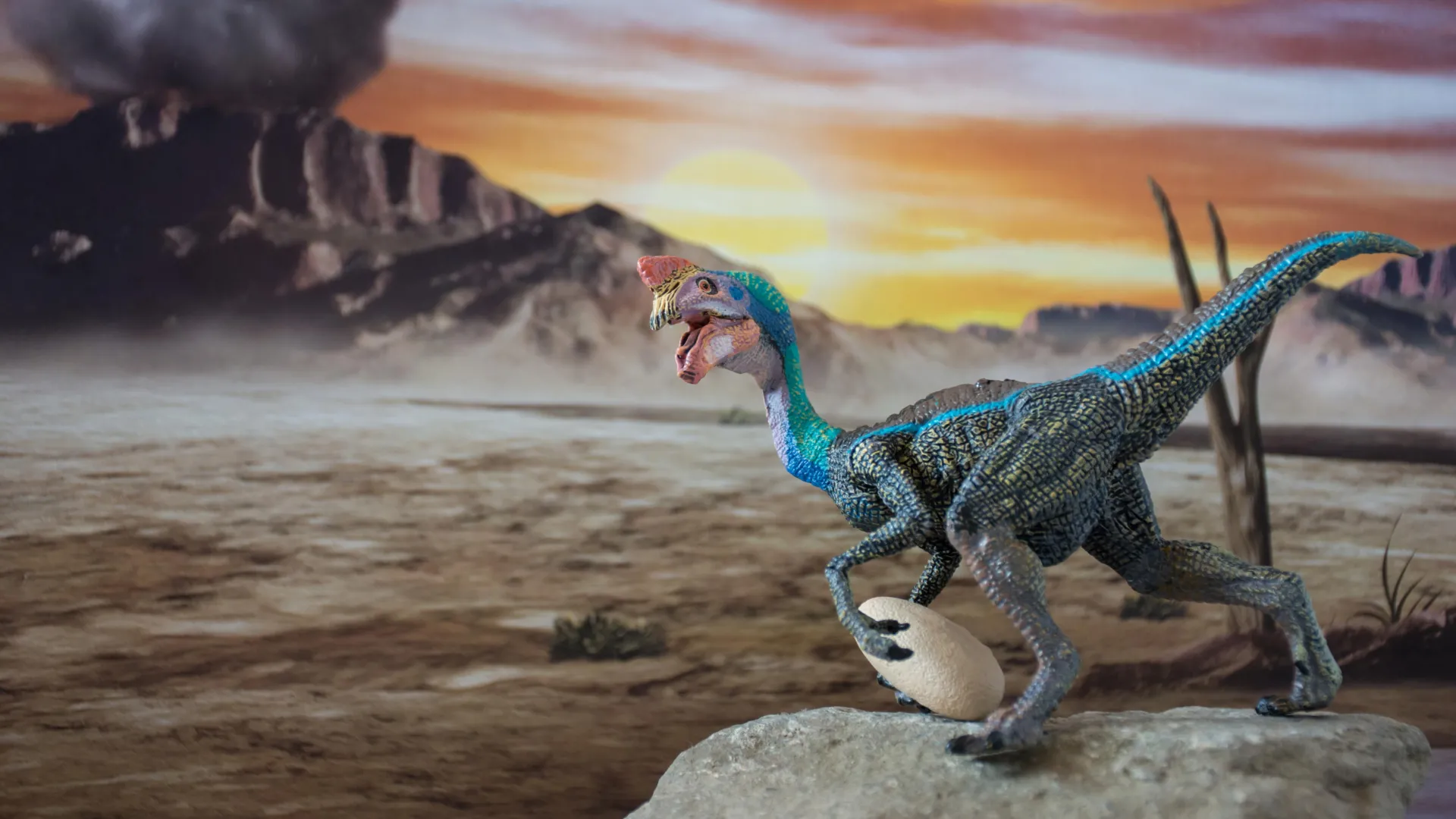
For centuries, the reproductive habits of non-avian dinosaurs have remained one of paleontology’s most compelling enigmas. While the fossil record has increasingly revealed complex behaviors, such as brooding and nest-guarding, the precise thermodynamic mechanisms by which dinosaurs brought their young into the world have stayed largely obscured. A groundbreaking study published in the journal Frontiers in Ecology and Evolution now sheds fresh light on this mystery, offering a detailed look at how oviraptors—feathered, bird-like dinosaurs of the Late Cretaceous—incubated their clutches. By merging physical experimentation with advanced computer simulations, researchers have demonstrated that these prehistoric animals relied on a hybrid approach to parenting, sharing incubation duties with the ambient heat of the sun.
The research centers on Heyuannia huangi, an oviraptor species that inhabited what is now China approximately 70 to 66 million years ago. Measuring roughly 1.5 meters in length and weighing an estimated 20 kilograms, these creatures constructed semi-open nests arranged in intricate, double-ringed patterns. To understand the thermal dynamics of these ancient structures, a scientific team based in Taiwan constructed a life-sized physical model of an oviraptor, pairing it with artificial resin eggs designed to mimic the unique morphology of oviraptor clutches.
The resulting data indicate that the relative position of the brooding adult, combined with environmental variables such as sunlight, played a decisive role in regulating egg temperature and, consequently, embryonic development. The findings challenge long-held assumptions regarding the uniformity of dinosaur reproduction and offer a sophisticated look at the evolutionary stepping stones between cold-blooded ancestral reptiles and warm-blooded modern birds.
Unraveling the Evolutionary Bridge of Oviraptors
To contextualize the study’s findings, it is necessary to examine the unique evolutionary standing of oviraptors within the dinosaur lineage. Living during the final stages of the Cretaceous Period, these creatures belonged to a group of feathered, theropod dinosaurs characterized by beak-like jaws, long necks, and often prominent cranial crests. Despite their historical misnomer—oviraptor translates to "egg thief," a moniker assigned after the first fossil was discovered suspiciously close to a nest—scientists now recognize these animals as devoted parents rather than predators of foreign eggs. Subsequent fossil discoveries across Mongolia and China have preserved adults directly atop their nests in brooding postures, confirming advanced parental care behaviors.
These anatomical and behavioral traits make oviraptors vital subjects for understanding the evolutionary transition from non-avian dinosaurs to modern birds. Their possession of feathers, paired with complex nesting habits, demonstrates that many reproductive and physiological characteristics previously thought exclusive to modern avians actually originated deep within the dinosaurian family tree. However, despite these similarities, the structural design of their nests presented distinct physical challenges when it came to transferring body heat.
Reconstructing an Ancient Nesting Environment
Recreating the thermal environment of an animal that vanished millions of years ago required an innovative interdisciplinary approach. Led by Dr. Tzu-Ruei Yang, an associate curator of vertebrate paleontology at Taiwan’s National Museum of Natural Science, alongside first author Chun-Yu Su—who was a high school student in Taichung when the project was undertaken—the research team undertook a meticulous reconstruction process.
The physical model of the Heyuannia huangi torso was constructed using a sturdy wooden framework enveloped in polystyrene foam. To accurately simulate the thermal properties of soft tissues, the researchers incorporated cotton, cloth, and bubble paper. Because oviraptor eggs possess distinct morphological characteristics unlike those of any living animal, the team cast custom artificial eggs from resin, arranging them in the characteristic double rings documented in the fossil record.
"Part of the difficulty lies in reconstructing oviraptor incubation realistically," Su noted regarding the physical demands of the project. "For example, their eggs are unlike those of any living species, so we invented the resin eggs to approximate real oviraptor eggs as best as we could."
With the physical model assembled, the team subjected the nest setup to a variety of simulated environmental conditions to observe how heat transferred through the clutch.
The Sun as a Co-Incubator
The core discovery of the study revolves around the thermal gradient within the nest and the profound influence of ambient environmental factors. Modern birds rely on what scientists call thermoregulatory contact incubation, or TCI. This method requires the brooding adult to make direct physical contact with every individual egg, serving as the primary and uniform heat source while maintaining the entire clutch within a narrow, stable temperature band.
The physical experiments and computer simulations revealed that oviraptors were structurally incapable of executing TCI in the manner of modern birds. Due to the geometry of their nests and the arrangement of the eggs, the brooding adult could not simultaneously touch every egg in the outer rings.
Under cooler atmospheric conditions, this limitation resulted in pronounced temperature disparities. Eggs situated in the outer ring of the nest exhibited temperature variations of up to 6 degrees Celsius compared to those closer to the center or in direct contact with the adult’s body. In biological terms, such a wide thermal gap would likely have induced asynchronous hatching, meaning that embryos would develop at uneven rates, causing some chicks to emerge significantly earlier than others within the same clutch.
However, when the researchers simulated warmer environmental conditions, the dynamics shifted dramatically. Under higher ambient temperatures, the temperature gap between the innermost and outermost eggs dropped to a mere 0.6 degrees Celsius. This dramatic reduction pointed to a crucial variable: sunlight. Because oviraptor nests were semi-open to the air rather than completely buried beneath soil or vegetation like the nests of crocodiles or turtles, solar radiation acted as a powerful secondary heat source.
"It’s unlikely that large dinosaurs sat atop their clutches. Supposedly, they used the heat of the sun or soil to hatch their eggs, like turtles," explained Dr. Yang. "Since oviraptor clutches are open to the air, heat from the sun likely mattered much more than heat from the soil."
Rethinking Avian Evolution and Efficiency
By quantifying these thermal dynamics, the researchers were able to estimate the overall incubation efficiency of oviraptors. The data confirmed that oviraptor incubation was markedly less efficient than that observed in modern birds. Rather than functioning as independent, self-contained heating units, the dinosaurs and the sun operated as co-incubators.
This realization challenges teleological assumptions that evolution moves in a strictly linear direction toward increasing perfection. Dr. Yang and his co-authors emphasize that the brooding strategy of oviraptors should not be categorized as inferior to that of modern birds.
"Modern birds aren’t ‘better’ at hatching eggs," Yang pointed out. "Instead, birds living today and oviraptors have a very different way of incubation or, more specifically, brooding. Nothing is better or worse. It just depends on the environment."
This hybrid brooding strategy represents a fascinating behavioral and physiological halfway point. It highlights how prehistoric animals adapted to the ecological niches and climatic conditions of the Late Cretaceous, leveraging available environmental energy sources to compensate for anatomical limitations in direct heat transfer.
Broader Implications and Future Research Directions
While the study provides robust new models for understanding dinosaur reproduction, the authors acknowledge certain inherent limitations. The experimental conclusions are necessarily tied to the specific nest reconstruction utilized in the study. Furthermore, global climate conditions during the Late Cretaceous featured significantly higher baseline temperatures and atmospheric compositions compared to the modern Earth, variables that would have influenced absolute thermal transfer rates. Paleontological estimates also suggest that oviraptors required considerably longer incubation periods than their modern avian descendants.
Despite these variables, the integration of physical reconstructions with advanced computational heat-transfer modeling establishes a powerful new methodological framework for paleontology. By bypassing the limitations of static fossil records, researchers can begin to reconstruct the dynamic, living behaviors of extinct species with unprecedented precision.
Beyond its scientific contributions, the project serves as a testament to global and regional scientific collaboration. Dr. Yang highlighted the symbolic importance of the research originating from Taiwan, a region devoid of native dinosaur fossils.
"It also truly is an encouragement for all students, especially in Taiwan," Yang concluded. "There are no dinosaur fossils in Taiwan, but that does not mean that we cannot do dinosaur studies."
As paleontology continues to embrace multidisciplinary techniques—merging engineering, computer simulation, and traditional fossil analysis—studies like this one dismantle old caricatures of dinosaurs as primitive, unfeeling beasts. Instead, they reveal a complex tapestry of ancient parental dedication, where feathered theropods patiently tended their nests beneath the ancient sun, bridging the evolutionary divide between the age of reptiles and the age of birds.
