
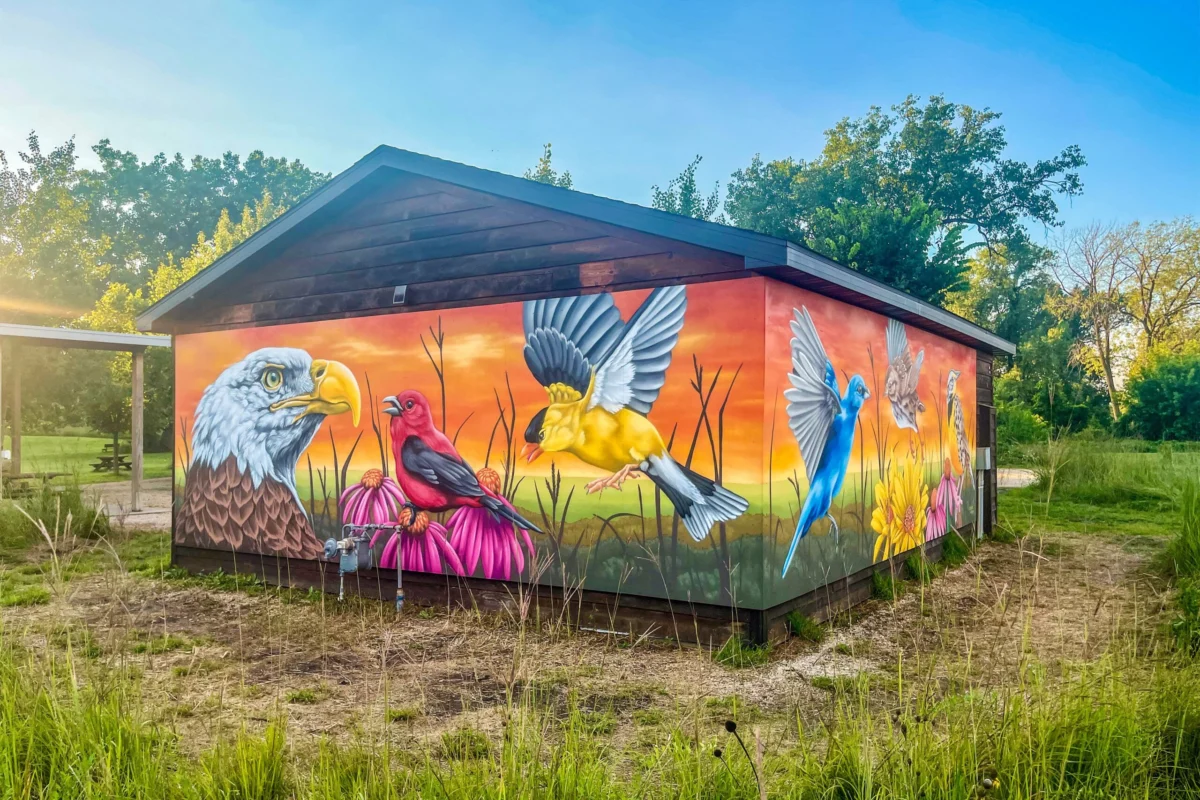
The city of South Beloit, positioned strategically along the vibrant riverfront where Illinois meets Wisconsin, has recently undergone a striking visual transformation. Three new public art installations—two sprawling murals and a monumental mosaic—have emerged as permanent fixtures in the community. These works, brought to life through a collaborative effort between the Audubon Mural Project, the Sinnissippi Audubon chapter, and the environmental hub Nature at the Confluence, serve a dual purpose: they beautify the urban landscape while functioning as an urgent, visual narrative regarding the precarious status of the region’s avian residents.
Spearheaded by Jennifer Kuroda, president of the Sinnissippi Audubon chapter, the project represents a significant investment in both community aesthetics and environmental education. With funding secured through municipal grants and the "Audubon in Action" initiative, the project underscores a growing trend in conservation efforts: using public art as a catalyst for environmental advocacy. By situating these works in high-traffic areas, organizers hope to bridge the gap between abstract climate science and the daily lives of local citizens.
A Chronology of Artistic Advocacy
The rollout of these installations followed a deliberate, multi-month schedule throughout 2025, designed to maximize visibility and community engagement.
- July 2025: The project’s urban presence was established with the unveiling of "The Last Watcher" by artist Brett Whitacre at 511 Blackhawk Blvd. This mural, located in the heart of South Beloit’s downtown district, immediately brought a sense of color and ecological awareness to a historic brick structure.
- August 2025: The focus shifted to Nature at the Confluence, an 80-acre nature preserve and environmental learning center. Artist Justin Suarez, known professionally as Aerosol Kingdom, spent the month completing "Where the Grasses Grow," a massive, two-sided mural covering a wooden structure onsite.
- October 2025: The final piece of the initiative was installed. "Woodrow the Woodpecker," a 9-foot-tall mosaic sculpture, was placed at the entrance of the nature preserve. This installation was the culmination of a summer-long educational program led by artist Susan Burton, where local students learned to assemble intricate mosaics, mirroring the collaborative nature of ecological restoration.
The Science Behind the Paint: Species Under Threat
The artistic choices made by the project organizers were far from arbitrary. Each piece features species that are native to northern Illinois but are currently facing existential threats due to habitat loss, agricultural development, and, most notably, the warming climate.
According to data from the National Audubon Society’s Survival By Degrees report, the impact of climate change on these species is quantifiable and severe. The Scarlet Tanager, for instance, is projected to lose approximately 68 percent of its current breeding range if global temperature increases remain on their current trajectory. Similarly, the Red-headed Woodpecker—represented by the towering mosaic—faces potential displacement from the majority of its Illinois breeding grounds.
"The Last Watcher," featuring the Whooping Crane, serves as a sobering reminder of past failures and current challenges. While the species has staged a miraculous comeback from the brink of extinction—rising from a global population of just 15 individuals in 1941 to several hundred today—the eastern migratory flock remains critically vulnerable. Recent losses, including suspected cases of highly pathogenic avian influenza, have underscored that the recovery of the Whooping Crane is a fragile process. By placing these images in the public eye, the project forces a confrontation with the reality that species recovery is not a one-time achievement, but a continuous, active responsibility.
Professional Perspectives on Public Engagement
For the partners involved, the installations are more than just murals; they are essential tools for public outreach. Julie Uram, executive director of Nature at the Confluence, notes that the visual appeal of the birds acts as a "gateway" for multi-generational education. "It is a way to get people of all ages interested in the outdoors," Uram stated. By bringing the birds into the downtown environment, the project removes the barrier of entry that often accompanies traditional nature study.
Justin Suarez, the artist behind the mural at the nature center, brings a unique perspective to the project. Having spent over a decade working at a rehabilitation center for birds of prey, Suarez possesses an anatomical understanding of his subjects that informs his hyper-realistic style. For Suarez, the use of spray paint—a medium often associated with urban graffiti—to depict delicate songbirds is a deliberate subversion of expectations. "I personally feel that you can get just as much small detail using a can of spray paint as you can with the tiniest brush," Suarez observed, noting that his work is intended to "plant a seed" of curiosity in passersby.
The Mosaic Approach: Collective Action
The final installation, "Woodrow the Woodpecker," provides a distinct metaphor for the broader conservation message. The process of creating a mosaic—where hundreds of individual glass pieces are painstakingly placed to form a larger, coherent image—mirrors the collective effort required for environmental preservation.
Susan Burton, who led the student-driven SPARK! Mosaic project, emphasizes the educational value of this medium. "One tiny piece by itself doesn’t seem like much, but when everyone contributes, something amazing happens," Burton noted. This philosophy aligns with the broader goals of the Sinnissippi Audubon chapter: that local actions, such as protecting backyard habitats or supporting public policy, are the "pieces" that eventually form the "mosaic" of regional conservation success.
Implications for Urban Environmentalism
The South Beloit project is part of a larger, national movement to integrate "green" values into the "gray" infrastructure of American cities. As urbanization continues to encroach upon native habitats, the role of cities as potential refuges for birds becomes increasingly important.
The inclusion of prairie plants and native flora alongside the bird depictions in these murals is not merely decorative; it serves as a visual suggestion for residents to consider their own landscaping choices. By promoting native plant gardening, the Audubon Mural Project hopes to turn residential lawns into "corridors" that support migratory species, effectively extending the reach of the nature preserve into the private sphere.
Furthermore, the economic and social implications of these murals are notable. By investing in public art, South Beloit is fostering a "sense of place" that links the town’s identity to its unique riverfront ecology. This strengthens local support for the preservation of the Rock River corridor, a critical stopover point for thousands of birds in the Mississippi Flyway.
Conclusion: A Legacy of Awareness
As these murals weather the seasons, their impact will be measured not just in the number of visitors they attract to the nature center, but in the shift in public discourse surrounding local biodiversity. The project has effectively transformed blank, utilitarian walls into educational signage, and a mundane entrance into a landmark for conservation.
The challenges facing the Eastern Meadowlark, the Scarlet Tanager, and the Whooping Crane are complex and global in scope. However, by grounding these issues in local context, the residents of South Beloit have been given a unique opportunity to participate in the conversation. Whether through the artistic precision of Suarez’s eagles, the pop-art vibrancy of Whitacre’s cranes, or the collective labor of the student-made woodpecker, the message remains consistent: the survival of these species is a shared responsibility, and the first step toward protection is observation.
In the words of the organizers, these installations are intended to have a "life beyond" the artists themselves. As the paint fades or the seasons change, the hope is that the awareness sparked by these works will endure, serving as a permanent, visual reminder that even in an era of climate uncertainty, there is still much to protect, and much to watch over.
