
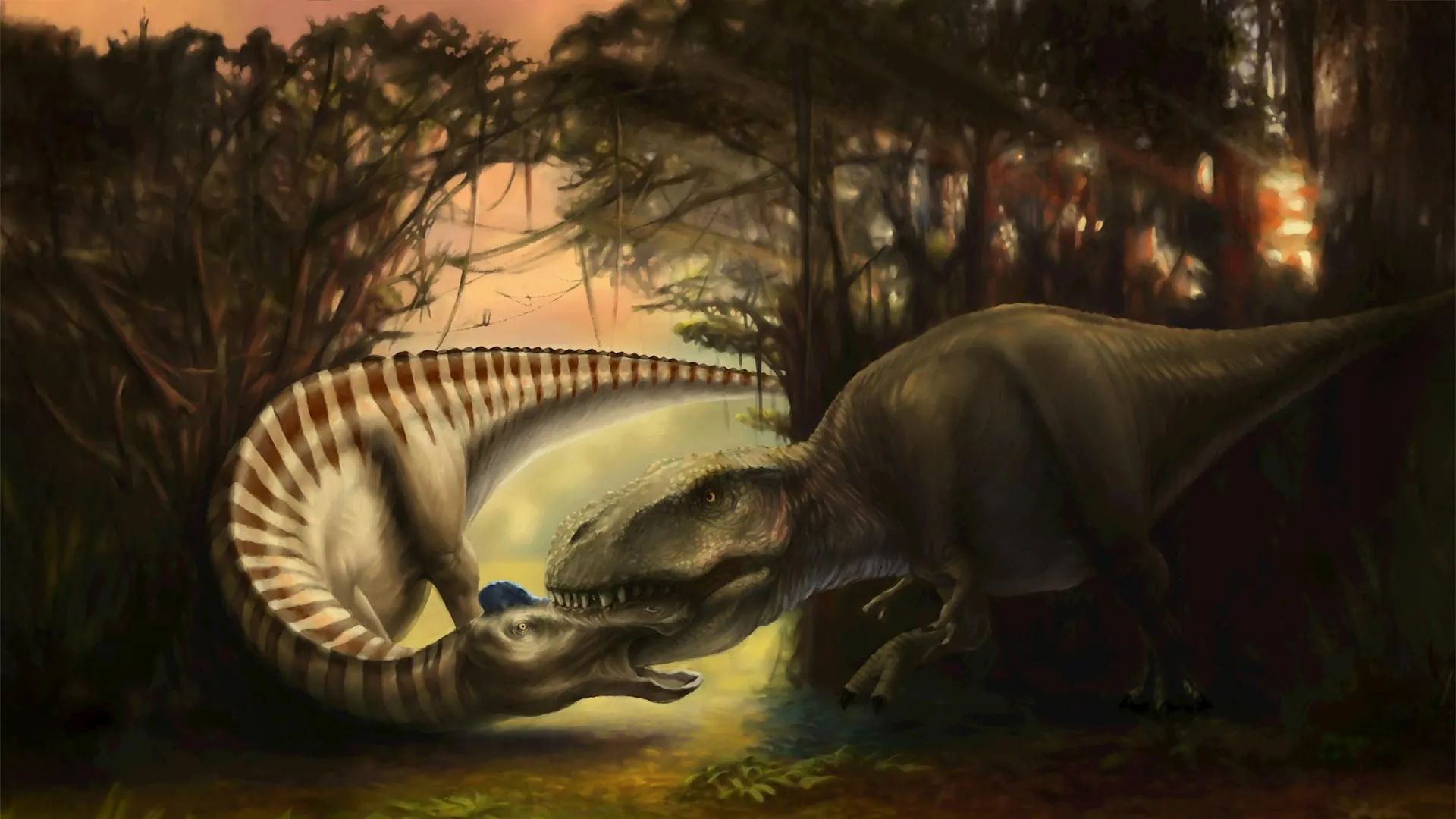
Deep within the badlands of eastern Montana, where the rugged terrain preserves a prehistoric world frozen in stone, a singular fossilized skull is reshaping our understanding of the Earth’s most formidable apex predator. Housed at the prestigious Museum of the Rockies in Bozeman, Montana, a remarkably well-preserved Edmontosaurus skull bearing a broken, deeply embedded Tyrannosaurus tooth has become the focal point of a major new scientific investigation. Published in the peer-reviewed scientific journal PeerJ, this collaborative research between the Museum of the Rockies and Canada’s University of Alberta offers paleontologists an unprecedented window into the violent, high-stakes interactions of the late Cretaceous period, approximately 66 million years ago.
The specimen bridges a critical gap in behavioral paleontology, moving researchers beyond static anatomical studies and into the realm of dynamic ecological behavior. While paleontologists have long cataloged isolated bite marks and superficial gouges on dinosaur bones across North America’s prolific Hell Creek Formation, finding a predator’s tooth physically lodged within the facial bones of its prey is an extraordinary rarity. This physical artifact acts as an ancient forensic marker, locking the identities of both predator and victim into a singular, violent moment in deep time.
The Anatomy of a Cretaceous Ecosystem
To fully comprehend the significance of this discovery, scientists must reconstruct the complex ecological theater of the late Cretaceous, specifically the final millions of years leading up to the catastrophic Cretaceous-Paleogene extinction event. During this epoch, the interior of North America was dominated by the Western Interior Seaway, a vast shallow body of water that split the continent in two. Along its western margins lay a low-lying coastal plain characterized by sprawling floodplains, meandering river systems, and dense subtropical forests.
In this hyper-productive environment, Tyrannosaurus rex stood undisputed at the top of the food chain. As one of the largest terrestrial carnivores in Earth’s history, an adult T. rex could reach lengths exceeding 40 feet and weights approaching nine metric tons. Yet, it did not hunt in a vacuum. The Hell Creek ecosystem was a bustling nexus of megafauna that required specialized predatory strategies. Tyrannosaurus shared its habitat with heavily armored ceratopsians like Triceratops, heavily-plated ankylosaurids, and massive hadrosaurs, commonly known as duck-billed dinosaurs, such as Edmontosaurus.
Edmontosaurus was a massive herbivore capable of growing up to 43 feet in length and weighing several tons. While lacking physical offensive weaponry like horns or spikes, these animals relied on immense body mass, potential herd behavior, and complex dental batteries designed to grind tough vegetation. For a Tyrannosaurus, subduing an adult Edmontosaurus was no trivial task; it required immense bite forces capable of crushing bone and piercing thick muscle tissue. The newly studied skull from Montana provides tangible, physical evidence of how these titanic forces collided.
Chronology of a Discovery: From the Hell Creek Badlands to the Laboratory
The journey of this scientific breakthrough spans two decades, beginning with the initial field expedition and culminating in advanced technological analysis. The chronology of the discovery highlights the methodical nature of modern paleontological research:
Summer 2005: Field paleontologists working within the Hell Creek Formation of eastern Montana uncover a nearly complete Edmontosaurus skull. The excavation site is situated on public land managed by the United States Department of the Interior’s Bureau of Land Management (BLM), an agency responsible for stewarding vast tracts of fossil-rich federal lands in the American West.
Post-Excavation Curation: Following extraction, the fossil is transported to the Museum of the Rockies, an institution globally renowned for housing one of the world’s most comprehensive collections of dinosaur fossils. The skull is cleaned, prepared, and eventually placed on public display in the museum’s renowned Hall of Horns and Teeth, where visitors can observe its massive proportions and distinct anatomical features.
The Research Partnership: Recognizing the unique nature of the fossil, a collaborative research initiative is established between Taia Wyenberg-Henzler, a doctoral student at the University of Alberta, and Dr. John Scannella, Curator of Paleontology at the Museum of the Rockies. The team sets out to systematically document and analyze the anomalies present on the duck-billed dinosaur’s facial structure.
Advanced Imaging and CT Scans: To peer beneath the surface without damaging the priceless fossil, researchers transport the skull for advanced computed tomography (CT) scanning at Advanced Medical Imaging at Bozeman Health Deaconess Hospital. These high-resolution scans allow the scientific team to visualize the internal architecture of the bone and the exact trajectory and depth of the embedded tooth fragment.
Publication and Peer Review: Following comprehensive comparative analysis against known theropod dentition from the Hell Creek Formation, the findings are compiled, peer-reviewed, and formally published in the open-access scientific journal PeerJ, opening the data to the global paleontological community.
Forensic Paleontology: Reconstructing the Final Moments
The methodological rigor applied to the Edmontosaurus skull mirrors the protocols of modern forensic science. Taia Wyenberg-Henzler, lead author of the study, draws direct parallels between her team’s work and criminal investigations.
"The great thing about an embedded tooth, particularly in a skull, is it gives you the identity of not only who was bitten but also who did the biting," Wyenberg-Henzler explains. "This allowed us to paint a picture of what happened to this Edmontosaurus, kind of like Cretaceous crime scene investigators."
To confirm the identity of the biter, the research team conducted a meticulous comparative morphological analysis. They evaluated the serrated edges, curvature, and cross-sectional dimensions of the embedded tooth fragment against every known carnivorous dinosaur species inhabiting the Hell Creek ecosystem during the late Maastrichtian age. The matches definitively pointed to Tyrannosaurus, ruling out smaller contemporaneous theropods such as Dromaeosaurus or Saurornitholestes, whose teeth lack the robust, bone-crushing morphology characteristic of tyrannosaurids.
Furthermore, CT scans revealed critical insights into the physical dynamics of the attack. The tooth is deeply lodged within the nasal region of the Edmontosaurus skull. The positioning of the impact provides profound behavioral clues. According to the researchers, the placement of the bite on the front of the face strongly indicates a direct, face-to-face confrontation between the predator and its prey.
In the natural world, predatory attacks that terminate in face-to-face engagement are typical of active hunting scenarios, where the prey animal is conscious, resisting, and perhaps attempting to confront or deter its attacker. This challenges purely scavenged-based hypotheses by offering physical evidence of an active, aggressive engagement. Moreover, the sheer mechanical force required to snap a heavily enameled Tyrannosaurus tooth and leave it deeply embedded within dense cranial bone underscores the immense bite force generated by the predator—estimates for adult T. rex routinely place this force in excess of 12,000 pounds, equivalent to the weight of a medium-sized elephant resting entirely upon the tips of the teeth.
Pathology and the Question of Survivability
One of the most telling indicators uncovered during the CT scanning process relates to biological response—or the lack thereof—at the wound site. When a living animal sustains a traumatic injury, its body initiates a healing response, resulting in bone remodeling, swelling, and porous bone growth around foreign objects if the animal survives the initial trauma.
Dr. John Scannella, co-author of the study and Curator of Paleontology at the Museum of the Rockies, points out the absence of such evidence on the specimen. "The skull shows no signs of healing around the tyrannosaur tooth," Scannella notes, "so it may have already been dead when it was bitten, or it may be dead because it was bitten."
This pathological ambiguity touches upon a long-standing debate within vertebrate paleontology regarding the precise feeding habits of Tyrannosaurus rex. For decades, scientists have debated whether the animal was an apex predator that actively hunted live prey, an opportunistic scavenger that fed primarily on already-dead carcasses, or a flexible generalist that utilized both strategies depending on ecological availability.
While the absence of healing does not definitively prove whether the Edmontosaurus was alive at the precise microsecond of the bite—as the animal could have succumbed to the traumatic blow almost instantaneously—the energetic investment and aggressive frontal placement of the bite strongly align with active predation. A scavenger would have little biological motivation to aggressively strike the heavily boned snout of a decaying carcass with such bone-shattering force. Instead, the evidence paints a vivid, albeit sobering, picture of a violent predatory strike aimed at disabling or dispatching a large, resistant herbivore.
Broader Implications for Tyrannosaurid Research
The implications of the Montana State University and University of Alberta study extend far beyond a single fossil specimen. By demonstrating how advanced medical imaging and rigorous comparative anatomy can extract behavioral data from museum archives, the research sets a new benchmark for paleontological investigations.
Museum collections worldwide house thousands of fossilized bones collected over centuries of exploration. Many of these specimens, once studied primarily for taxonomic classification or gross anatomical description, are now being revisited with modern technological tools. CT scanning, three-dimensional digital photogrammetry, and elemental composition analysis are breathing new life into historical collections, allowing scientists to ask sophisticated ecological questions that earlier generations of paleontologists could only speculate upon.
Furthermore, this discovery contributes critical data points to ongoing computer modeling of tyrannosaur biomechanics. Biomechanists studying jaw muscle arrangements, skull stress distribution, and tooth strength rely on empirical evidence like broken and embedded teeth to test the accuracy of their digital simulations. When a computer model predicts that a T. rex bite at a specific angle will generate enough stress to fracture a tooth within bone, and a physical fossil matches that exact prediction, the scientific validity of the biomechanical model is vastly reinforced.
As research into the Hell Creek Formation continues, specimens like the Bozeman Edmontosaurus serve as timeless reminders of the dynamic, unforgiving nature of prehistoric ecosystems. They strip away the abstraction of deep time, translating millions of years of geological history into an instantaneous, visceral flash of biological reality: a predator lunging, bone shattering, and an ancient world locking into stone.
