
Over 60 million years ago, a monumental geological event unfolded as the Indian subcontinent embarked on a colossal collision with the Eurasian continent. This titanic clash of tectonic plates, a process that continues even today, gave birth to the planet’s most formidable mountain range: the Himalayas. Towering majestically, these peaks reach dizzying altitudes, their upper echelons perpetually shrouded in layers of snow and ice, forming vast, ancient glaciers. These frozen reservoirs, nestled amidst the frigid temperatures found at nearly 8,000 meters above sea level, represent a lifeline for an immense expanse of Asia.
For the myriad countries and billions of people nestled around the Himalayas, the steady, life-giving drip of water from these glaciers has been, and remains, an indispensable force. This precious meltwater does far more than merely quench thirst; it forms the arterial network that sustains vast agricultural lands, powers vital energy production infrastructure, and underpins the growth and prosperity of countless communities. Crucially, these glacial waters have also sculpted and maintained unique, high-altitude habitats, providing essential refuges for a diverse array of wildlife specially adapted to these extreme environments. On this World Water Day, the global community turns its attention to the critical importance of these vital water sources, celebrating not only their intrinsic value but also highlighting three iconic avian species of the Himalayas whose very existence is intricately interwoven with the health and continued flow of this glacial water. Their stories underscore the profound interconnectedness of climate, water, and biodiversity in one of the world’s most sensitive ecosystems.
The Majestic Himalayas: A Cradle of Glacial Life
The Himalayan range, often referred to as the "Third Pole," holds the largest concentration of glaciers outside the polar regions. This colossal ice mass is the source of ten of Asia’s largest rivers, including the Ganges, Indus, Brahmaputra, Yangtze, Mekong, Salween, and Yellow River, providing freshwater to nearly two billion people across South and Southeast Asia. The geological forces that shaped these mountains continue to influence the region’s climate and hydrology. The slow, persistent accumulation of snow over millennia, compressed into ice, forms these massive glaciers, which act as natural water towers, storing water during colder months and releasing it during warmer periods, thereby regulating river flows and mitigating seasonal droughts. The sheer scale of this water provision is staggering, supporting diverse ecosystems from alpine meadows to vast deltaic plains.
World Water Day: Highlighting Himalayan Water Security
World Water Day, observed annually on March 22nd, serves as a crucial platform to raise awareness about the global water crisis and advocate for sustainable management of freshwater resources. The theme often revolves around the importance of freshwater and advocating for the sustainable management of freshwater resources. In this context, the Himalayan glaciers represent a paramount concern. The reliance of densely populated nations like India, China, Pakistan, Bangladesh, and Nepal on these glaciers makes their preservation a matter of regional, and indeed global, water security. The intricate balance of the Himalayan ecosystem, where glacial melt dictates the rhythm of life, makes it a focal point for understanding the broader implications of climate change on freshwater availability and biodiversity.
Avian Icons of the Glacial Realms

The high-altitude wetlands, lakes, and rivers fed by Himalayan glaciers are unique havens for specialized bird species. Their adaptations to extreme cold, low oxygen, and specific diets make them extraordinary examples of evolutionary resilience.
The Adaptable Brown-headed Gull (Larus brunnicephalus)
While the common perception of gulls often associates them with bustling coastlines and maritime environments, the Brown-headed Gull (Larus brunnicephalus) presents a striking counter-narrative, spending a significant portion of its life thriving in the high-altitude, freshwater lakes of the Tibetan Plateau and the broader Himalayan region. These lakes, sustained by the gradual, perennial melt of glaciers, are not only vital drinking sources but also teeming with life, offering an abundance of fish and aquatic invertebrates. This rich food supply allows these gulls to congregate in impressive numbers, with colonies often exceeding hundreds of individuals.
The Brown-headed Gull is a migratory species, undertaking seasonal movements between its breeding grounds on the Tibetan Plateau and its wintering areas, which often include the warmer plains of the Indian subcontinent, as well as coastal regions in Southeast Asia. Their presence in these high-altitude freshwater environments underscores the ecological connectivity between the glaciers and distant ecosystems. Their diet primarily consists of fish, insects, and crustaceans, making the health of the glacial-fed lakes directly proportional to their foraging success. Conservation efforts for this species often focus on protecting these critical high-altitude breeding and feeding grounds from pollution, habitat degradation, and human disturbance, ensuring the continued vitality of these unique inland gull populations. According to BirdLife International, the species is currently classified as ‘Least Concern,’ reflecting its relatively widespread distribution and large population, though local threats from habitat degradation and climate change impacts on its unique high-altitude habitats are continuously monitored.
The High-Flying Bar-headed Goose (Anser indicus)
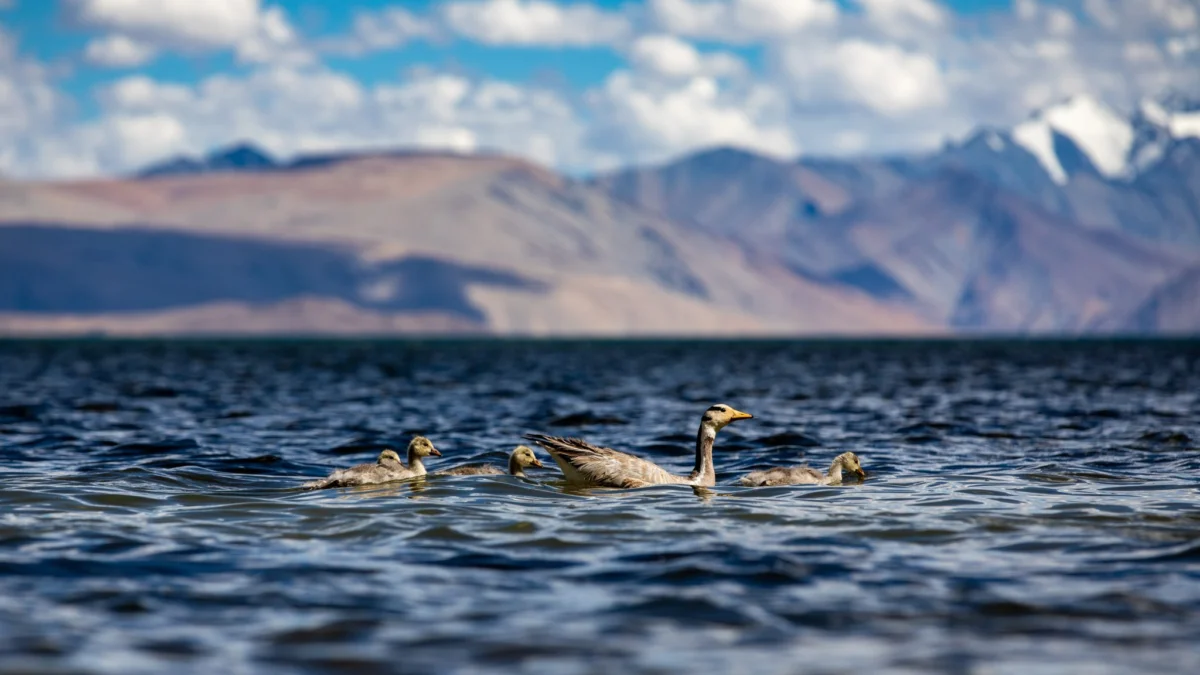
Few birds embody the extraordinary spirit of the Himalayas quite like the Bar-headed Goose (Anser indicus). This species is renowned globally for its unparalleled migratory feats, particularly its ability to traverse the world’s highest mountain range. Unlike most migratory birds of the Central Asian Flyway, which meticulously weave their way through the valleys and lower passes of the tall peaks, Bar-headed Geese possess the astonishing physiological capacity to travel directly over the Himalayas. Their documented flights regularly reach altitudes of nearly 7,000 meters (approximately 23,000 feet) and, in some cases, even higher, challenging conventional understanding of avian respiration and endurance.
The precise mechanisms enabling them to achieve such altitudes with minimal oxygen availability remain a captivating subject of scientific inquiry. However, research has revealed several key adaptations: they possess larger lungs and a more efficient respiratory system than other geese, a higher density of capillaries in their muscles, and hemoglobin with an exceptionally high affinity for oxygen, allowing them to extract oxygen more effectively from the thin air. This extraordinary feat allows these birds to exploit the network of high-altitude lakes and marshes that dot the Himalayan landscape along their migratory journey. These glacial-fed wetlands serve as critical stopover points, providing essential rest areas and rich foraging grounds where the geese can replenish their energy reserves by feasting on grasses, roots, and aquatic vegetation before continuing to their next destination. Their breeding colonies, often numbering in the thousands, are typically found near mountain lakes in Central Asia, from which they undertake their epic migrations to wintering grounds primarily in the Indian subcontinent. The Bar-headed Goose is also classified as ‘Least Concern’ by BirdLife International, but its dependence on healthy high-altitude wetlands makes it particularly vulnerable to climate-induced changes in water availability and habitat quality.
The Sacred Black-necked Crane (Grus nigricollis)

With an impressive two-meter (nearly seven-foot) wingspan, the majestic, slow-motion flight of the Black-necked Crane (Grus nigricollis) is a truly captivating spectacle, capable of halting anyone in their tracks. These massive birds hold significant cultural and religious importance, particularly in regions like Bhutan, where they are revered as sacred symbols, and in parts of the Tibetan Plateau. Despite their grand wingspan, Black-necked Cranes undertake a relatively short migration compared to other crane species. Their seasonal movements primarily involve flying between lower and higher elevation wetlands scattered across the Himalayan range, including areas in Ladakh (India), Bhutan, and Arunachal Pradesh (India), as well as the Tibetan Plateau.
These high-altitude wetlands, sustained by glacial meltwater, are crucial foraging grounds where the cranes meticulously feast on a diverse diet of roots, tubers, small fish, insects, and other aquatic invertebrates. The species is unique as it is the only crane that breeds exclusively at high altitudes. Interestingly, the initial phases of accelerated glacial melt, driven by climate change, have presented a short-term, albeit precarious, advantage for these birds. The increased inflow of meltwater has, in some instances, led to the expansion of existing wetlands or the creation of new temporary ones, providing more habitat and foraging opportunities. However, this fleeting benefit masks a far more ominous long-term prognosis. Scientists project that with the current, accelerating rate of climate change, the glaciers feeding these vital wetlands will eventually diminish and, in many cases, disappear entirely. This would lead to a monumental shrinkage of the birds’ high-elevation wetland habitats, posing an existential threat to this vulnerable species. The Black-necked Crane is currently listed as ‘Near Threatened’ by BirdLife International, primarily due to habitat loss, degradation, and the increasing impacts of climate change on its specific high-altitude wetland ecosystems. Conservation efforts include the establishment of protected areas and community-based initiatives to minimize human disturbance.
The Accelerating Threat of Climate Change to Himalayan Glaciers
The overarching threat looming large throughout the Himalayas is the accelerating impact of climate change on its glaciers. Scientific consensus, supported by extensive research from organizations like the International Centre for Integrated Mountain Development (ICIMOD) and reports from the Intergovernmental Panel on Climate Change (IPCC), indicates that Himalayan glaciers are retreating at an alarming rate. Studies have shown that glaciers in the Hindu Kush Himalayan (HKH) region have lost ice ten times faster since 2000 than in any period over the preceding centuries. Projections suggest that even under a low-emissions scenario, the region could lose one-third of its glaciers by 2100, while a high-emissions scenario could see a two-thirds loss.
This rapid glacial melt directly disrupts the region’s delicate hydrological cycle. Initially, increased meltwater can lead to higher river flows and the expansion of glacial lakes, which, as observed with the Black-necked Crane, can sometimes create temporary new habitats. However, this is a transient phase. The long-term consequence is a significant reduction in water availability as the glaciers shrink beyond a critical point, leading to diminished dry-season flows in major rivers. This phenomenon, often termed "peak water," signifies a point after which water availability from glacial melt will decline sharply, leading to widespread water scarcity. The ecological implications are profound: beyond birds, entire aquatic ecosystems, including unique fish species, amphibians, and the diverse plant life dependent on consistent water flows, face collapse. The increased frequency of glacial lake outburst floods (GLOFs) also poses a direct threat to downstream communities and infrastructure.
Far-Reaching Consequences: Beyond Birds to Billions
The disappearance of the life-giving waters provided by Himalayan glaciers would unleash a cascade of profound impacts, affecting not only the unique avian species and broader biodiversity but also billions of people across Asia. The most immediate and devastating consequence would be widespread water scarcity. Agricultural practices in the fertile plains of the Indus, Ganges, and Brahmaputra river basins, which feed hundreds of millions, are heavily reliant on glacial meltwater, particularly during the crucial dry seasons. A significant reduction in water supply would cripple food production, leading to food insecurity, economic hardship, and potentially mass displacement.
Furthermore, hydropower generation, a cornerstone of energy security for many Himalayan nations, would be severely hampered. Less water means less electricity, impacting industrial development, urban centers, and rural electrification efforts. The socio-economic effects would be immense, exacerbating poverty, increasing health risks due to lack of clean water, and potentially fueling resource conflicts within and between nations. The geopolitical implications are also significant; reduced water availability in transboundary rivers could intensify existing tensions and create new flashpoints between riparian states, threatening regional stability. The intricate web of life, from the smallest microorganism to the largest human settlement, is inextricably linked to the fate of these frozen giants.

Conservation Imperatives: Protecting a Vital Ecosystem
Recognizing the urgent and multifaceted threat posed by climate change to Himalayan glaciers and the life they sustain, comprehensive conservation strategies are more critical than ever. Organizations like BirdLife International are at the forefront of these efforts, working tirelessly to protect crucial habitats and biodiversity across the Himalayas. Their approach includes advocating for the designation and effective management of protected areas, implementing species-specific conservation programs for endangered and vulnerable birds, and fostering community engagement in conservation initiatives.
A key focus is on promoting nature-safe renewable energy solutions, ensuring that the transition away from fossil fuels does not inadvertently harm critical ecosystems or biodiversity. This involves careful planning and site selection for new energy infrastructure, minimizing habitat fragmentation and disturbance. Beyond specific projects, BirdLife and its partners are actively involved in policy advocacy, urging governments and international bodies to adopt more ambitious climate targets and implement effective climate adaptation and mitigation strategies. This includes supporting initiatives to reduce global carbon emissions, which are the primary drivers of glacial retreat.
International collaborations are also vital, bringing together scientific expertise, financial resources, and political will to address a challenge that transcends national borders. This involves supporting research into glacial dynamics, developing early warning systems for natural disasters like GLOFs, and implementing sustainable water management practices that account for changing river flows. Programs promoting ecosystem restoration, sustainable land use, and climate-resilient agriculture are also crucial for building the adaptive capacity of both human communities and natural ecosystems.
The vision shared by conservationists, scientists, and communities is for a future where the majestic Himalayan glaciers continue to stand tall, their life-giving streams flow perpetually, and the diverse communities of birds and people alike can flourish side by side in harmony with nature. Achieving this future requires not only immediate action to curb climate change but also a sustained commitment to protecting the precious water resources and unique biodiversity that define the roof of the world. The stories of the Brown-headed Gull, Bar-headed Goose, and Black-necked Crane serve as powerful reminders of what is at stake and the urgent necessity for collective global stewardship.
