
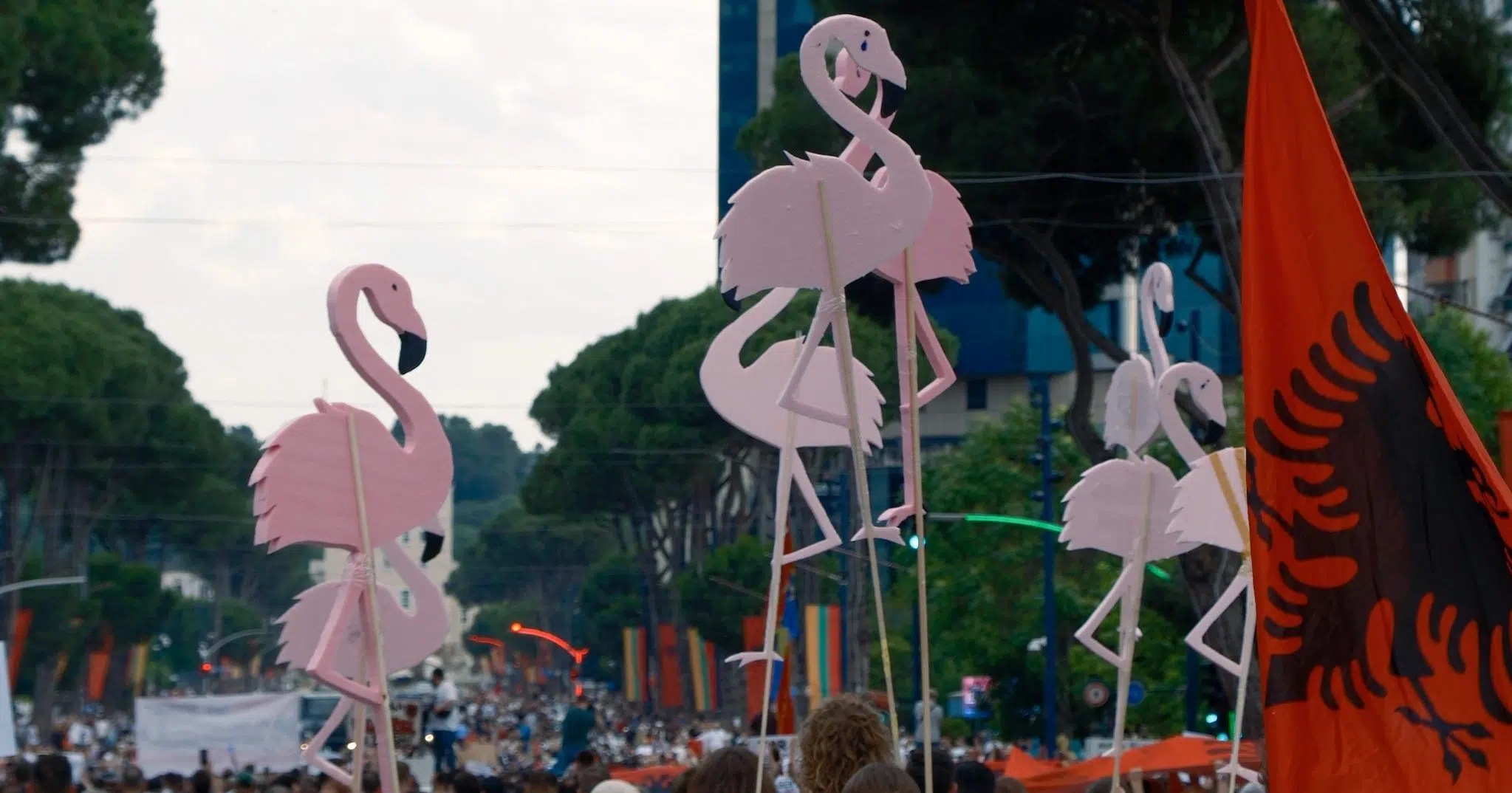
TIRANA, ALBANIA – Thousands of Albanian citizens have taken to the streets of Tirana for four consecutive days, demonstrating against a proposed vast luxury tourism development that threatens the Vjosa Narta Protected Landscape, one of the Mediterranean’s last remaining intact coastal ecosystems. The contentious project, backed by foreign investors including former White House advisor Jared Kushner, has ignited widespread public outrage, drawing attention not only to critical environmental concerns but also to fundamental questions of democratic governance, transparency, and the rule of law in Albania.
The Pristine Vjosa Narta: A Jewel of Mediterranean Biodiversity
The Vjosa Narta Protected Landscape, located along Albania’s Adriatic coast, is a wetland of international importance, recognized under the Ramsar Convention. Spanning approximately 19,200 hectares, this ecologically rich area encompasses a mosaic of habitats, including lagoons, salt marshes, dunes, and coastal forests. It serves as a vital resting, feeding, and breeding ground for an extraordinary array of wildlife, distinguishing itself as a biodiversity hotspot in a region where most coastal areas have already succumbed to extensive development.
Its wetlands are a sanctuary for hundreds of bird species, making it a prime location for ornithological observation. Among its most iconic residents are vibrant flocks of flamingos (Phoenicopterus roseus), whose presence has lent the protests the evocative moniker "Flamingo Revolution." Beyond the avian spectacle, Vjosa Narta provides critical habitat for critically endangered species, including the Mediterranean monk seal (Monachus monachus), one of the rarest marine mammals globally, and serves as essential nesting beaches for Loggerhead sea turtles (Caretta caretta). The delicate balance of this ecosystem, largely untouched by human intervention compared to other Mediterranean coastlines, means that any significant alteration poses a severe risk of cascading, irreversible consequences for the species that depend on it. Its unique ecological value also underpins traditional livelihoods for local communities, including fishing and salt production, which have coexisted sustainably with the natural environment for generations.
The Proposed Development: "Durrës Yachts & Marina" and "Lalzi Bay Resort and Residences"

The luxury tourism development sparking the current protests is part of a larger government push to expand Albania’s tourism sector. While the exact scope of the project within the Vjosa Narta Protected Landscape remains a point of contention and limited public disclosure, reports suggest it involves large-scale construction of resorts, hotels, and associated infrastructure. The involvement of Jared Kushner, through his investment firm Affinity Partners, has been widely reported. Kushner’s firm is reportedly eyeing projects along the Albanian coast, including a luxury development on Sazan Island and a major resort in Zvërnec, near Vlora, which directly borders or overlaps with parts of the Vjosa Narta area. While specific details linking Kushner’s investment directly to the current immediate threat within the Protected Landscape are sometimes conflated with broader coastal development plans, the public perception and activist focus have squarely placed foreign investment, particularly from prominent figures, at the heart of the controversy. This perception fuels concerns about influence and preferential treatment in development decisions.
The project is widely seen by environmentalists and local communities as an existential threat to the delicate ecosystem. Construction activities, increased human traffic, waste generation, and altered hydrological regimes would inevitably degrade habitats, disrupt breeding cycles, and potentially displace endangered species. Critics argue that the economic benefits of such high-impact tourism are often short-lived and concentrated among a few, while the environmental and social costs are borne by the wider public and future generations.
A Chronology of Contention
The seeds of the current conflict were sown long before the recent demonstrations. Albania has, for years, balanced its ambitions for economic growth, particularly through tourism, with its commitments to environmental protection.
- Early 2000s: Albania begins to identify key areas for environmental protection, with Vjosa Narta being formally designated as a Protected Landscape under national law. International recognition, such as Ramsar site status, further solidifies its importance.
- Mid-2010s: The Albanian government signals increasing interest in attracting foreign investment for large-scale tourism projects along its coastline, often citing the need for economic development and job creation.
- Late 2010s – Early 2020s: Environmental organizations, including local groups like PPNEA (Protection and Preservation of Natural Environment in Albania) and international partners like BirdLife Europe and Central Asia, begin to raise alarms about proposed developments in sensitive areas, including Vjosa Narta. They highlight potential violations of existing environmental laws and international conventions.
- 2023-2024: Reports emerge detailing specific proposals for luxury resorts and the involvement of prominent foreign investors. Public awareness grows, fueled by investigative journalism and persistent advocacy from civil society.
- Early June 2024 (approximate): Details of the specific development plans within or adjacent to the Vjosa Narta Protected Landscape become more concrete, triggering a surge in organized opposition. The immediate catalyst for the current wave of protests is often a government decision or a perceived advancement of the project without adequate public consultation.
- June 2024: Thousands converge in Tirana for four consecutive days of protests, demonstrating a powerful and sustained rejection of the proposed development. The demonstrations unify environmental activists, local residents, and concerned citizens under the banner of protecting both nature and democratic principles.
The "Flamingo Revolution": Beyond Environmentalism
While the immediate trigger for the protests is ecological loss, the demonstrations in Tirana resonate with deeper frustrations. As one protester articulated, "What is at stake is something more immediate: the right to participate in decisions about places people live, landscapes they value, and a future they will pass to their children."

Environmental conflicts, particularly in developing economies or countries in transition, are often misleadingly framed as a binary choice between conservation and economic development. This narrative, pervasive and politically convenient, often casts environmental protection as an obstacle to prosperity, rather than acknowledging its foundational role in sustainable economic well-being. The "Flamingo Revolution" actively pushes back against this false dichotomy.
Instead, these conflicts invariably involve fundamental questions of democratic governance: Who holds the power to decide how shared resources are utilized? Whose interests are prioritized in national development strategies? And, crucially, whose voices are genuinely heard and considered in these decisions? When the practical answer to these questions is perceived to be "not yours," citizens mobilize.
Democracy relies on an implicit social contract: citizens grant authority to their government in exchange for responsible stewardship of common assets, including the natural environment. When public assets are disposed of without transparency, when environmental protection laws are repeatedly flouted, and when judicial oversight proves ineffective, this pact erodes. Protest, in such circumstances, becomes a legitimate and often necessary expression of civic dissent.
Statements and Reactions
- Environmental Activists and NGOs: Organizations like PPNEA and BirdLife Europe and Central Asia have been at the forefront, providing scientific data, legal analysis, and organizing the protests. They demand the immediate halt of any development within the protected area, strict enforcement of environmental laws, and genuine public participation in decision-making processes. "Vjosa Narta is not merely a landscape; it’s a testament to Albania’s natural heritage and a critical lifeline for endangered species. Allowing luxury resorts to destroy it would be an act of unforgivable ecological vandalism," stated a representative from PPNEA.
- Local Communities: Residents whose livelihoods are tied to the Vjosa Narta ecosystem express profound concern over potential displacement, loss of traditional fishing grounds, and the destruction of cultural heritage. They emphasize the long-term sustainability of ecotourism and traditional practices over short-term, high-impact development.
- Albanian Government: While promoting Albania as an attractive destination for foreign investment and emphasizing the economic benefits of tourism, the government has largely maintained a defensive stance regarding the protests. Official statements often reiterate commitments to sustainable development and adherence to legal procedures, yet activists accuse them of a lack of transparency and prioritizing investor interests over environmental protection and public welfare. Specific ministerial responses have often deflected criticism, asserting that all projects undergo rigorous environmental impact assessments, a claim frequently challenged by independent experts.
- Jared Kushner’s Representatives/Affinity Partners: While direct public statements on the Vjosa Narta specific controversy are scarce, representatives of Kushner’s firm have generally highlighted the potential for job creation and high-end tourism development to boost local economies. They often emphasize their commitment to responsible development, though specific environmental safeguards for the Vjosa Narta project have not been detailed publicly by the investors themselves.
- European Union: The situation in Albania has drawn the attention of EU officials. Albania is a candidate for EU membership, and fundamental accession criteria—including rule of law, democratic accountability, and effective institutions—are non-negotiable. Events in Tirana raise legitimate doubts about how seriously these commitments are being taken by the Albanian government. A spokesperson from the European Commission, without directly commenting on the specific project, might reiterate the importance of aligning national legislation with EU environmental acquis and ensuring transparent, participatory governance in line with accession requirements. "Respect for environmental protection, rule of law, and civil society engagement are cornerstones of the European Union, and these principles are central to the accession process," an inferred statement might read.
Broader Implications and The Road Ahead
The "Flamingo Revolution" carries implications far beyond Albania’s borders. Across Europe, environmental protections are increasingly being framed as impediments to economic growth, and civil society organizations advocating for them are often dismissed as anti-progress. The protests in Tirana challenge this narrative, asserting that citizens will not quietly accept such a framing, especially when it threatens irreplaceable natural heritage and undermines democratic participation.

Environmental Implications: The destruction of Vjosa Narta would represent a significant blow to Mediterranean biodiversity conservation efforts. It would set a dangerous precedent, signaling that even internationally recognized protected areas are vulnerable to commercial development. The ecological costs—loss of species, degradation of habitats, disruption of migratory routes—would be irreversible and could contribute to the broader climate and biodiversity crises.
Socio-Economic Implications: While proponents argue for job creation, critics contend that luxury tourism often creates low-wage, seasonal jobs while displacing traditional, sustainable livelihoods. The long-term economic viability of a region that sacrifices its natural assets for short-term gain is questionable. Ecotourism, which respects and leverages the natural environment, could offer a more sustainable and equitable economic path for Vjosa Narta.
Democratic Governance and Rule of Law: The conflict highlights a worrying trend where powerful interests, often foreign, appear to bypass transparent decision-making processes and undermine existing environmental regulations. If courts fail to provide effective oversight and public consultation remains a formality rather than a substantive engagement, the democratic fabric of the nation is weakened. This directly impacts Albania’s credibility as a prospective EU member state, where robust rule of law and democratic accountability are paramount.
International Relations and Investment Scrutiny: The involvement of high-profile foreign investors brings international scrutiny to Albania’s governance practices. Such controversies can deter responsible foreign direct investment (FDI) that adheres to high environmental and social standards, potentially attracting only those willing to operate in less transparent environments. It also tests the commitment of international financial institutions and development partners to sustainable development goals in the region.
As the flamingos wade in the tranquil shallows of Vjosa Narta, as a Mediterranean monk seal occasionally hauls out onto its untouched beaches, and as Loggerhead turtles seek intact nesting sites, these natural wonders remain possible. They endure because a pristine coastline has, thus far, been protected—and because, right now, thousands of people in Tirana are in the streets, passionately insisting that it remains that way. The future of Vjosa Narta, and indeed the integrity of Albania’s democratic processes, hangs in the balance, a powerful test of whether environmental values and citizen voices will prevail over unchecked development.
