
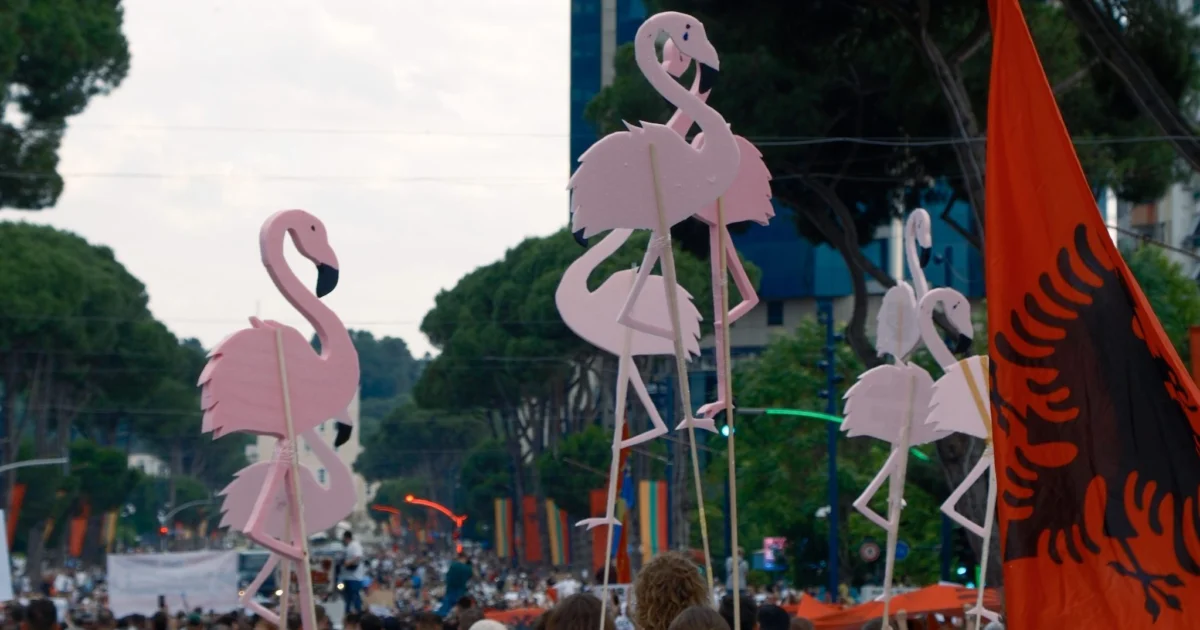
Thousands of citizens have taken to the streets of Tirana for four consecutive days, demonstrating against a proposed luxury tourism development that threatens the Vjosa Narta Protected Landscape, one of the Mediterranean’s last remaining intact coastal ecosystems. The protests, dubbed the "Flamingo Revolution" by some media outlets, highlight a multifaceted struggle that extends beyond environmental protection to encompass fundamental questions of democratic governance, transparency, and Albania’s commitment to the rule of law as it seeks European Union membership. The controversial project, backed by foreign investors including prominent American real estate developer Jared Kushner, has ignited widespread concern among environmentalists and ordinary citizens alike, who fear irreversible damage to a vital natural heritage.
The Pristine Jewel Under Threat: Vjosa Narta Protected Landscape
The Vjosa Narta Protected Landscape, located along Albania’s Adriatic coast, is an ecological marvel, a biodiverse sanctuary encompassing extensive wetlands, salt marshes, lagoons, and pristine beaches. This area is recognized internationally for its exceptional ecological value, holding designations such as an Important Bird and Biodiversity Area (IBA) and being part of the Emerald Network, Albania’s contribution to the European Natura 2000 ecological network. It serves as a critical stopover for migratory birds, a wintering ground, and a nesting site for numerous species, many of which are endangered or critically threatened.
Among its most iconic residents are thousands of Greater Flamingos (Phoenicopterus roseus), whose graceful presence has lent the protests their evocative moniker. These birds, along with Dalmatian Pelicans (Pelecanus crispus) and various other waterfowl, rely on the lagoon’s rich resources. Beyond avian life, the Vjosa Narta coastline provides crucial nesting grounds for the endangered Loggerhead Sea Turtle (Caretta caretta), a species whose populations are in decline across the Mediterranean due to habitat loss and human disturbance. Perhaps even more significantly, the area is one of the few remaining habitats for the critically endangered Mediterranean Monk Seal (Monachus monachus), considered one of the rarest marine mammals in the world. Its secluded coves and undisturbed waters are vital for their survival and breeding.
The proposed "vast luxury tourism development" envisions an expansive resort complex, potentially including hotels, villas, golf courses, and marinas, within or immediately adjacent to this ecologically sensitive zone. Such a project would inevitably lead to significant habitat fragmentation, wetland drainage, increased human disturbance, light and noise pollution, and alteration of natural hydrological regimes. Any substantial modification to this delicate balance risks triggering cascading, irreversible consequences for the intricate web of species that depend on it for survival, effectively dismantling an ecosystem that has remained largely untouched despite centuries of human activity along the Mediterranean.

A Timeline of Mounting Tensions and Resistance
The current wave of protests in Tirana is not an isolated event but the culmination of months, if not years, of simmering discontent and growing alarm over the Vjosa Narta project.
- Early 2023: Reports began to surface regarding preliminary plans for a large-scale tourism development in the Vjosa Narta area. Environmental organizations, including the PPNEA (Protection and Preservation of Natural Environment in Albania) and BirdLife Europe and Central Asia, immediately raised red flags, emphasizing the protected status and ecological significance of the site.
- Late 2023: Details of the proposed project, including the involvement of foreign investors and the sheer scale of the development, became clearer. Public consultations, if held at all, were widely criticized by civil society groups as inadequate and non-transparent, failing to genuinely engage local communities or address expert environmental concerns.
- Early 2024: Concerns escalated as local media reported on government statements seemingly supportive of the development, framing it as a boon for economic growth and job creation. Environmental impact assessments (EIAs), if conducted, were not made fully public or were deemed insufficient by independent experts.
- May 2024: The first organized public demonstrations and awareness campaigns began to gain traction, primarily led by environmental activists and local residents. Petitions were launched, and legal challenges were reportedly considered to halt the project.
- June 2024 (Current Events): The protests escalated dramatically, with thousands converging in Tirana. The demonstrations have been characterized by a strong presence of young people, families, and environmental activists, all united under the banner of protecting Vjosa Narta. For four consecutive days, protesters have marched, chanted, and held banners, demanding the immediate cessation of the development plans and greater transparency from the government. The evocative imagery of flamingos has become a powerful symbol of their cause, giving rise to the "Flamingo Revolution" moniker, which underscores both the ecological stakes and the vibrant, determined nature of the citizen movement.
Beyond Environmentalism: A Crisis of Democratic Governance
While the immediate catalyst for the protests is the ecological threat to Vjosa Narta, the deeper currents driving thousands onto the streets reflect a profound disillusionment with democratic processes and a demand for greater accountability. The narrative often propagated by proponents of such projects, framing them as an inevitable conflict between "conservation and development," is increasingly seen by citizens as a false dichotomy designed to obscure more fundamental issues.
This pervasive and disingenuous narrative casts nature as an impediment to prosperity rather than its very foundation. Protesters argue that the conflict is not truly between environmental protection and economic progress, but rather between sustainable, inclusive development that benefits all citizens and unchecked, opaque exploitation driven by narrow private interests.
At the heart of these conflicts lie basic questions of democratic governance:

- Who determines how shared resources are used? In a democratic society, decisions concerning public assets and natural heritage should ideally involve broad public participation and reflect the collective will, not merely the prerogatives of a few powerful entities.
- Which interests are prioritized? The rapid advancement of the Vjosa Narta project, despite strong expert and public opposition, suggests that the interests of foreign investors and perceived short-term economic gains are being prioritized over long-term environmental sustainability and community well-being.
- Whose voices count? When public consultations are merely cosmetic, when expert warnings are ignored, and when legal avenues appear to be bypassed or circumvented, citizens feel their voices are being systematically marginalized. The feeling that the answer, in practice, is "not yours" is a powerful catalyst for collective action and protest.
Democracy, at its core, rests on a relatively simple yet profound social contract: citizens grant their governments authority in exchange for responsible stewardship of what is held in common. Nature, as a shared inheritance, is an integral part of this common trust. When public assets are disposed of without transparency, when established environmental laws and regulations are repeatedly violated, and when judicial and administrative institutions fail to provide effective oversight and redress, this fundamental pact breaks down. Protest, therefore, becomes not merely an expression of dissent but a critical mechanism for citizens to reclaim their agency and demand adherence to democratic principles.
Official Reactions and Stakeholder Positions
The Albanian government has largely maintained a stance that emphasizes the economic benefits of such investments, portraying them as crucial for job creation and boosting the nation’s tourism sector. While official statements often include assurances of adherence to environmental standards, critics argue that these assurances are not backed by concrete actions or transparent processes. There have been no public statements from the government indicating a halt or re-evaluation of the Vjosa Narta project in response to the protests, instead focusing on the need for "responsible development."
The foreign investors, including entities associated with Jared Kushner, have generally remained silent or issued generic statements about their commitment to "sustainable and eco-friendly tourism." Such statements often aim to assuage public concerns without offering specific details on how a large-scale luxury development can genuinely be "eco-friendly" within a critically sensitive protected area. The lack of detailed public disclosure regarding the financial backing, environmental impact assessments, and specific project plans further fuels public suspicion.
Environmental organizations like PPNEA and BirdLife Europe and Central Asia have been vocal in their condemnation of the project. They have released detailed scientific reports outlining the ecological damage, initiated public awareness campaigns, and called for international intervention. Their demands include the immediate revocation of any permits issued, a transparent and independent environmental impact assessment, and genuine public participation in all decisions affecting protected areas. They stress that the economic benefits cited by the government are often exaggerated and fail to account for the immense long-term ecological and societal costs.
Broader Implications: Albania’s European Aspirations and a Continental Trend

The unfolding events in Tirana carry implications that reach far beyond Albania’s borders, particularly concerning the country’s aspiration for European Union membership. Albania is an EU candidate country, and the fundamental criteria for accession—rule of law, democratic accountability, and effective institutions—are not merely administrative checkboxes. They describe the very essence of the kind of state the EU is built upon. The handling of the Vjosa Narta controversy raises legitimate and serious doubts about how seriously these core commitments are being taken by the Albanian authorities.
A lack of transparency in decision-making, allegations of environmental law violations, and the apparent disregard for civil society concerns directly undermine the principles of good governance and rule of law that are non-negotiable for EU integration. The European Union has a robust environmental acquis (body of law), and any candidate country is expected to demonstrate a strong commitment to its implementation and enforcement. The "Flamingo Revolution" serves as a stark reminder to Brussels that progress on paper must be matched by tangible action and respect for democratic norms on the ground.
Moreover, the situation in Albania mirrors a concerning trend across Europe, where environmental protections are increasingly being framed as obstacles to economic growth, and civil society organizations advocating for them are often dismissed as anti-progress. The protests in Tirana actively push back against this misleading narrative, asserting that citizens will not quietly accept such an undermining of environmental safeguards and democratic rights. They demonstrate that public engagement and collective action remain powerful forces capable of challenging powerful interests and demanding a more sustainable and equitable future. The struggle for Vjosa Narta is, therefore, also a struggle for the soul of environmental governance and democratic participation across the continent.
A Future Yet Unwritten
None of this remains abstract. Right now, flamingos wade gracefully in the shallows of Vjosa Narta. A Mediterranean Monk Seal might haul out onto a secluded beach, finding temporary refuge. A Loggerhead sea turtle may still navigate the currents to find her nesting site intact, a testament to an ecosystem that has, against many odds, remained largely pristine. These precious ecological realities are still possible today because this vital coastline has, thus far, been protected, and because, at this very moment, thousands of people in Tirana are in the streets, raising their voices, demanding that it stays that way. Their courage and determination are a beacon of hope, not just for the wetlands of Vjosa Narta, but for the fundamental principles of environmental justice and democratic accountability in Albania and beyond. The future of this unique natural treasure, and the democratic values it represents, now hangs in the balance, awaiting the outcome of this pivotal moment of citizen resistance.
