
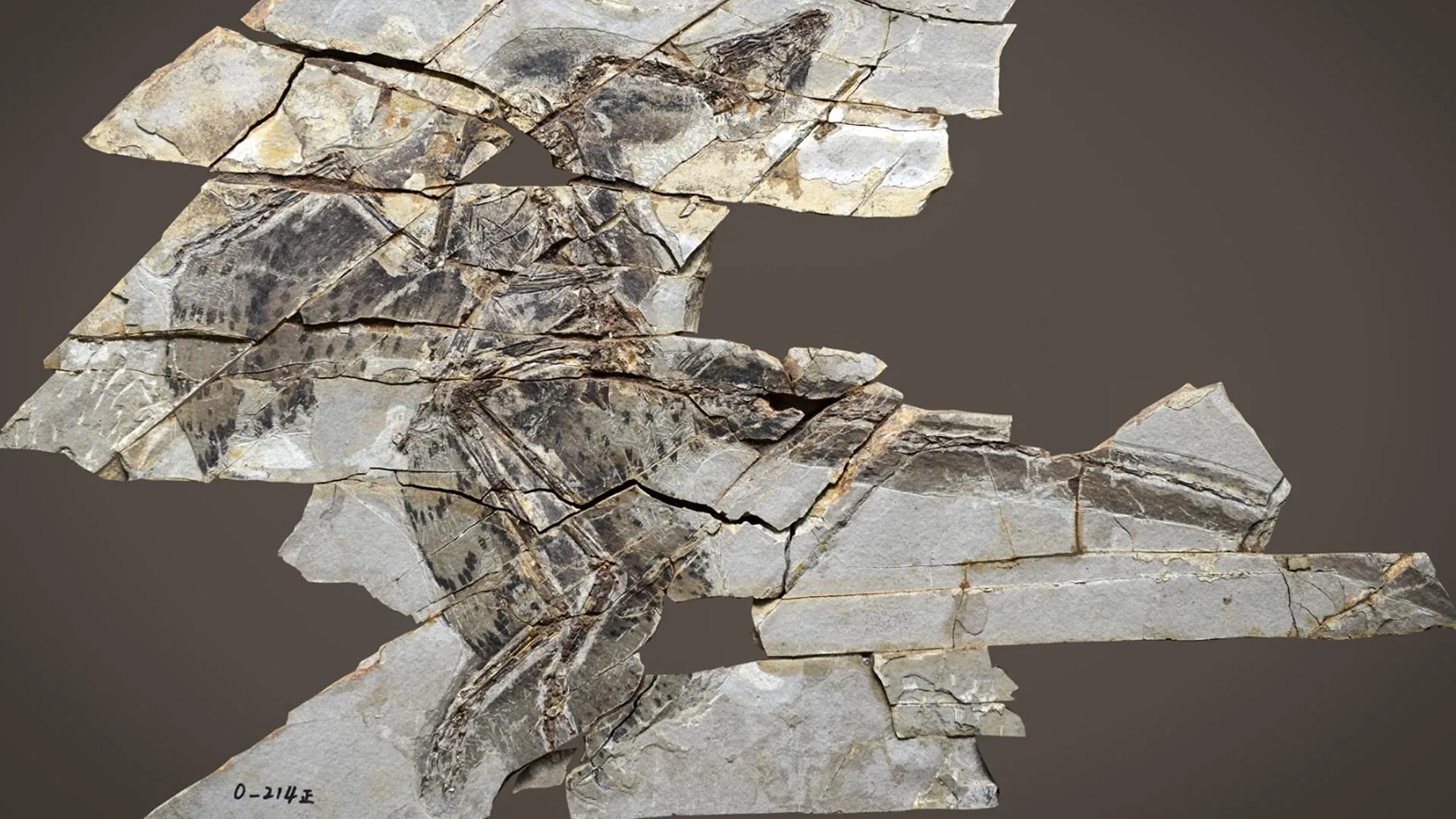
A groundbreaking new study, spearheaded by a researcher from Tel Aviv University’s School of Zoology and the Steinhardt Museum of Natural History, has revealed compelling evidence that some feathered dinosaurs, despite possessing wing-like structures, had already forfeited the ability to fly. This remarkable finding, published in the esteemed journal Communications Biology by Nature Portfolio, upends long-held assumptions about the linear progression of flight evolution, underscoring its intricate and often non-linear trajectory in both dinosaurs and their modern avian descendants. The research team emphasizes, "Feather molting seems like a small technical detail — but when examined in fossils, it can change everything we thought about the origins of flight, highlighting how complex and diverse wing evolution truly was."
The study, led by Dr. Yosef Kiat in collaboration with researchers from China and the United States, meticulously analyzed an exceptionally rare collection of nine fossilized specimens from eastern China. These fossils, belonging to the feathered Pennaraptoran dinosaur Anchiornis, offered an unprecedented window into the anatomy and life history of animals that roamed the Earth approximately 160 million years ago during the Late Jurassic period. Unlike typical fossil records that primarily preserve skeletal structures, these specimens retained an astonishing level of detail, including the delicate imprints of their feathers and, crucially, their original coloration. This extraordinary preservation allowed for a detailed examination of feather structure and growth patterns, revealing secrets about Anchiornis‘s aerial capabilities – or lack thereof.
The Enigmatic Anchiornis: A Glimpse into Jurassic Life
Anchiornis huxleyi is a fascinating creature in the paleontological record. Discovered in the Tiaojishan Formation of Liaoning Province, China, in 2009, it quickly became a pivotal species in understanding the dinosaur-to-bird transition. Anchiornis was a small, pigeon-sized dinosaur, estimated to be around 34 centimeters (13 inches) long and weighing approximately 110 grams (3.9 oz). It possessed long limbs, a relatively short tail, and feathers covering nearly its entire body, including its forelimbs, hindlimbs, and tail. Its feathers were particularly striking, forming distinct wings on both its arms and legs, giving it a "four-winged" appearance, similar to the slightly later Microraptor.
The exceptional preservation of Anchiornis fossils from the Jehol Biota – a rich fossil lagerstätte in northeastern China – has allowed scientists to reconstruct not only its skeletal morphology but also its soft tissues and even its coloration. Prior studies, using melanosome analysis (pigment-bearing organelles in feathers), had already revealed that Anchiornis likely had a grey and black body, a reddish-brown crest, and prominent white and black banded wings. It is this preserved coloration, specifically the continuous line of black spots along the wing edges observed in the new study, that proved instrumental in unraveling its molting patterns and, consequently, its flight status. The region’s unique fossilization conditions, often involving rapid burial in fine volcanic ash or anoxic lake sediments, have provided an unparalleled record of feathered dinosaurs, significantly advancing our understanding of avian origins.
The Evolution of Feathers and the Dawn of Flight
To fully appreciate the significance of this Anchiornis discovery, it’s essential to understand the broader evolutionary context of feathers and flight. Dinosaurs, as Dr. Kiat explains, diverged from other reptiles approximately 240 million years ago, during the Middle Triassic period. Relatively soon after, on an evolutionary timescale, many species began to develop feathers. Initially, these lightweight, protein-based structures were not believed to be for flight. Instead, paleontologists hypothesize that early feathers served functions such such as insulation for thermoregulation, elaborate display structures for mating or species recognition, or even as aids for climbing or insect-netting.
Around 175 million years ago, during the Middle Jurassic, a crucial group of feathered dinosaurs known as Pennaraptora emerged. This clade includes oviraptorosaurs, scansoriopterygids, dromaeosaurids, troodontids, and Avialae (the group containing modern birds). Pennaraptorans are considered the closest non-avian relatives of modern birds, and it is within this lineage that the true precursors to avian flight began to develop. The feathers of Pennaraptorans became more asymmetrical, a key aerodynamic feature for lift generation, and their skeletal structures showed adaptations consistent with powered flight. This lineage was the only one to survive the catastrophic mass extinction event at the end of the Mesozoic era, approximately 66 million years ago, when an asteroid impact led to the demise of most non-avian dinosaurs.
For decades, the prevailing scientific narrative suggested a relatively straightforward progression: feathers evolved, became specialized for flight, and then birds took to the skies. However, recent discoveries and analyses, including this new study, are painting a much more complex picture. It appears that while flight did indeed evolve within the Pennaraptoran lineage, its development was not always a one-way street. Certain species may have developed rudimentary flight capabilities only to lose them later in their evolutionary history, a phenomenon known as secondary flightlessness. This is observed in many modern birds, such as ostriches, emus, penguins, and kiwis, which possess wings and feathers but are utterly incapable of aerial locomotion. This study suggests that such evolutionary regressions were already occurring in the deep past, long before the emergence of modern avian groups.
Molting Patterns: An Ancient Indicator of Flight Ability
The most innovative aspect of Dr. Kiat’s research lies in its novel application of molting analysis to fossilized remains. Dr. Kiat, an ornithologist with extensive experience studying modern bird feathers, highlights that feathers are dynamic structures. They grow for two to three weeks, during which they are supplied with blood vessels that nourish their development. Once they reach their final size, these blood vessels recede, and the feather becomes a "dead material," much like human hair or fingernails. Over time, feathers wear out due to environmental exposure and mechanical stress, necessitating their replacement through a process known as molting.
Crucially, the pattern of molting provides a critical clue about an animal’s flight capability. In birds that depend on flight for survival – whether for hunting, escaping predators, or migration – molting is a highly organized, gradual process. Flight feathers, particularly the primary and secondary feathers of the wing, are shed and replaced in a symmetrical fashion, often one or two at a time on each wing. This ensures that the bird maintains aerodynamic symmetry and sufficient lift and thrust to continue flying effectively throughout the molting period. A sudden, simultaneous loss of multiple flight feathers would render a flying bird grounded and vulnerable.
Conversely, in flightless birds, or those that do not rely on flight, molting tends to be a far more random and irregular process. Without the imperative to maintain aerodynamic integrity, these birds can shed feathers in a less orderly fashion, sometimes even losing many at once. "Consequently," Dr. Kiat explains, "the molting pattern tells us whether a certain winged creature was capable of flight."
By examining the Anchiornis fossils, the researchers were able to identify distinct molting patterns. The preserved coloration, specifically the black spots at the tips of the wing feathers, was key. They observed a continuous line of these black spots along the wing edges, indicating mature feathers. However, they also spotted developing feathers whose black spots were out of alignment with this continuous line, signifying that these feathers were still in various stages of growth. A meticulous, detailed analysis of these observations revealed that the molting pattern in Anchiornis was indeed irregular and asymmetrical, rather than the orderly, symmetrical molting characteristic of flying animals.
Evidence for Flightlessness in Anchiornis
Based on his extensive familiarity with modern avian biology, Dr. Kiat concluded, "Based on my familiarity with modern birds, I identified a molting pattern indicating that these dinosaurs were probably flightless." This conclusion marks a significant departure from earlier interpretations of Anchiornis, which, given its elaborate feathering and wing-like structures, was often depicted as a gliders or even a weak flier.
The ability to discern such functional traits from fossilized remains, beyond mere skeletal structure, is what makes this finding particularly exciting. "This is a rare and especially exciting finding: the preserved coloration of the feathers gave us a unique opportunity to identify a functional trait of these ancient creatures — not only the body structure preserved in fossils of skeletons and bones," Dr. Kiat elaborated. The study not only confirms the extraordinary information locked within exceptional fossils but also opens new avenues for paleontological research, suggesting that details often overlooked could hold keys to understanding ancient animal behavior and physiology.
Broader Implications for the Evolution of Flight
The revelation that Anchiornis was likely flightless despite its sophisticated feathering profoundly impacts our understanding of the origins of flight. It reinforces the concept that evolution is not a linear, progressive march towards increasing complexity or efficiency. Instead, it is a branching, often convoluted process where traits can be gained, modified, and even lost over vast stretches of time.
Anchiornis now joins a growing list of feathered dinosaurs, such as Caudipteryx and some larger dromaeosaurids, that possessed feathers but were clearly not capable of powered flight. This suggests that the evolutionary pathway to avian flight was far more circuitous and complex than previously imagined. It wasn’t a simple case of feathers evolving and immediately conferring flight; rather, there were likely multiple experiments with flight, gliding, and arboreal locomotion, with some lineages eventually committing to powered flight while others either never achieved it or secondarily abandoned it.
This finding also challenges the notion that the presence of well-developed "wing" feathers automatically implies flight capability. It underscores the importance of examining the intricate details of these structures, their growth, and their wear patterns. The study suggests that the evolution of wings and feathers might have served multiple functions simultaneously or sequentially – from insulation and display to gliding, and eventually, to sustained powered flight. The subsequent loss of flight in certain lineages could be attributed to various environmental pressures or ecological niches that favored terrestrial or aquatic lifestyles over aerial ones, much like modern flightless birds.
For the field of paleontology, this study sets a new precedent. It encourages researchers to look beyond skeletal morphology and consider the micro-details preserved in exceptional fossils. The analysis of molting patterns, once thought to be only applicable to living birds, has now proven to be a powerful tool for deciphering the life histories of ancient creatures. This could lead to re-examinations of other feathered dinosaur fossils, potentially revealing more instances of secondary flightlessness or further refining our understanding of how and when different forms of aerial locomotion evolved.
Dr. Kiat’s concluding remarks encapsulate the profound impact of this discovery: "Feather molting seems like a small technical detail — but when examined in fossils, it can change everything we thought about the origins of flight. Anchiornis now joins the list of dinosaurs that were covered in feathers but not capable of flight, highlighting how complex and diverse wing evolution truly was." This research serves as a potent reminder that the natural world, even in its ancient past, holds layers of complexity that continue to challenge and enrich our scientific understanding. The skies of the Mesozoic era, it seems, were not merely the domain of skilled flyers, but also home to feathered creatures that, for reasons we are only just beginning to uncover, chose to keep their feet firmly on the ground.
