
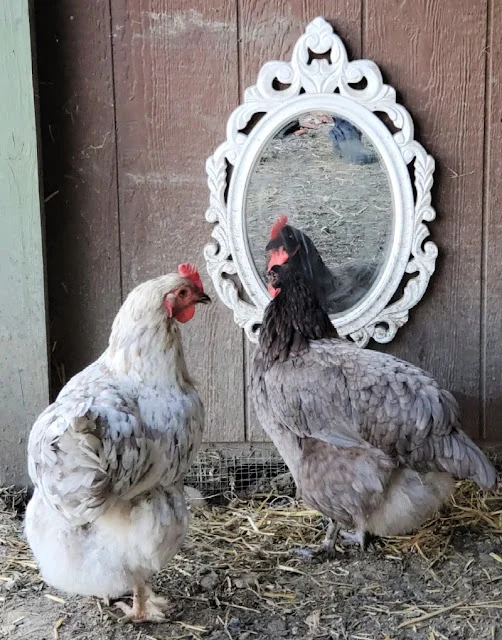
Recent scientific investigations into the cognitive capabilities of the domestic chicken, Gallus gallus domesticus, have challenged long-standing assumptions regarding avian intelligence and self-perception. For decades, the benchmark for animal self-awareness has been the "mirror self-recognition" (MSR) test, a protocol designed to determine whether an animal can identify its own reflection as an image of itself rather than as a different individual. While the list of animals capable of passing this test has historically been limited to a small group of highly encephalized mammals, such as great apes, dolphins, and elephants, new research suggests that roosters may possess a level of self-awareness that requires a more nuanced approach to testing than the traditional "mark test" provides.

The implications of these findings extend beyond academic curiosity, touching upon the ethical treatment of poultry, the evolution of consciousness, and the methodology used to define animal sentience. As researchers refine their understanding of how different species perceive their environment, the domestic chicken is emerging as a primary subject for studies on complex social behavior and internal cognitive processing.
The Genesis of the Mirror Self-Recognition Test
To understand the significance of recent avian studies, one must look back to the 1970s, when psychologist Gordon Gallup Jr. developed the first mirror self-recognition test. The experiment was straightforward but profound: a visible, odorless mark was placed on an animal in a location it could only see through a reflection, such as the forehead or ear. If the animal looked in the mirror and attempted to touch or remove the mark on its own body, it was deemed to possess "self-awareness"—the understanding that "that individual in the glass is me."

Human infants typically reach this developmental milestone at approximately 18 months of age. In the animal kingdom, the results have been sporadic. While chimpanzees and orangutans passed with ease, other highly intelligent animals, including dogs and cats, consistently failed. Critics of the MSR test have long argued that the test is biased toward species that rely primarily on vision and possess the dexterity (such as hands or trunks) to touch a mark. For species like dogs, which navigate the world through olfaction, or birds, which may have different social pressures regarding physical grooming, the mark test may not be a definitive indicator of consciousness.
A Paradigm Shift: The Rooster Alarm Call Study
A pivotal study published in the journal PLOS ONE by researchers from the University of Bonn and Goethe University Frankfurt has introduced a behavioral alternative to the mark test. This study focused on the natural social behaviors of roosters, specifically their tendency to emit "alarm calls" when they perceive a threat.

In a natural setting, a rooster acts as a sentinel for its flock. When a predator, such as a hawk, appears overhead, the rooster sounds a specific vocalization to warn others to take cover. Crucially, roosters are selective with these calls; they typically only sound the alarm if another chicken is present. If a rooster is alone, it remains silent to avoid drawing the predator’s attention to itself. This "audience effect" provided researchers with a unique tool to test self-recognition without relying on the physical manipulation of a mark.
The Chronology of the Experiment
The research team, led by Sonja Hillemacher, designed a controlled environment to observe how roosters reacted to a predator stimulus under three distinct conditions:

- The Control Group (Social Presence): A rooster was placed in a compartment where it could see another chicken through a clear partition. When a silhouette of a hawk was flown overhead, the rooster consistently emitted alarm calls, fulfilling its role as a protector.
- The Solitary Group: A rooster was placed in the compartment alone, with no other birds in sight. When the hawk silhouette appeared, the rooster remained silent, as there was no "audience" to warn.
- The Mirror Group: The clear partition was replaced with a mirror. The rooster could now see its own reflection. If the rooster perceived the reflection as another chicken (a "conspecific"), it would theoretically sound the alarm. However, the roosters remained silent.
The silence of the roosters in front of the mirror suggested that they did not perceive their reflection as a stranger. While this does not provide the same "smoking gun" evidence as a chimpanzee touching a mark, it indicates that the birds were able to distinguish between a real companion and a reflected image of themselves.
Supporting Data: The Complexity of Avian Vision and Sociality
The ability of chickens to navigate complex social structures provides further context for their cognitive depth. Chickens are known to recognize up to 100 individual members of their species and remember past interactions with them. This social complexity is supported by highly evolved visual systems.

Unlike humans, who possess trichromatic vision, chickens are tetrachromatic. They have a fourth type of cone cell that allows them to see ultraviolet (UV) light. This allows them to perceive patterns in feathers and nuances in their environment that are invisible to the human eye. Furthermore, their eyes are positioned laterally, providing a nearly 300-degree field of vision.
Data from the PLOS ONE study also revealed a secondary layer of complexity. When a second rooster was placed behind the mirror—audible and smellable but not visible—the test rooster still remained silent. This suggests that for Galliformes, visual confirmation is the primary trigger for the "audience effect." The failure to alarm-call in front of the mirror was not due to a lack of sensory input from other birds, but specifically because the visual stimulus (the reflection) was recognized as "not a different bird."

Official Responses and Scientific Debate
The scientific community remains divided on whether the mirror test, in any form, truly proves self-awareness. Following the publication of the rooster study, various ethologists and cognitive psychologists offered differing interpretations.
Dr. Gordon Gallup Jr., the creator of the original test, has historically been skeptical of non-mammalian passes. He has argued that many animals may learn to use a mirror as a tool without necessarily possessing a concept of "self." Conversely, proponents of avian intelligence argue that the "mark test" is an anthropocentric standard. They suggest that the rooster’s behavior represents a "kinesthetic-visual matching" that is a precursor to, if not a direct form of, self-consciousness.

In statements to the New York Times and New Scientist, researchers involved in the study emphasized that while their findings are significant, they represent a "different kind of evidence." They posit that the absence of a social response to a reflection is a more ecologically valid measure for birds than the presence of a grooming response to a mark.
Broader Impact and Implications for Animal Welfare
The enrichment of our understanding of chicken cognition has immediate implications for the agricultural industry and animal welfare legislation. Globally, billions of chickens are raised for meat and eggs, often in environments that offer little cognitive stimulation.

Implications for Enrichment
The anecdotal evidence from backyard poultry keepers, such as Lisa Steele of Fresh Eggs Daily, suggests that mirrors can serve as a form of "boredom buster" or enrichment. In a domestic or agricultural setting, mirrors may provide:
- Reduced Anxiety: For solitary birds (such as those in quarantine), a mirror can simulate the presence of a companion, reducing stress hormones.
- Cognitive Engagement: The interaction with a reflection provides a level of visual complexity that barren environments lack.
- Behavioral Observation: Watching birds preen or display in front of mirrors allows keepers to monitor the social health and confidence of their flock.
Ethical and Legal Shifts
If chickens are recognized as possessing a degree of self-awareness, the ethical argument for "five freedoms" (freedom from hunger, discomfort, pain, fear, and the freedom to express normal behavior) becomes even more compelling. In the European Union and other jurisdictions, animal welfare laws are increasingly being updated to reflect the "sentience" of livestock. Acknowledging that a chicken can recognize itself suggests a level of internal life that demands higher standards of care, more space, and the prevention of "behavioral vices" like feather pecking, which often stem from cognitive deprivation.

Conclusion: The Future of Avian Cognitive Research
The study of avian self-recognition is still in its infancy. Future research is expected to delve into whether other poultry, such as ducks and turkeys, exhibit similar patterns. While current deductions regarding ducks remain largely speculative and non-scientific, the precedent set by roosters provides a roadmap for future experimentation.
As science moves away from a one-size-fits-all approach to animal intelligence, the domestic chicken stands as a testament to the fact that "bird brain" should be considered a compliment rather than an insult. The silence of a rooster in front of a mirror may be one of the loudest statements yet in the ongoing conversation about the nature of the animal mind. By continuing to bridge the gap between laboratory research and practical, everyday observation in the coop, we gain a more holistic view of the creatures that share our world.
