
In an era where digital photography often champions hyper-sharpness and pixel-perfect detail, Mohammad Murad, an acclaimed wildlife photographer and Canon EMEA Ambassador, has carved a distinctive path, advocating for an interpretive and emotionally resonant approach to capturing the natural world. His philosophy transcends mere documentation, embracing motion, the nuanced play of light, and raw emotion as the primary narrative elements within his evocative images. Murad’s work is less about recording reality and more about expressing an inner vision, inviting viewers into the profound stories he perceives unfolding in the wild. This artistic stance positions his photography as a personal language, communicating through the dynamic interaction of subjects with their environment and the ephemeral glow cast by nature’s ever-changing light.

The Genesis of Motion: Blurring Boundaries for Emotional Depth

The evolution of Murad’s unique style traces back to a pivotal moment that reshaped his understanding of photography’s potential. He recalls an encounter with a flock of cormorants moving across water, an ordinary scene that transformed dramatically when he experimented with a lowered shutter speed. The static record dissolved into a fluid, living tableau—a painting rendered by the sweeping motion of wings and the subtle ripples on the water’s surface. This experience was a revelation, demonstrating that photography could pulsate with life, rather than merely freezing a fleeting instant. Since then, Murad has consistently integrated techniques such as slow shutter speeds, panning, and Intentional Camera Movement (ICM) into his practice. These methods are not just technical choices but foundational elements of his expressive lexicon, designed to imbue his work with energy and convey the vibrant pulse of nature.

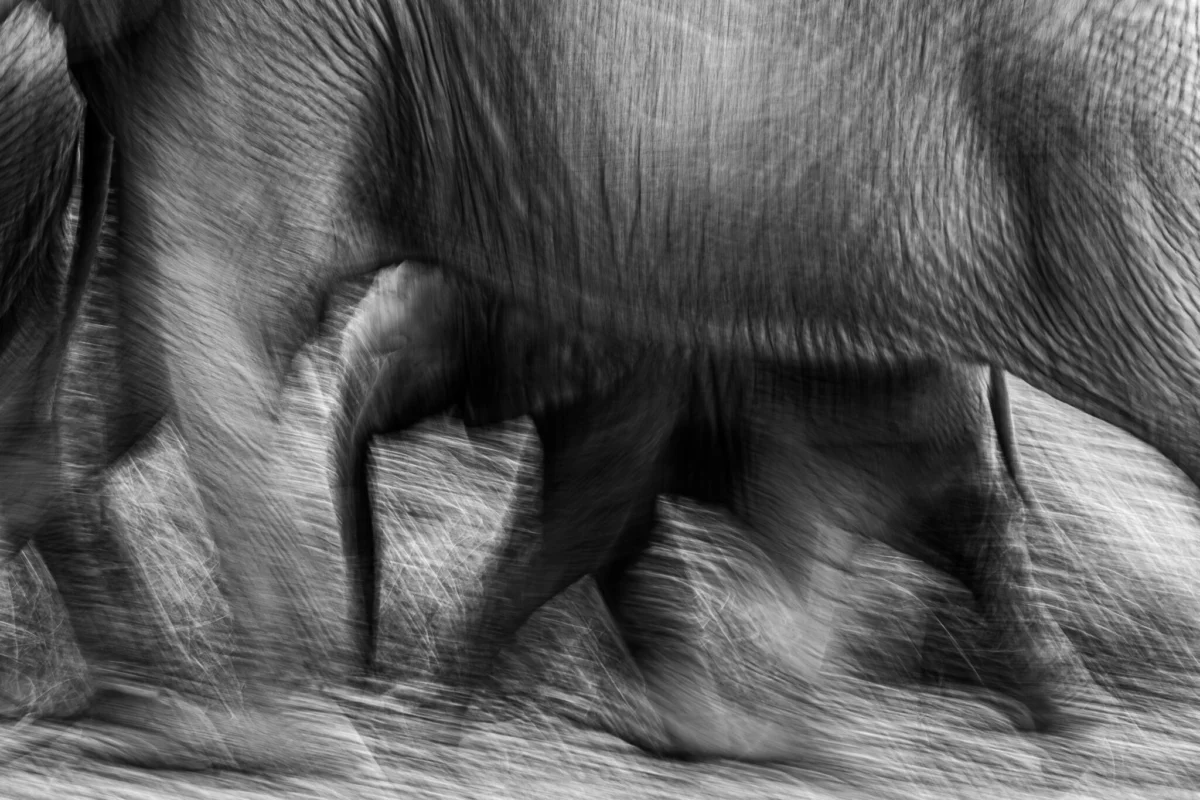
His portfolio is replete with examples illustrating this commitment to capturing dynamic essence. A photograph of zebras, startled into flight by a nearby cheetah, uses slow shutter speed not to blur indiscriminately, but to emphasize the frantic urgency and collective motion of their escape, transforming individual animals into a unified streak of raw instinct. Similarly, a herd of gazelles racing across the Maasai Mara plains under dramatic cloud formations becomes a blur of speed and grace, with only their forms defined against the streaking landscape. This technique draws the viewer into the visceral experience of the chase and the vastness of the plains. Another compelling image features a lone Grant’s gazelle, its elegant movement accentuated by a soft rim light at dawn, captured with an aperture of f/5 to create a painterly effect that allows the viewer to feel the animal’s serene progress. Even the powerful, pillar-like legs of an elephant, capable of detecting low-frequency rumbles from miles away, are depicted not in a frozen pose but as a study in strength and movement, highlighting their vital role in the animal’s massive form and sensory perception. These images collectively challenge the conventional pursuit of pristine sharpness, instead prioritizing the emotional and kinetic experience of wildlife.

Light as an Emotional Architect: Crafting Mood and Narrative

For Murad, light is far more than a mere illuminator; it is an intrinsic storyteller, capable of dictating the mood, emotion, and narrative depth of an image. He has cultivated a keen eye for how varying light conditions can radically alter a scene: how golden hour light can soften the most rugged landscapes, how deep shadows can introduce tension or mystery, and how strategic backlighting can transform a common bird into a silhouette of profound poetry. This sensitivity to light guides his exposure choices and informs the overall emotional register of his compositions, enabling him to convert familiar scenes into something sublime or enigmatic. Murad’s dedication to this aspect of his craft is evident in his willingness to wait for hours, sometimes enduring challenging conditions, for the precise quality of light to filter through a scene. His aim is not photographic perfection but an honest capture—a truthful rendition of how the moment feels. This commitment allows the light itself to shape and narrate the story, becoming an active participant rather than a passive element.

Illustrative examples from his collection underscore this mastery. A White (Pied) Wagtail, encircled by a swarm of mosquitoes at sunset in one of Kuwait’s nature reserves, becomes a luminous focal point. By positioning the sun behind the subject, Murad crafts a beautiful, glowing backdrop, creating an almost ethereal halo around the bird and the tiny insects, transforming a common avian moment into an atmospheric spectacle. In another poignant capture, a full-bellied hyena wanders solitarily at sunset, the warm, fading light casting long shadows that amplify its sense of isolation and the quiet close of the day. Similarly, a herd of blue wildebeest, pausing after a frantic flight from predators, is bathed in the setting sun’s warm, yellow glow. The dust kicked up by their hooves is illuminated, adding a dramatic, almost cinematic quality to the scene, emphasizing both their recent peril and their enduring resilience on the vast African plains.

Urban Wilderness: The Foxes of Kuwait City and a Deeply Personal Project

One of Murad’s most compelling and unique photographic endeavors involved documenting Arabian red foxes within the urban sprawl of Kuwait City. This project, set along the Doha shore, directly challenged the conventional notion of wildlife photography as strictly confined to pristine natural environments. Here, the vibrant glow of streetlights and passing car lights, reflecting off the sea, formed an unconventional yet captivating backdrop. To achieve the distinctive rim light that highlights the foxes, Murad employed an ingenious technique: two small handheld flashlights, patiently positioned to illuminate the nocturnal creatures. He describes waiting for the mother fox to unearth food she had meticulously hidden for her cubs, a ritual that provided opportunities for these uniquely lit compositions. This innovative approach allowed him to capture the magical glow of the urban night, revealing a rare and intimate glimpse into the lives of wildlife thriving amidst a bustling cityscape.

The project was not merely a technical challenge but a deeply personal commitment. For over two months, Murad dedicated himself to visiting the fox den four days a week, spending countless hours after sunset. His approach was characterized by profound respect and patience, initially maintaining a careful distance. This consistent, non-intrusive presence gradually fostered an extraordinary level of trust with the fox family. Eventually, the curious cubs and even the mother began to approach him, some even licking his camera gear and his feet as he sat quietly observing. This connection was particularly meaningful to Murad, not only because he is a father to five children himself, mirroring the fox family’s dynamic, but also because he felt an acute responsibility to protect these vulnerable urban inhabitants. Images from this series showcase an Arabian red fox cub gazing directly into the lens, its form silhouetted by the beautiful bokeh of distant streetlights. Another depicts a kitten exploring the night just outside its den, framed by the city’s luminous backdrop. The series culminates in a powerful shot of the mother fox, silhouetted against Kuwait City’s vibrant lights, surveying her urban territory—a poignant reminder of nature’s resilience and the delicate balance between urban expansion and wildlife survival. This project powerfully illustrates how dedicated, empathetic photography can reveal hidden narratives and foster a greater understanding of our shared ecosystems, even in unexpected places.

Global Expeditions and Life Lessons: Adaptability and Serendipity

Murad’s artistic journey has spanned diverse and often extreme landscapes, from the arid deserts of Kuwait to the icy expanses of Mongolia and Iceland. Each expedition has served as a profound classroom, imparting invaluable lessons in patience, adaptability, and an openness to the unpredictable nature of the wild. He recounts numerous challenges—lost luggage in remote regions, relentless arctic winds, and bone-chilling temperatures—all of which he regards as "teachers in disguise." These experiences have instilled in him a deep understanding that nature adheres to its own timetable, emphasizing that waiting for the "perfect moment" is often futile. Instead, he advocates for moving with nature, allowing scenes to unfold organically, recognizing that the most profound and authentic images frequently emerge when one relinquishes control and embraces serendipity.

His travels have yielded some of his most compelling work. In the remote Hornstrandir Nature Reserve in Iceland, accessible only by a rugged boat ride, Murad captured an intimate portrait of an Arctic fox peacefully napping behind snow-covered dry plants. The fox, camouflaged by its pristine white winter coat, looked directly into his lens while curled under its tail. This moment, achieved by filling the frame without disturbing the animal, speaks to the unparalleled tranquility of a land largely untouched since the 1950s, a testament to pure, undisturbed wilderness. Another monumental achievement was the capture of an elusive snow leopard in the Altai Mountains of Mongolia. Enduring extreme conditions, including temperatures plummeting to -34°C and fierce winds, Murad was rewarded with a rare glimpse of this magnificent "ghost of the Altai." The leopard, perfectly camouflaged against the fiery orange lichens and rugged rocks, symbolizes nature’s incredible adaptability and serves as an urgent reminder of the precarious existence of this endangered predator. Such photographs are not merely beautiful; they are compelling narratives of survival, resilience, and the fragile beauty that demands protection.

Beyond Documentation: Finding Your Creative Voice and Broader Impact

At the very core of Mohammad Murad’s photographic endeavor lies a fervent desire to express something beyond the purely visible. He strives for his images to be felt—to resonate deeply on an emotional, rather than merely intellectual, level. This aspiration drives his continuous experimentation with techniques that extend far beyond conventional photographic norms. He seeks to translate the inherent fragility of a bird in mid-flight, the stoic resilience of a migrating herd, or the silent, ancient conversation between predator and prey. His body of work, therefore, transcends mere wildlife portraiture; it is an artistic interpretation of life itself, capturing the ephemeral spirit and profound interconnectedness of the natural world.

As a Canon EMEA Ambassador, Murad’s innovative approach garners significant recognition and serves as an influential platform. His ambassadorship highlights Canon’s commitment to supporting artists who push creative boundaries and explore new dimensions of visual storytelling. This role enables him to share his unique philosophy with a global audience, inspiring aspiring and established photographers alike. He actively encourages others to liberate themselves from the relentless pursuit of technical perfection, urging them instead to trust their creative instincts and cultivate their own distinct artistic voices. This message is particularly resonant in a field often dominated by technical discourse, advocating for a return to the emotive power of art.

The implications of Murad’s work extend beyond the artistic realm into conservation advocacy. By fostering an emotional connection through his abstract and interpretive images, he subtly but powerfully champions environmental stewardship. His blurred renditions of seagulls along Kuwait’s seaside, captured with slow shutter speeds to create an abstract, "fiery-wing effect," transform common birds into symbols of dynamic energy and freedom. An ethereal image of a baby elephant and its mother in Tanzania, captured with slow shutter speed, reinvents the scene, adding mystery and a deeply personal expression of his inner self, inviting viewers to interpret the narrative. Such images are not merely aesthetically pleasing; they cultivate empathy, encouraging viewers to appreciate the beauty and vulnerability of wildlife in a new light, thereby fostering a stronger desire to protect these invaluable natural treasures. His photography stands as a testament to the idea that art can serve as a potent catalyst for connection and conservation, bridging the gap between human perception and the wild heart of our planet.

Conclusion: An Ever-Evolving Conversation with Nature

For Mohammad Murad, photography is an enduring journey without a fixed destination—a dynamic and continuous dance between light and shadow, motion and stillness, technical precision and the glorious unpredictability of chance. Through each carefully considered image, he endeavors to draw viewers into this intricate dance, to invite them to feel the authentic, rhythmic heartbeat of the world. Every frame he captures is imbued with a piece of his personal narrative—his challenges overcome, his profound sense of wonder, and his unwavering respect for the natural world.

His unique vision and dedication to interpretive wildlife photography offer a compelling alternative to traditional approaches. It is a powerful reminder that the true essence of art lies not just in what is seen, but in what is felt and understood. Murad’s work serves as an inspiration for both photographers and nature enthusiasts to look beyond the immediate surface, to seek out their own rhythm in the wild, and to embrace photography not merely as a craft, but as an ever-evolving, deeply personal conversation with the boundless beauty and mystery of nature itself. His legacy will undoubtedly be defined by his ability to transcend the literal, transforming wildlife imagery into a profound artistic statement that resonates with universal emotions and a timeless reverence for the wild.
